
The Case for Compost
By Michael Clapper
Compost is what’s left of my daily newspaper, my neighbor’s leaves, and all the fruit rinds, vegetable stems and rotted veggies we chop up. It comes from literally nothing yet is valuable. It’s free to make but can sell for many dollars a pound. Nature does it on its own without any help and I can’t help but try and mirror the process.
I have four composters going in my house right now. Two spinners sit on the side of the house. Both are trash picked and as it’s mid-winter, they’re full of chopped leaves from the fall and probably too much food waste.
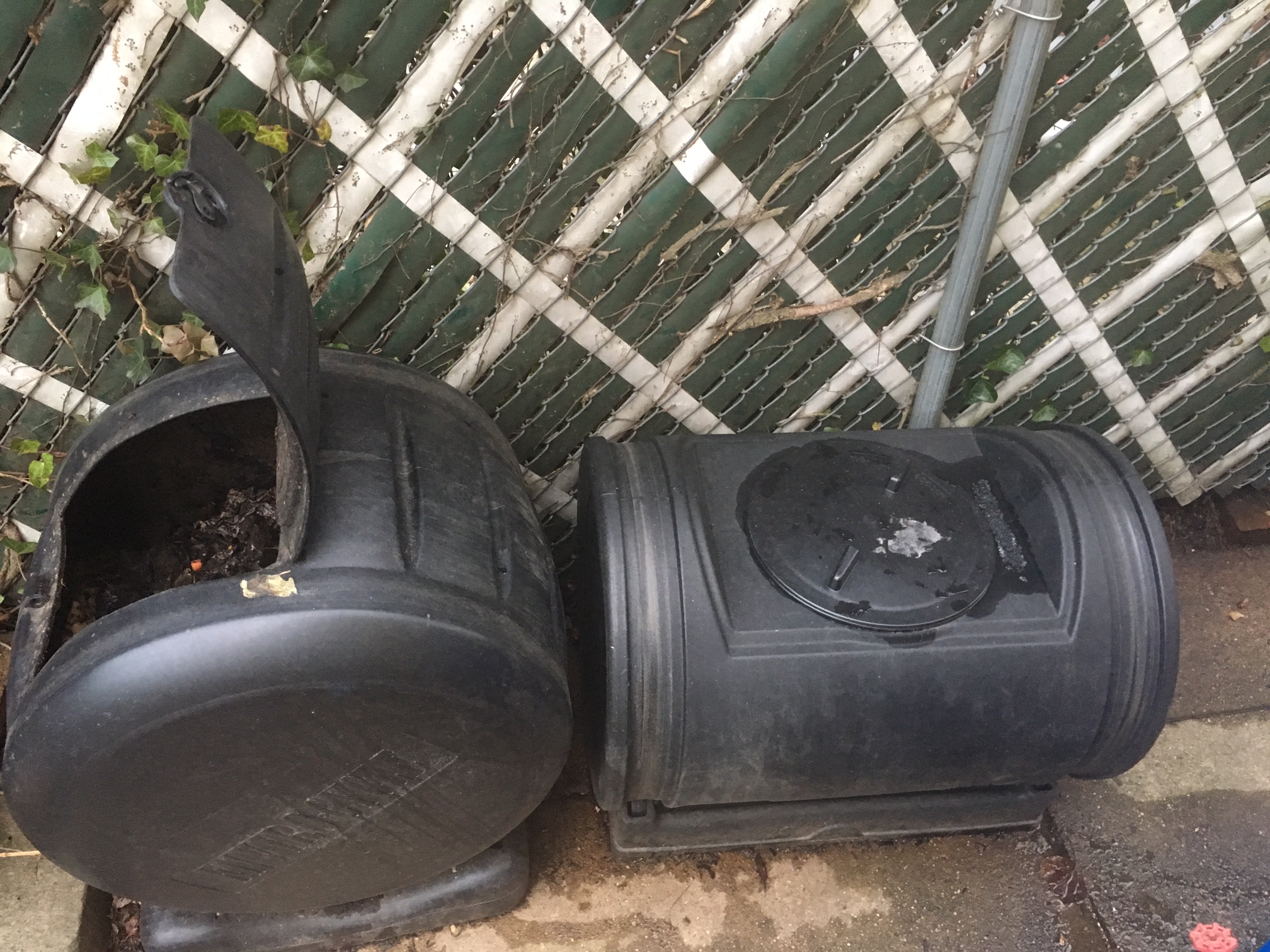
Clapper Family Backyard Composters Feb 2017
A trash-picked worm bin is operating in the basement next to the old SW worm bin that I’ve just started again. If you’re quiet it seems like you can hear the worms chomping away. Between them is a failed Kobashi processor, which I will eventually restart but until now had only proved capable of generating a smell so bad we thought the house waste line had cracked. Vermicompost requires worms, lots of worms, lots of red wrigglers, which I’ve always bought from Uncle Jim’s Worm Farm. One established, these creatures eat and eat. If you don’t muck up the bin by putting into too much food or water, they’re pretty much indestructible.
Kobashi is an anaerobic process. What’s supposed to happen is you add a substance derived from various wheats that contains microbes that activate in the anaerobic environment. If you draw off the leachate, you’re supposed to have pickled pre-compost in a couple of weeks, which you can put in your garden far from plant roots. As I noted above, what I’ve mostly managed to do is produce a truly awful smelling anaerobic reaction.
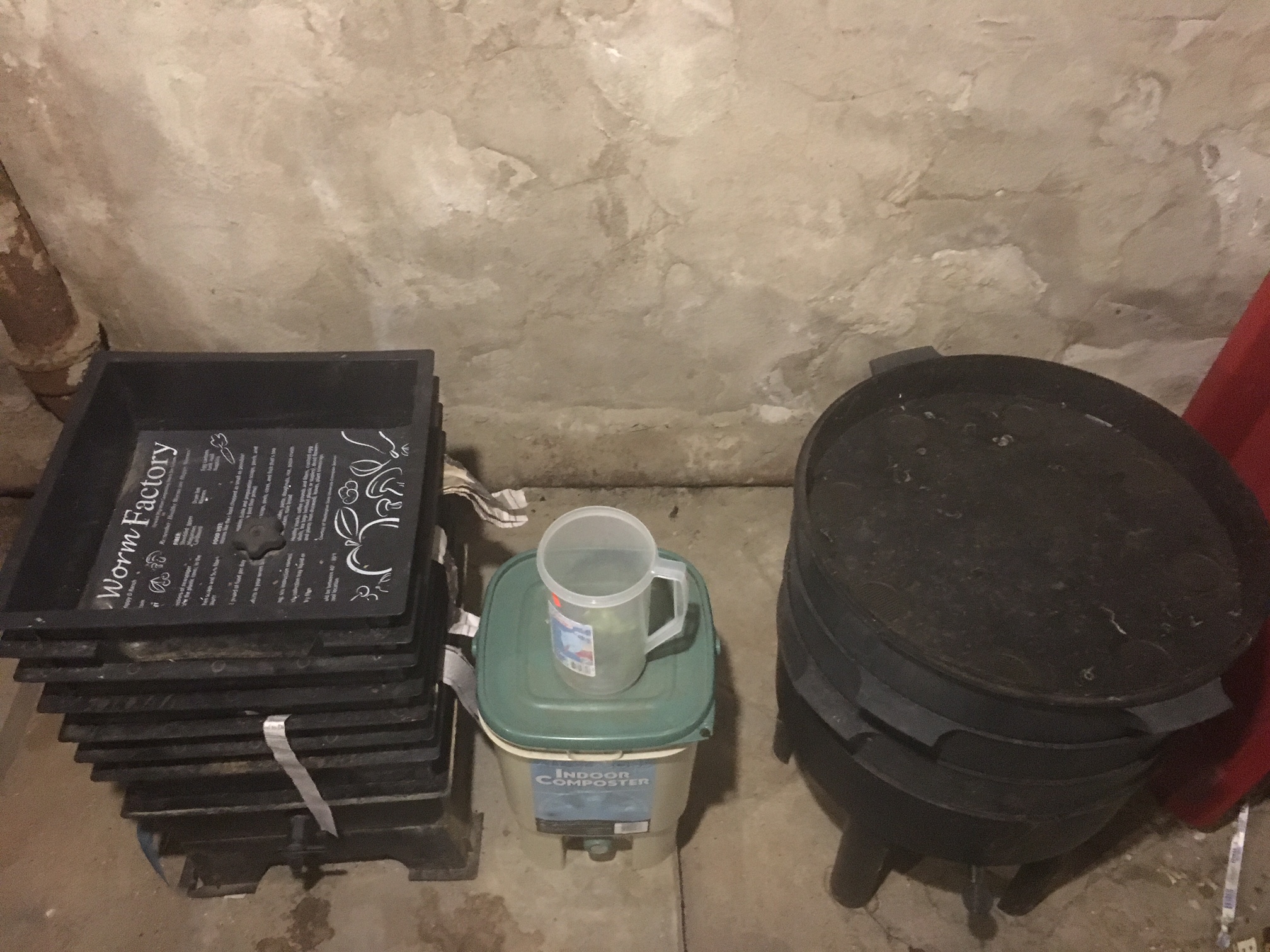
Clapper Family Indoor Compost
February 2017
“You can make the best compost in the world in twelve hours by putting vegetable matter through the guts of an animal. To make it any other way will take you months, whatever you do.”
Sadly, I don’t have animals in my yard. We thought about chickens but decided against it. While we do have one dog and three cats, their waste is hardly the kind we need here. All these systems, then, mirror the animal process, but also accomplish two things: reducing the food waste the Clappers send to the landfill and give my gardens, house plants, and tree pits as many homegrown nutrients as possible. And I like to be able to say that I’m eating the New York Times, which we’re doing as the lettuce and dark greens come in each spring.
“I want to start by giving you four gifts: free plant-feeding fertilizer, free weed-preventing mulch, free clay- and sandy-soil improver, and free plant disease prevention. And I can fit all four inside one package because they’re what you receive when you apply compost to your lawn and garden.”
This definition, from a man whose voice is as polarizing as Bob Dylan’s, Mike McGrath, describes just how much compost can helps one’s growing area, no matter how big. Whether the giant pile on a farmer’s land or smaller household systems, compost supports the soil. Even in an urban setting, the soil, as Wendell Barry tells us, is everything.
“The soil is the great connector of lives, the source and destination of all. It is the healer and restorer and resurrector, by which disease passes into health, age into youth, death into life. Without proper care for it we can have no community, because without proper care for it we can have no life.”
This isn’t a definition but it’s the primary reason why I compost. It’s your responsibility to make the world a better place and that falls to your choices as a consumer, a worker, and a steward of your community. Not creating waste but instead creating a product to share with your community is one great step.
The mathematical case for compost
The Food and Drug Administration suggests that Americans ought to eat five servings of vegetables a day and some similar amount of fruit. There’s also supposed to be a mix between green and orange/yellow veggies. As the fool who wakes each morning to wash and cut vegetables for his children, I’m aware of exactly how much is unused – the tops of peppers, the tops of carrots, the squishy bits of cucumber – and the same goes for fruit as one looks at the skin of a cantaloupe or the apple cores that seem to get left all over our house.
After weighing my kitchen collector (more on this in a second), is adds up to between 11 and 12 ounces of food a day, which adds up to 5 pounds a week, which pretty quickly becomes an incredible amount of waste. Locally, the average Philadelphian sends twenty pounds of food waste to the curb each month. One national study suggests that the trash of an average American family is composed of between 20-30% of yard waste and food waste.
I’d like to say that we carefully use up all of veggies each week but my eyes are bigger than our ability to actually eat and we end up with a blackening bag of green veggies. And there’s all the red leaf lettuce that if you don’t eat right away turns black and crumbly. I feel terrible about wasting food, particularly when I pay twice — once for the veggies and once for takeout — and I can at least tell myself the food will come back around again.
All of this compost – and these are small systems – stays out of my pipes and out of the landfill. While I love the Water Department in Philadelphia and I’ve seen the system that turns food waste to heat and energy, the more I can keep out of my waste pipes, the better.
While I can calculate how much is not going to the landfill, at least in terms of food, I have not yet calculated how much compost I’m producing. I harvest a good quart of vermicompost a month but I probably could have more if I was willing to harvest more often. At this point I have about six pounds of worms spread over both bins, which should equal out to about 21 pounds of castings a month. This is hard to believe.
The environmental case
My West Philly house stands on a piece of land that measures 112 ft by 18 ft, for a total of 2,016 sq feet. Nearly all of that is taken up with the house, but I’m still able to maintain the following growing areas:
The front spaces has three raised beds. (15 sq ft, 15 sq ft, and 22.5 sq ft; 52.5 sq ft)
There’s space in front of the porch. (48 sq ft.)
The back yard has five raised beds as well. (30, 30, 30, 10, and 12; 132 sq ft)
Total growing area: 232.5 sq ft or 1/200th of an acre.
While I do lose square footage to a small patio and the alley, I maximize the growing area as much as I can. The soil in the beds came from a landscaping outfit and it’s a mix of mushroom soil and topsoil. I’ve augmented with compost from my backyard as well as regular trips to the Fairmount Recycling center. The worms from my basement have helped as have my neighbor Kathy’s operation.
Yet underneath all of this soil is urban soil. It’s got 200+ years of urban use; my house is 110 years old and was likely covered with leaded paint on multiple occasions. While I’ve brought all the soil into the yard that we grow vegetables in, all of the underlying soil needs to be remediated, one way or another. Lead poisoning is a huge concern for all parents but especially for those living in the city and having soil that can support plants that will slowly remediate this problem is another plus for composting. Indeed, composting allows me to do this slowly and surely, to bring all segments of the yard to a space where a flower can grow. While most research seems to show that the real danger is lead dust (wash your vegetables), I like the idea that I am rebuilding all of the soil to be as healthy as it can be. And with the various flower gardens and tree pits that line our street, I also like the idea that I can distribute compost there to support that soil.
The convenience case
Only in middle life have I come to be much of a cook and even that’s a bit of a stretch. I commit to getting my kids fresh veggies and I’m okay with fruit, although I will say that fresh fruit is harder to deal with because of our mid-Atlantic location. All that to say that I’m better in the kitchen but I don’t think I’m ever going to love it. Thinking about composting or really any additional step had better be easy, or it’s just not going to get done.
There are two things I do that help make composting easy and convenient. One, I have a small bin that I think we got at Target, that all the stuff goes into. I make fresh coffee in a French Press each morning, so I’ve got 60 grams of coffee grounds every day, which makes 1.8 kg a month, which is about 21kg a year, which is, wait for it: 46 pounds of coffee grounds a year!
When this bin is full, I can take it out the back door, or I take it down to the worm bin. If it’s warm, I combine this with spinning the composter: bring it out, spin it down. If it’s cold, I wait until I’m going down to feed the dog and bring it down the basement then. Knowing that I can empty it in one of five places helps but the important part is that emptying this gets attached to something else you’re going to do anyway. If it becomes a separate trip, that’s an issue. One thing: many folks keep their stuff in freezer bags as they wait for a space in the composter to open up.
One other thing I’ll tell myself about collecting compost to help offset those few minutes: nearly all of the houses in Philadelphia have old waste lines running out to the street. They’re cast iron and when they break it’s a major hassle: you have dig up the street, the sidewalk and all of your yard. It’s expensive too — $4-5k. One thing I’ve heard is that you want to avoid sending stuff down through a waste disposal as it can slowly catch and erode the quality of your pipes, even with a good garbage disposal. I’m not sure if this is an urban myth, and certainly the Water Department has done a heroic job developing spaces to turn food waste into energy, but it’s one thing I tell myself when I’m thinking I don’t want to walk to the compost.
The other inconvenience I feel is the process of chopping down some vegetables and fruits. Part of the composting process is maximizing the surface area so that the bacteria can go to work but it’s still not a lot of fun to chop down broccoli stalks or fruit rinds. What’s amazing is how fast some of these disappear when they’ve been chopped small. I suppose I could use a food processor but I hate cleaning that thing more than just about anything. I’ve been thinking about the chop down as a way to practice my knife skills.
One final note: one of my worst habits is not putting stuff back where it belongs. I’m working on it. One way around it with compost is to keep lots of yogurt containers or take out tubs nearby so that if you’re producing vegetable waste you can collect it quickly if you’ve left the last container outside.
Conclusion
It makes sense for all sorts of reasons to compost. My children watch me saving eggshells or cutting rotting vegetables. They see me shredding newspaper and they know just how little goes out it in the trash. Maybe they understand that I’m trying to keep a circle of life going or that minimizing waste is a laudable goal. Maybe just they think Daddy’s crazy. Yet in a Philly neighborhood where some houses can put out four or more trash cans alongside four recycling bins (or worse, no recycling bins at all), they can see just how much waste goes into the world. In one small way, we’re doing our part.
Note: Working on footnotes which disappeared in the transition from drive to .html.


