Category Archives: Books

The Wolf in Winter

I read to try and find ways to link all that I do together. I love a good thriller and if you add a bit of ancient religion, I’ll read them all.

This is a good quote about social work but really any non-profit work:

Stephen was clearly a good kid, but he had the egotism of youth. The world revolved around him, and consequently he believed that he had the power to change how it worked. And, in the way of the young, he had made another’s pain about himself, even if he did so for what seemed the best of reasons. Time and age would change him; if they didn’t, he wouldn’t be working in soup kitchens and shelters much longer. His frustrations would get the better of him and force him out. He’d blame others for it, but it would be his own fault.

John Connolly, The Wolf in Winter (NY: Simon & Schuster, 2014), 115.

Quote on resilience

From a terrific novel, Universal Harvester:

If you work with or around children, you often hear a lot about how resilient they are. It’s true: I’ve met children who’ve been through things that would drive most adults to the brink. They look and act, most of the time, like any other children. In this sense — that they don’t succumb to despair, that they don’t demand a space for their pain — it’s very true that children are resilient.

But resiliency only means that a thin retains it shape. That it doesn’t break, or lose its ability to function. It doesn’t mean a child forgets the time she shared in the backyard with her mother gardening, or the fun they had together watching Bedknobs and Broomsticks at the Astro. It just means she learns to bear it. The mechanism that allowed Lisa Sampson to keep her head above water in the wake of her mother’s departure has not been described by scientists. It’s efficient, flexible, and probably transferrable from one person to another should they catch the scent on each other. But the rest of the details about it aren’t observable from the outside. You have to be closer than you really want to get to see how it works.

John Darnielle, Universal Harvester (New York: Farrar, Strauss and Giroux, 2017),137.

Notes from Age of Opportunity

I enjoyed reading this book.

Two quotes:

118 “I also object to the “skills” portion of “noncognitive skills.” Determination, perseverance, and tenacity aren’t skills, like riding a bike, using a word processing program, or playing a G major scale on the violin. Determination, perseverance, and tenacity are capacities to be nourished, rather than skills to be acquired.

The distinction between skills and capacities is vital, because intellectual abilities and the drive to succeed are cultivated through entirely different processes.”

204 “I don’t harbor any delusions about the use of scientific evidence to inform policymaking, though. Policymakers and advocacy groups use science the way that drunks use lampposts –for support, not illumination. If the political will is absent, no amount of science, no matter how persuasive it is, is going to change the law.”

I also was fascinated by the discussion of “Mental Contrasting with Implementation Intentions.” This is what we do now in advisory, but not necessarily in a systematic way. I look at this blog over the past three years and most of the activities I’ve designed have been based on this idea (think of a goal, best thing that would result, obstacles, plan). (p.160 in Steinberg. Here’s the link to the study.)

Laurence Steinberg, Age of Opportunity: Lessons from the New Science of Adolescence (Boston: Houghton Mifflin Harcourt, 2015).

Get out

I’ve read nothing about this film. I was told by my wife that I had to see it. I saw it with my students today. Awesome.

First of all, I may be wrong, but I assumed all along that the title came from the Eddie Murphy routine about Poltergeist.

1:33
Get out.

Too bad we can’t stay.

As for the rest of the film, what a great starting point for many conversations:

One, when and how do Americans talk about race? The movie, by virtue of the horror plot, teases you on this: is he asking that question out of racial motives? Or out of class motives? Or because of the craziness that undergirds the rest of the plot? If we get rid of the plot and head into real life, why do people talk this way? Why can the movie continue for as long as it does before the horror part becomes necessary? Is part of the minority experience in America a near constant stream of comments that you’re forced into trying to decipher or identify the meaning behind? What slights might you come to take for normal that someone with majority status would never feel?

Two, what are the codes, the handshakes, the nods, the secret looks that a group shares and how do we become aware of these? I was reminded of George Chauncey’s social history of gay New York where he documented all the ways a minority group facing persecution secretly communicated with each other. Chris, the main character, faces a steady diet of confusion through the film as he seeks to forge these connections; again, in real life, what does this feel like?

Three, I was reminded of multiple social histories of slavery, most notably Walter Johnson. Central to his book was the idea that of different forms of southern white identity emerged via their treatment and understanding of black bodies. This racial tragedy remains, I think, and came up throughout this film. How does a dominant group understand themselves or even make themselves through their treatment of minority groups?

Too much to talk about. This is an amazing film.
#nowIcanreadandtalkabouit

Nobody’s Son

Of all the fools in the world, the ones hiding behind self-awareness may be the worst. You can know yourself, or think you do, and be none the wiser, analyze your predicament to the nth degree and be no closer to escaping it. Melville had put it beautifully: “For in tremendous extremities human souls are like drowning men; well enough they know they are in peril; well enough they know the cause of that peril; —nevertheless, the sea is the sea, and these drowning men do drown.”

Slouka, Mark. Nobody’s Son. New York: Norton, 2016.

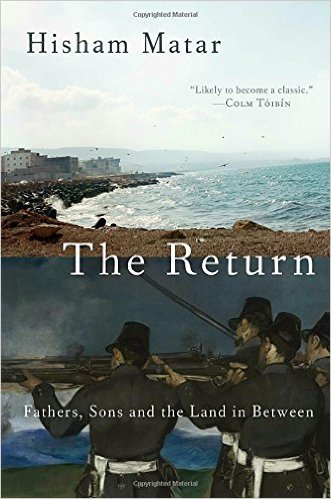
Block quotes from The Return

Perhaps memorials and all the sacred and secular rituals of morning across our human history are but failed gestures.The dead live with us. Grief is not a whodunit story, or a puzzle to solve, but an active and vibrant enterprise. It is hard, honest work. It can break your back. It is part of one’s initiation into death — I don’t know why, I have no way of justifying it — it is a hopeful part at that. What is extraordinary is that, given everything that happened, the natural alignment of the heart remains towards the light.

Matar, Hisham. The Return: Fathers, Sons and the Lands in Between. New York: Random House, 2016.

Quote from Julian Barnes

Quote from the weekend:

Was there a greater portrayal of the shattering of human illusions than King Lear? No, that was not quite right: not shattering, because that implied a single great crisis. Rather, what happened to human illusions was that they crumbled, they withered away. It was a long wearisome process, like a toothache reaching far into the soul. But you can pull out a tooth and it will be gone. Illusions, however, even when dead, continue to rot and stink within us. We cannot escape their taste and smell. We carry them around with us all the time. He did.
(p.93)

Is a dream a lie if it don’t come true, or is it something worse?

Barnes, Julian. The Noise of Time. New York: Albert A. Knopf, 2016.

Matt Desmond talk

Monday night I got to hear Harvard sociologist and MacArthur Genius Matt Desmond present the 33rd Annual Urban Studies lecture.

Awesome.

Two questions I would have asked:

1. This research reveals a key source of the mobility that teachers in city schools have always felt. I’d always assumed that this was about poverty, crappy housing stock, and slumlords, but this book makes clear that the weight of the state stands behind the craplords and, as Desmond said so eloquently, “eviction is a cause, not a condition, of poverty.” I wondered what policies the school district as well as the massive network of charter schools in Milwaukee had adopted to deal with this situation or whether it was another thing teachers would have to deal with. Desmond notes the enormous cost kids pay when the “rent eats first” but I hope an ethnographer on his team is studying the overlap between the affordable housing crisis and challenges in urban education. (For example, I would guess that kids who have more stable housing situations are more likely to be involved in charter schools where managing the admission process requires a kind of stability; similarly, entering (and staying) at at a magnet school would be difficult amidst constant housing change.

When he announced that he was hiring lots of research assistants, I got that crazy project-based teacher feeling and wondered if we could design a project for our students in West Philadelphia to try and take on some piece of this. They could write and conduct their own mini-survey, graph their experiences, and do some interviewing about this issue. Especially if we could use Desmond’s notion that eviction is an issue of “inevitability not personal responsibility” as a way of making clear this is a big issue, not one to feel shame about.

2. I appreciated that Desmond spent so much time with Milwaukee’s landlords and tried to get their side of the story. I got to thinking about my block, where there are 46 structures but only 11 (or so) are owner occupied and only about half are still single family homes, even if they’re rented as group homes. The rest are apartment buildings.

Over the past twenty-two years I see the same story repeated again and again: folks in their late 20s or early 30s, having purchased their own home then use the equity to purchase a second or third rental building. These mini-real estate empire builders cross all racial and ethnic lines but they follow a similar pattern:

* they use craptastic contractors who do quick and dirty work or they do the work themselves,
* they do not pull permits for the work.
* they purchase the home and we see them regularly for the first year or so, then not so much.

There’s all sorts of tax incentives and financial incentives to keep apartments just nice enough to stay full and barely legal. There’s no incentive to contribute to the community of the block especially as it seems as though rent keeps going up.

If we just embrace housing vouchers, don’t we miss the other structures that allow landlords (and slumlords) to keep on keepin’ on? What other ideas might we pursue? I’ve always wanted a tax break for individuals who convert shitty apartments into single family homes, which would work for my block, but might also fuel gentrification.

W.E.B. DuBois Quote

“We must insist upon this to give our children the fairness of a start which will equip them with such an array of facts and such an attitude toward truth that they can have a real chance to judge what the world is and what its greater minds have thought it might be. —W.E.B. DuBois”

Darling-Hammond, Linda. The Flat World and Education: How America’s Commitment to Equity Will Determine Our Future. New York: Teachers College Press, 2010.