Category Archives: Books

Making Learning Whole

Liking this book…Perkins is not overclaiming, not trying to kill you with the scholarship, and carefully offers some things to consider in framing a teaching practice.

Four things:
1. The question I’ve been churning on is “what makes something hard ?” He frames this out to help separate normal stuff that all humans contend with (I’d rather eat cookies than steamed broccoli) so that you can consider when and where your students will stumble. It was helpful for me to think about academic/intellectual stumbles and trying to identify the exact spots where they’ll need help.

2. In this section, he references an article I need to track down, where the authors discuss what can go wrong when kids don’t have enough structure or scaffolding in doing project based learning/problem based learning/inquiry learning.

Kichscner, PA, J Sweller, and R.E. Clark. “Why Minimal Guidance during Instruction Does Not Work: An Analysis of the Failure of Constructivist, Discovery, Problem Based, Experiential and Inquiry-Based Teaching.” Educational Psychologist 41, no. 2 (2006): 75–86.

3. There’s no reference to Grant Wiggins here. I like his books and thought Perkins travels many of the same roads; I might replace Educative Assessment with this book if I ever do teacher ed again. Just interesting that scholars can have similar conclusions and work in such similar areas yet you’d not know it.

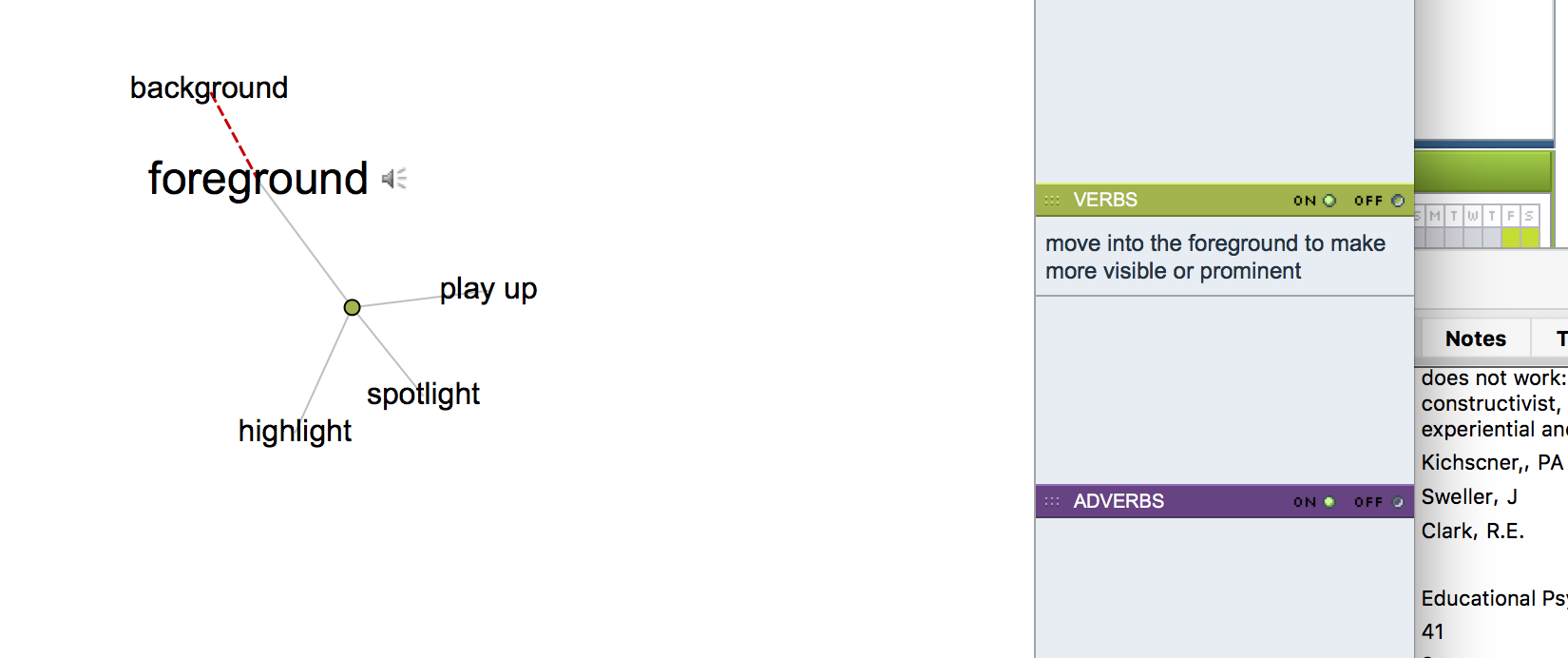
4.Perkins uses foreground as a verb. A lot. Nothing new there. Got me thinking…what words/expressions do I use, knowing that I once I made my list, I was going to visual thesaurus.

clarifies
highlights
puts forward
advances
demonstrates

VT jpg:
Screen Shot 2016-07-27 at 10.13.06 AM

Perkins, David N. Making Learning Whole: How Seven Principles of Teaching Can Transform Education. San Francisco, Calif.: Jossey-Bass, 2009.

New Reading List

Sorry for the big block quote. I just finished The Last Bookaneer, which made me think about Kidnapped and reading it thirty-five years ago. I was skimming Browsings last night and found these two the description of these two courses, the very thought of which makes me want to be an undergraduate English major.

Michael Dirda writing at The American Scholar

Last year, for instance, I taught a course at the University of Maryland entitled “The Classic Adventure Novel: 1885-1915,” covering 10 books. Given those dates, you can probably guess half the titles on the reading list: H. Rider Haggard, King Solomon’s Mines; Robert Louis Stevenson, Kidnapped; H. G. Wells, The Time Machine; Baroness Orczy, The Scarlet Pimpernel; E. Nesbit, The Story of the Amulet; G. K. Chesterton, The Man Who Was Thursday; Rudyard Kipling, Kim; A. Conan Doyle, The Lost World; Edgar Rice Burroughs, Tarzan of the Apes; and John Buchan, The Thirty-Nine Steps.

If one were to characterize all these disparate works, one might settle for the phrase “comfort books.” Other descriptive clichés come to mind: ripping yarns, action-packed swashbucklers, escapist fantasies, boys’ books. All accurate designations, but I will make the case that such stories are as important to our imaginations as the more canonical classics.

To my delight, the class proved immensely popular. Students said that it reminded them of why they had majored in English: not because they could hardly wait to read the latest in literary theory, but because they loved stories. This spring the Maryland English Department invited me back to teach again. Did they want me to take over a graduate seminar devoted to Lydgate’s Fall of Princes? Lead a class through the complete critical works of Gayatri Spivak? Teach Provençal poetry? Not a bit. Instead of these worthy projects, I’m back discussing “The Modern Adventure Novel: 1917-1973.” Our reading list picks up where the previous one left off and includes: Edgar Rice Burroughs, A Princess of Mars; Rafael Sabatini, Captain Blood; Georgette Heyer, These Old Shades; Dashiell Hammett, Red Harvest; H .P. Lovecraft, At the Mountains of Madness; Eric Ambler, A Coffin for Dimitrios; Alfred Bester, The Stars My Destination; Chester Himes, The Real Cool Killers; Charles Portis, True Grit; and William Goldman, The Princess Bride.