All posts by history

First day

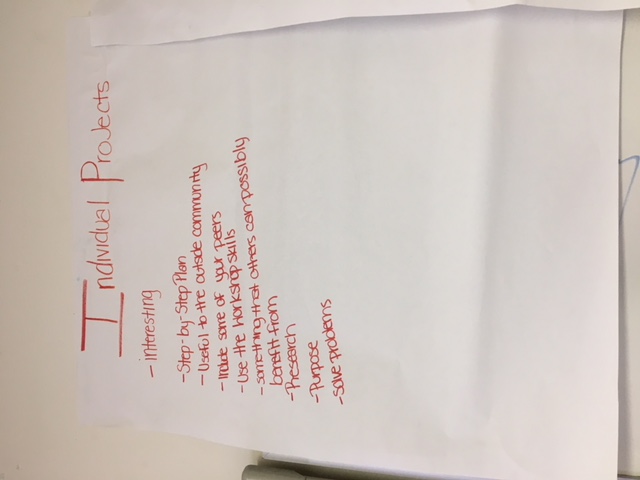
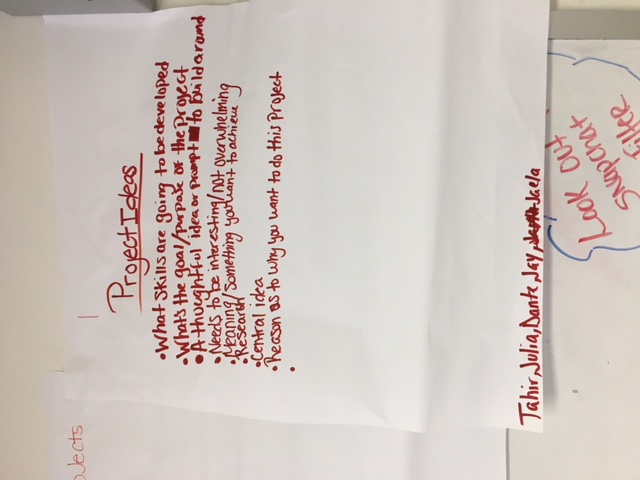
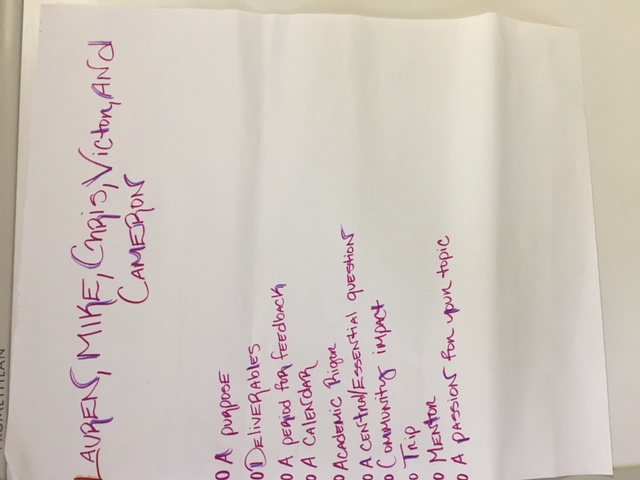
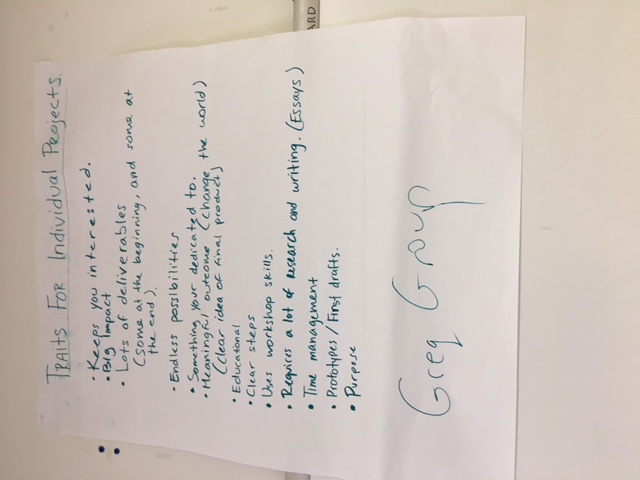
Crap day: first day of second quarter when it’s a three day week (no school Tuesday, no school Friday). I wanted to start thinking about what it means to do an individual project, mostly because I want to make sure these projects are viable.

I was thrilled because several key things I learned from last year came up:

One, there has to be an external mentor who they are regularly working with to ensure that there’s something real there. As a teacher, the work of the student in building and maintaining this relationship is not only necessary for the project’s success, it’s one of the more valuable things they’ll do.

Two, “impact” shows up on three of the posters and it allowed us to talk about how one measures a project, both while it’s going and once it’s complete.
Poetry from student presentation

These are lines directly from JYs presentation. One of the top-five presentations I’ve seen.

You won’t always get justice but at least you’ll be heard.
Making honest money.
I don’t only have to help the place I come from, I can help people everywhere.
I gotta work extra hard to get these things down pat, things I shoulda got in middle school.
Building ideas on a prototype will get my brain working.
Making a model will help me actually engage, make my brain more engaged.
I try my best, my best, my best, to be apart of the community.
This was me motivating them.
Work ethic of an African.
He died this summer.

Day three: exhibitions

There are two things I have to nail in the coming months:

One, there is a complete and total lack of understanding of how much work needs to be done on projects outside of school in order for the students to be successful. I need to find a way to get students to spend at least one hour working on projects and college assignments at night.

This is one of those troubling conversations to have with adolescents because social pressures quickly shape the conversation — nobody does that, my cousin at Central does no work and has straight As, the kids at SLA do nothing — none of which are true and all of which render additional conversation difficult. I’m going to build slowly into this by asking them to chart the one hour they spent at home on the work. I might provide suggestions for what work they could do and let them decide which parts they take on.

Two, there is a complete disconnect between quality projects and grades. While I spend a significant amount of time talking about what makes a project outstanding, I still hear the following things way too much:

* “My goal is to improve my grades.”
In some ways, this is an empty statement because we’re much more interested in the quality of the final project and talking about that. It’s not that grades are irrelevant, it’s that if you develop and complete a quality project the grades will always follow. It’s worrisome on my part — why are they still talking about grades instead of the quality of the work?

* “I worked hard so I deserve a good grade.” Maybe. If I’ve done my job right, the work required for a project can’t be done in one sitting. If I’ve done my job right, you understand that working hard the day before something is due is not the same thing as working all along. If I’ve done my job right, they’re learning to (sorry cliche police) work better.

Day two exhibitions

Man, six in a row is hard, especially when a big visitor arrives midway through.

Some deep thoughts from today, phrased in the form of agree-disagree statements:

LM: To make the community stronger, it needs to start with advisory, not with the individual.

DW: It’s better to be talked to instead of talked at.

SJ: Most of us are creative and we want to test out our creativity.

KN: We each have our own worlds that we live in…
So John — when he talks, everytime he talks, he give a motivational speech.

MW: (If I had would have had more time to do it, it would have been perfect.
I can help anyone but people don’t ask.

Exhibition Reflections, Day one

When is it my responsibility and when is is theirs?

If I give out the assignment, explain it, define it, spend at least fifteen minutes (and sometimes more) talking about what makes it outstanding, how often do I have to remind you to do it? If I make a checklist on October 9th and give it to you, then send on-line reminders on the 16th, the 25th, and the 29th, what more do I need to do?

How do I provide reset buttons for kids? In other words, how do I make sure that when a project deliverable slips off their radar they can start thinking about it again without panic?

How do I make sure that the intention behind every activity we do is understood and that all students are clear about how the activity and the time supports the completion of the deliverable?

How do I make clear what college actually means? What do people think about when they think about college? What do they expect?

KH makes a lovely distinction between being goofy and being an intellectual.

Best thing anyone said: “everyone has a role in this community.”

Second best thing anyone said: “in this group, there’s a lot of freedom, responsibility and work.”

Reflecting on escape room

Tomorrow’s the big night when our escape room goes live. We have five interlocking puzzles. We have lots of fun clues. We’ve rehearsed three times and have a pretty good sense where things go wrong.

As a wrap-up on Wednesday reading circle, we looked at excerpts from this Atlantic article on escape rooms. As we looked at the article, we talked about how our own room reflected these ideals.

“We’re passionate about our school and our escape room will reflect that.”
“There are serious mental rewards as we’ve been doing this.”
“Without reflection you don’t learn nothing.”
“The escape room gave a different way of learning.”

A good circle and a good day.

We also came up with a title; CS suggested Raiders of the Lost Classroom, which got shortened to “The Lost Classroom.”

The best and the brightest

Monday’s circle began, as it always does, with a weekend update — what did you get up to this weekend — and a second question: what did you do to compete with the best and brightest? I prefaced this by talking about the potential I see in all of them and how I want them to someday be their best selves.

I wanted to highlight the fact that they are competing against children who spend far more time reading, writing, and thinking about their schoolwork. This is a hard one to do in circle: I didn’t want to produce automatic adolescent us vs. them stuff but I also didn’t want anyone believing that they’ve made it already. The intense, relationship based culture of our school allows us to see the immense potential of all students. Potential is just potential, though, and nothing’s sadder than when it goes unrealized.

It’s about creating the situation where you realize you need to work harder.

(Also, I’ve not forgotten how the so-called best and the brightest made a hash out of a war. )

Teens and anxiety

Found this article to be provocative and powerful.

This description of the impact of technology on teen anxiety was particularly telling:

At a workshop for parents last fall at the NW Anxiety Institute in Portland, Ore., Kevin Ashworth, the clinical director, warned them of the “illusion of control and certainty” that smartphones offer anxious young people desperate to manage their environments. “Teens will go places if they feel like they know everything that will happen, if they know everyone who will be there, if they can see who’s checked in online,” Ashworth told the parents. “But life doesn’t always come with that kind of certainty, and they’re never practicing the skill of rolling with the punches, of walking into an unknown or awkward social situation and learning that they can survive it.”

A quibble: there’s three all of three paragraphs on the students I’ve taught in West Philly. True, “addressing anxiety is low on the priority list in many economically disadvantaged communities” but that’s because more often than not, students, parents, and teachers are worried about basic needs being met, not because anxiety doesn’t exist. Even if I’m dubious about the political will or economic resources necessary for a treatment protocol to develop, it doesn’t mean it isn’t necessary.

**
Read this article.

Transfer: one skill to another

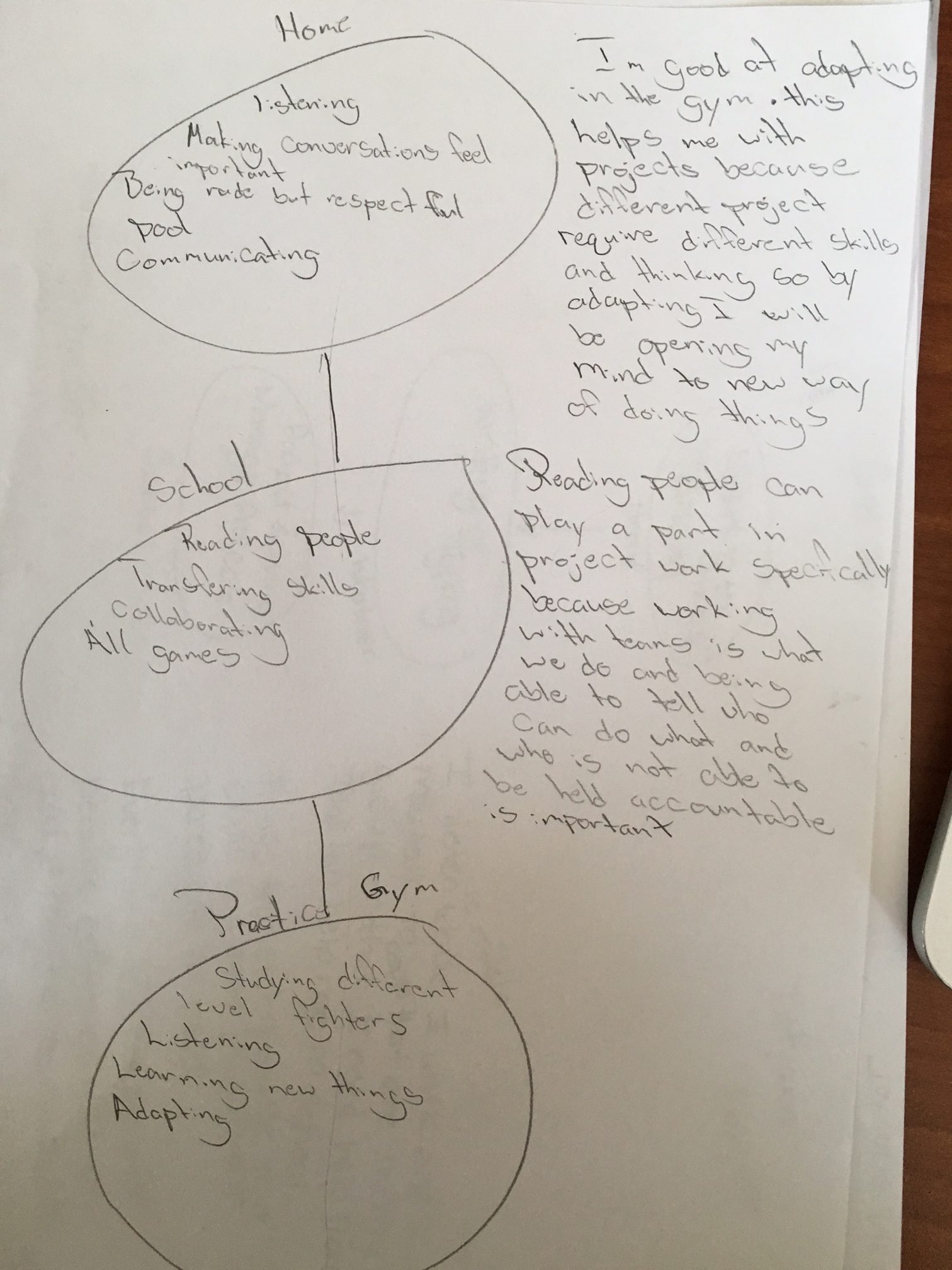
One of my big questions for the week is how we bring work we do in one sphere of our lives into another. In other words, do the skills we cultivate in our home matter for what we do at school? The skills we make on the playing field or in the rehearsal room — how do they make our project work, our academic work, our life work better? Do they? What transfers? What doesn’t transfer?

It’s surprisingly difficult to get people to identify things they’re good at, particularly in public, so we wrote first: name three things you’re good at, one from home, one from school, and one from everywhere else. Then we turned to the ways in which those skills/those strengths do support project work and the way they don’t.

I got some tape (amateur hour, I know) but we have some cool artifacts as well.