All posts by history

The exact opposite of how school funding works

This is a description from a great article from Pete Wells about new restaurants in NYC and the ways in which they are created. His larger point about how many groups are excluded is set up by this description:

Most restaurants, though, are funded by loans and private backers. Aby Rosen, one of the owners of the Seagram Building, recently told a reporter for Town & Country how he had raised $32 million for the Pool, the Grilland another restaurant the Major Food Group is building there. He and the restaurateurs solicited investments from “a nice mix of hedge fund guys, fashionistas, rich guys — an interesting group of 100 people who then bring 20 or 30 of their friends, and suddenly you have 2,000 people.”

Sadly, this approach doesn’t work for new schools.
Our smart principal

We read this as a group this morning:

When I was six or seven years old, growing up in Pittsburgh, I used to take a precious penny of my own and hide it for someone else to find. It was a curious compulsion; sadly, I’ve never been seized by it since. For some reason I always “hid” the penny along the same stretch of sidewalk up the street. I would cradle it at the roots of a sycamore, say, or in a hole left by a chipped-off piece of sidewalk. Then I would take a piece of chalk, and, starting at either end of the block, draw huge arrows leading up to the penny from both directions. After I learned to write I labeled the arrows: SURPRISE AHEAD or MONEY THIS WAY. I was greatly excited, during all this arrow-drawing, at the thought of the first lucky passer-by who would receive in this way, regardless of merit, a free gift from the universe. But I never lurked about. I would go straight home and not give the matter another thought, until, some months later, I would be gripped again by the impulse to hide another penny.
 
It is still the first week in January, and I’ve got great plans. I’ve been thinking about seeing. There are lots of things to see, unwrapped gifts and free surprises. The world is fairly studded and strewn with pennies cast broadside from a generous hand. But—and this is the point—who gets excited by a mere penny? If you follow one arrow, if you crouch motionless on a bank to watch a tremulous ripple thrill on the water and are rewarded by the sight of a muskrat kid paddling from its den, will you count that sight a chip of copper only, and go your rueful way? It is dire poverty indeed when a man is so malnourished and fatigued that he won’t stoop to pick up a penny. But if you cultivate a healthy poverty and simplicity, so that finding a penny will literally make your day, then, since the world is in fact planted in pennies, you have with your poverty bought a lifetime of days. It is that simple. What you see is what you get.

Great starting point for the year…

Annie Dillard, Pilgrim at Tinker Creek (NY: Harper Perennial, 1974).

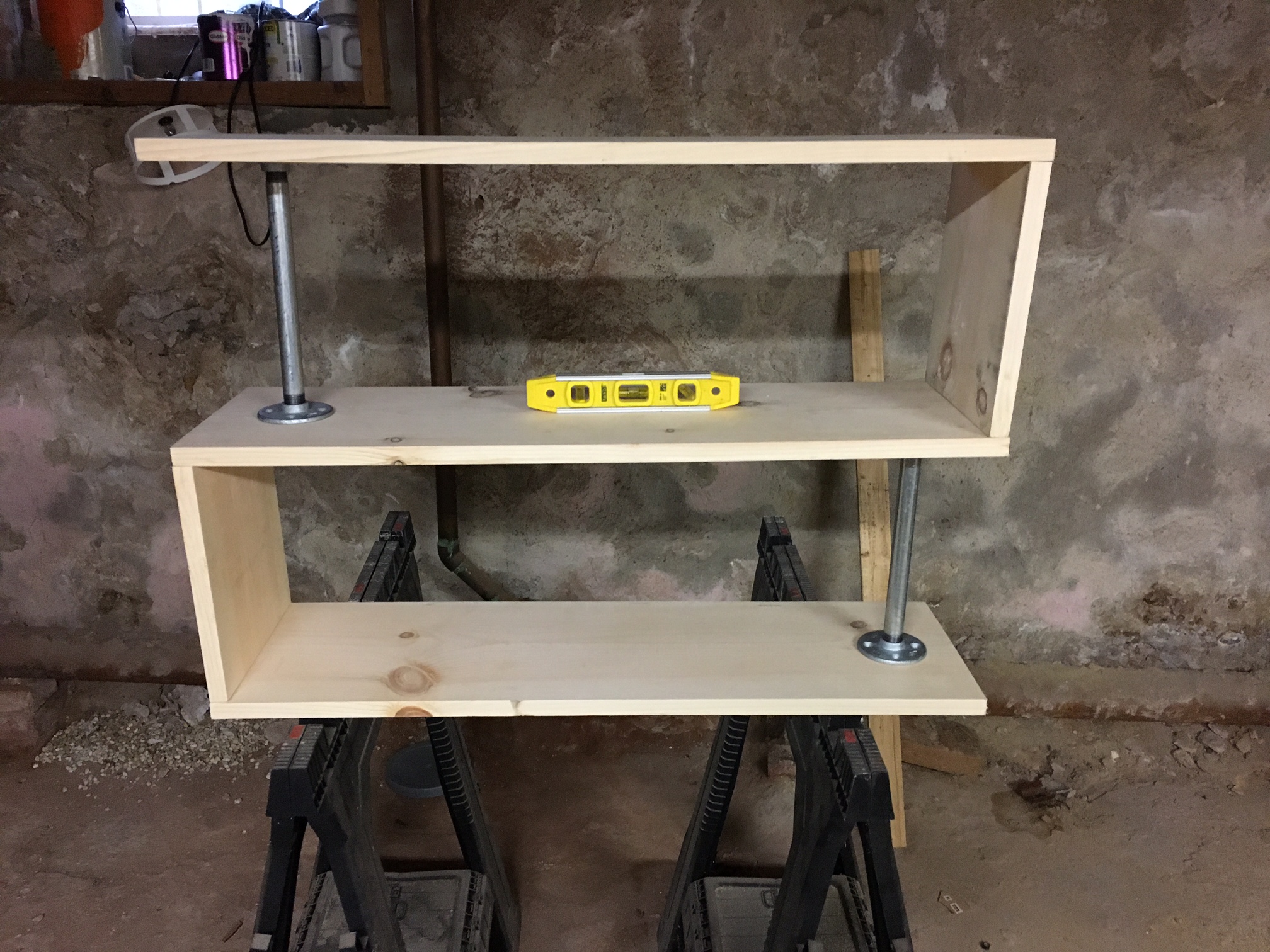
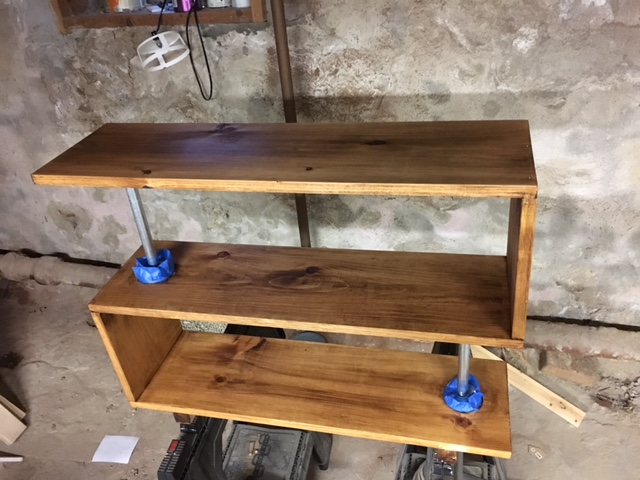
Day two: Junk under the TV stand

New lessons:

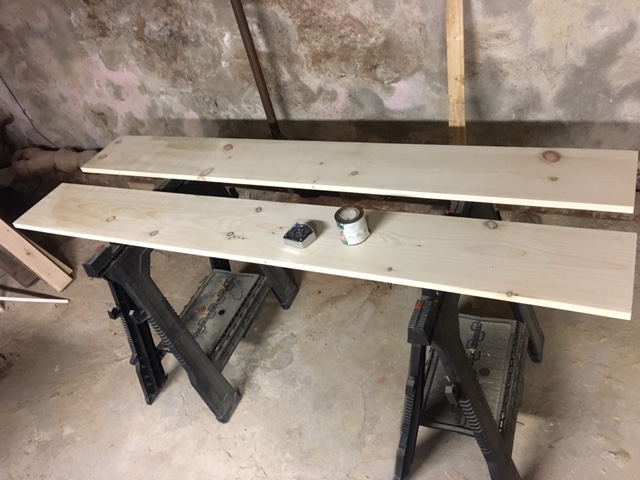
1. I knew this but a 1×10″ isn’t really a 1×10″. It’s a 1 x 9 1/4″. When does this knowledge of what you’re actually buying seep into your consciousness? When do the measurements of wood become automatic?
2. When you use this kind of piping, it’s shipped with a lot of grease, to prevent rust, I guess? That grease will get all over your wood.
3. Joints. Sigh. I wanted to do box joints here but realized that learning the hand craft of cutting a box joint might take me into my 50s. Dado set, here I come.

Building some stuff

I saw this in a Crate and Barrel catalog. I’m going to build a smaller version for our living room. I’m going to use 3/4″ pipe and flanges in the middle instead of that iron bar.

Challenges/things I want to learn:

*These finger joints on the end — I want to make a smaller version.
*What did people do before Home Depot’s/Lowe’s selection of crappy milled wood? Are there lumberyards where everything is cut well so that you don’t have to spend twenty minutes finding the least bad pieces?

Re-reading David Blight

Saw the latest Twitter blast and had to pull Professor Blight off the shelf. From the prologue:

“In many ways, this is a story of how in American culture romance triumphed over reality, sentimental remembrance won over ideological memory. For Americans broadly, the Civil War has been a defining event upon which we have often imposed unity and continuity; as a culture, we have often preferred its music and pathos to its enduring challenges, the theme of reconciled conflict to resurgent, unresolved legacies. The greatest enthusiasts for Civil War history and memory often displace complicated consequences by focusing on the contest itself…

Over time, Americans have needed deflections from the deeper meaning of the Civil War. It haunts us still; we feel it, to borrow from Warren, but often do not face it.”

David Blight, Race and Reunion: The Civil War in American Memory(Cambridge: Harvard University Press, 2001), 4.

Richard Sennett, part two

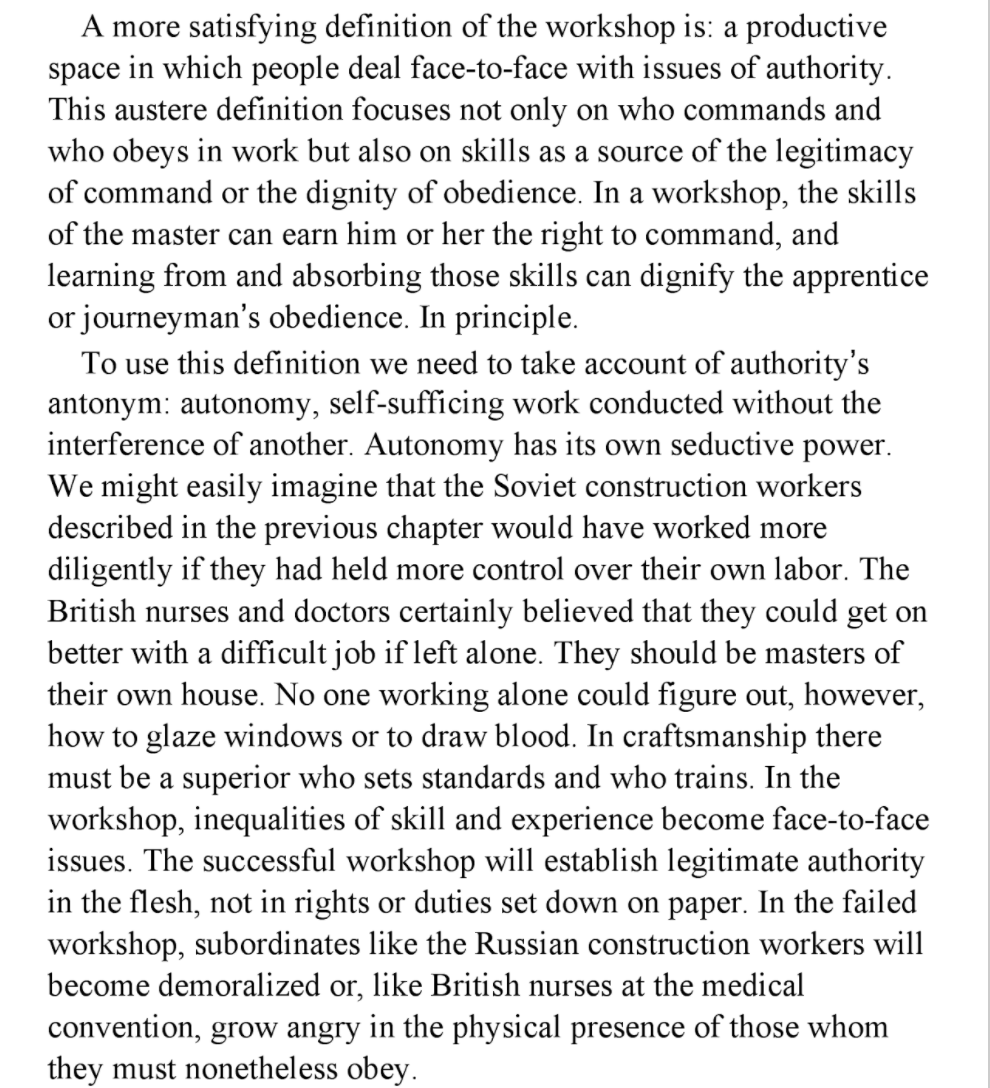
Finished reading yesterday and thought a lot about his distinction between authority and autonomy within a workshop. (Much joy at having a chapter called The Workshop).

This is the question we grapple with all the time. You want kids to become autonomous but you know that they’re not always ready. If you turn them loose too soon, you lose them, and it’s project-based learning going wrong. If you assume too much authority, it pretty quickly devolves into school and disengagement. We spend lots of time in PD discussing the nature of authority and how it’s earned; as teachers in a project-based school we have a number of our own projects that should serve as a model and as a source of authority.

I’m lazy, so I’m not typing this entire quote, but here it is:

I’ll use these two paragraphs in our opening week as try and figure out what rules the school sets, what expectations I have based on my authority as a teacher/project makes, and how they can begin to establish “legitimate authority in the flesh.”

Richard Sennett, The Craftsman (New Haven: Yale University Press, 2008), 54.

Richard Sennett

Reading The Craftsman. Great C. Wright Mills quote:

“The laborer with a sense of craft becomes engaged in the work in and for itself, the satisfaction of working are their own reward, the details of their daily labour are connected in the worker’s mind to the end product, the worker can control his or her own actions at work; skill develops within the work process; work is connected to the freedom to experiment; finally, finally, community and politics are measured by the standards of inner satisfaction, coherence, and experiment in craft labor.”

Richard Sennett, The Craftsman (New Haven: Yale University Press, 2009).

The Wolf in Winter

I read to try and find ways to link all that I do together. I love a good thriller and if you add a bit of ancient religion, I’ll read them all.

This is a good quote about social work but really any non-profit work:

Stephen was clearly a good kid, but he had the egotism of youth. The world revolved around him, and consequently he believed that he had the power to change how it worked. And, in the way of the young, he had made another’s pain about himself, even if he did so for what seemed the best of reasons. Time and age would change him; if they didn’t, he wouldn’t be working in soup kitchens and shelters much longer. His frustrations would get the better of him and force him out. He’d blame others for it, but it would be his own fault.

John Connolly, The Wolf in Winter (NY: Simon & Schuster, 2014), 115.