Category Archives: Uncategorized

1998

Woke up at 3:10 AM.  Damn.

Cleared the inbox, planned a bit of the day, paid the bills.  Then the internet got me and I started digging around on the old website.  Found an on-line journal from my teaching at WPHS (ca. 1998).  Here are the four quotes I featured on the opening page:

“The interest of the oppressors lie in changing the consciousness of the oppressed, not the situation which oppresses them.”
Paulo Freire

“Knowledge emerges only through invention and reinvention, through the restless, impatient, continuing,  hopeful inquiry human beings pursue in the world, with the world and with each other.”
Paulo Freire

“The displacement of the idea that facts and evidence matter by the idea that everything boils down to subjective interests and perspectives is — second only to American political campaigns — the most prominent and pernicious manifestation of anti-intellectualism in our time.”
Larry Laudan, Science and Relativism (1990)

“We must learn to enter the classroom “whole” and not as “disembodied spirit.”
bell hooks, 1994

Three thoughts

We often have guests through our building.  Sometimes it feels like too many guests.  It’s always a good moment, though, as a teacher/co-founder when the students describe our place in such awesome ways:

“Don’t make them do the work, make them want to do the work.”

“It’s easier to learn when you feel good.”

We’re “actually connected to our community through our projects.” 

It’s funny, too, that students describe our place as a community but focus on the fact that we do a weekend update every Monday as the way of describing how we make a community.   To me, it’s simple humanity — how was your weekend — and the other daily activities are much more valuable in building the community.  The way we learn to talk and listen to each other, to respectfully agree and disagree, to debate and deliberate… all that occurs during the work.  And because we’re “actually connected to the community”,  these conversations become real because they actually  matter.


Why we do this work this way…

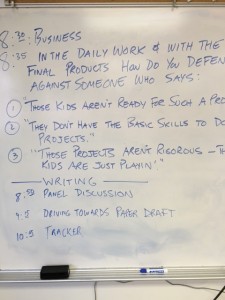
As their self-designed projects slowly round into shape — second drafts due tomorrow — we did some writing in defense of the project process followed by a debate where they had to stand up against the curmudgeons of the world.   Here are a number of great quotes from their writing:

If you think that project work is just playing, come spend a day there and you will most definitely see differently.  JH

We know how to solve real world problems and how to handle difficult situations.  JJ

The only issue (with creating their own projects) now is motivation.   ES

The only way (students)’ll learn is by experience and with that experience they can produce even better projects that will not only represent themselves but the school as well.   JR

The (students) who play do not define the students who don’t.  JR

Words don’t mean anything unless you can show proof.  TD

If we have an idea, (the teachers) help us turn it into reality.  JG

Look at the trackers to see what they did that day.   TC

Your mom isn’t ready for this project.  IB
IMG_4651

My answer to the second question (always do what you ask the kids to do!)

That’s true.  Many of the students are missing basic skills.   But the only way kids “catch up” is when they want to catch up, when they realize how far behind they are.   You can’t give or install basic skills; they develop when folks are motivated.   School, then, becomes a place where they realize the basic skills they might lack and try and build them because they need them in service of a project.


The twig

The books you read as a kid never leave you.  I read and re-read Lloyd Alexander’s Chroncles of Prydain.  I still find them in my kids’ rooms and read them over, mostly books four and five.

There’s a critical scene in book five when a small group turns away what was supposed to be an unstoppable army.   In a sad moment, a dying man notes that they were “the twig that turned the flood.”

Sometimes I feel like I’m Kevin Bacon in Animal House getting trampled.  Some days though, some magical days, I’m standing at a river that I’ve managed to turn with a small twig.

Confucius via Wendell Berry

“If a man have not order within him, he cannot spread order about him.”

I gather this comes from Ezra Pound’s translations, although I’m not familiar enough with this literature to tell if this is real.

Great mantra for teachers thinking about their own practice, though.


Everything is broken

Broken cutters, broken saws
Broken buckles, broken laws
Broken bodies, broken bones
Broken voices on broken phones
Take a deep breath, feel like you’re chokin’
Everything is broken

Every time you leave and go off someplace
Things fall to pieces in my face

Broken hands on broken ploughs
Broken treaties, broken vows
Broken pipes, broken tools
People bending broken rules
Hound dog howling, bullfrog croaking
Everything is broken

Bringing the words into reality

I had arrived this morning with the intention of thinking about how our four words — inspirational, altruistic, influential, and consistent — might help us think about some of the daily issues we face.   I wanted to write about it; my genius student teacher suggested that we make a carousel of it.  So we gave each of them a magic marker and walked the classroom weighing in on how these words might help us with:

*constant, disruptive  cell phone use
*sleeping/withdrawing from the group
*regular side conversations
*mean-spirited commentary
*arriving late

(If were a good teacher, or one not so desperately pressed for time, I would have had them identify the issues that distract from our community.)

The results were exciting and part of the never ending quest to help students follow through.   I began the post-conversation by asking everyone to think about how these issues linked together and the answers were telling — these are all things that make it hard for us, they’re all things that we do, they’re all things that we can manage — but I was also impressed how aware the students were of they could be managed with moderation.

It’s part of our place, that we try and find a middle, respectful ground — no group of teachers I’ve been around manages side conversations particularly well — and I hope that we can continue to build on these ideas.

FullSizeRender(13) FullSizeRender(12) FullSizeRender(11) FullSizeRender(10) FullSizeRender(9)