Category Archives: Uncategorized

Day Three

Altruistic.

Not the word I might have come up with.  Not a word I’d heard before in all of our efforts across the years to come up with words we want to be known by.   Not a word I tend to hear students using.   Not a word I hear friends and colleagues using that often.

Yet the group loved it.   IB proposed it initially and there’s this good, sincere energy around the table about it.   Having attended a high school whose motto (Non Sibi (not for self)) was addressed by creating lawyers and finance types whose yearly donations likely dwarf my salary, I was happy to hear the students talking about what this word might mean in our classroom.  The notion of selflessness held a surprising appeal.  I hope we can live up to this word.

Follow up: Did find this video that I hope to show next week.  And I think I have a book of Peter Singer essays that might have a piece or two that’s accessible.

Day Two

A brief note from seminar this afternoon.  We have all of our English students working on a series of readings and activities designed to get them thinking about their future.  Some of this is pretty typical English teacher stuff, but the hope is to get the students involved in their favorite texts — their own lives — and start thinking about how they will write their own stories.

Today we began by asking them to think about someone who is terrible at their job.   The goal was for them to write about this and then we’d have a discussion about the other kinds of workers, those who are good at their jobs.  The money part would be the conversation about why people are good or bad at their jobs.  If this part of the conversations went well, then the first assignment — writing a self-assessment — would make a lot more sense.   If you know what you’re about and what you like, then figuring out what to do with yourself will be easier.

And both groups delivered, offering some great insights.  The one that stuck with me was a young man who suggested that people are bad at their jobs because of stuff going on in their personal lives.   He noted that when people aren’t happy about their lives, they can’t be good at their jobs.

Such an interesting point, particularly in terms of education.   Teaching is such an intensely personal profession that it’s difficult to separate one’s real life with one’s teaching life.  Yet this student didn’t frame it as how a job might make a life tough; he framed it as a life making a job tough.

As a teacher, as a human, he’s right…if you’ve got your head on right, then it doesn’t matter what job you end up doing.   The joy I feel in my family, my home, my neighborhood, my friends, my garden, and my books can feel clouded by the difficulty of teaching.  But  if I let myself get too caught up in the dramas of my students’ lives, if I look at all the difficult parts of this work, if I see only the obstacles, then I won’t be able to succeed.   In other words, as this student points out, it would be about me.

Easier said then done.   Day two.

Day one

Over the past four years, we’ve begun with an activity that we stoleadapted from Mark Springer. We ask students to answer the question of how they want to be known in four words. The process of identifying what those words might be last several days, sometimes up to a week, as the entire class must come to a consensus about what they mean and why. We then use those words all year; one of my great highlights as a teacher was hearing one of my students ask another this question on a subway car and the look of surprise and pleasure on the adults who hear it.

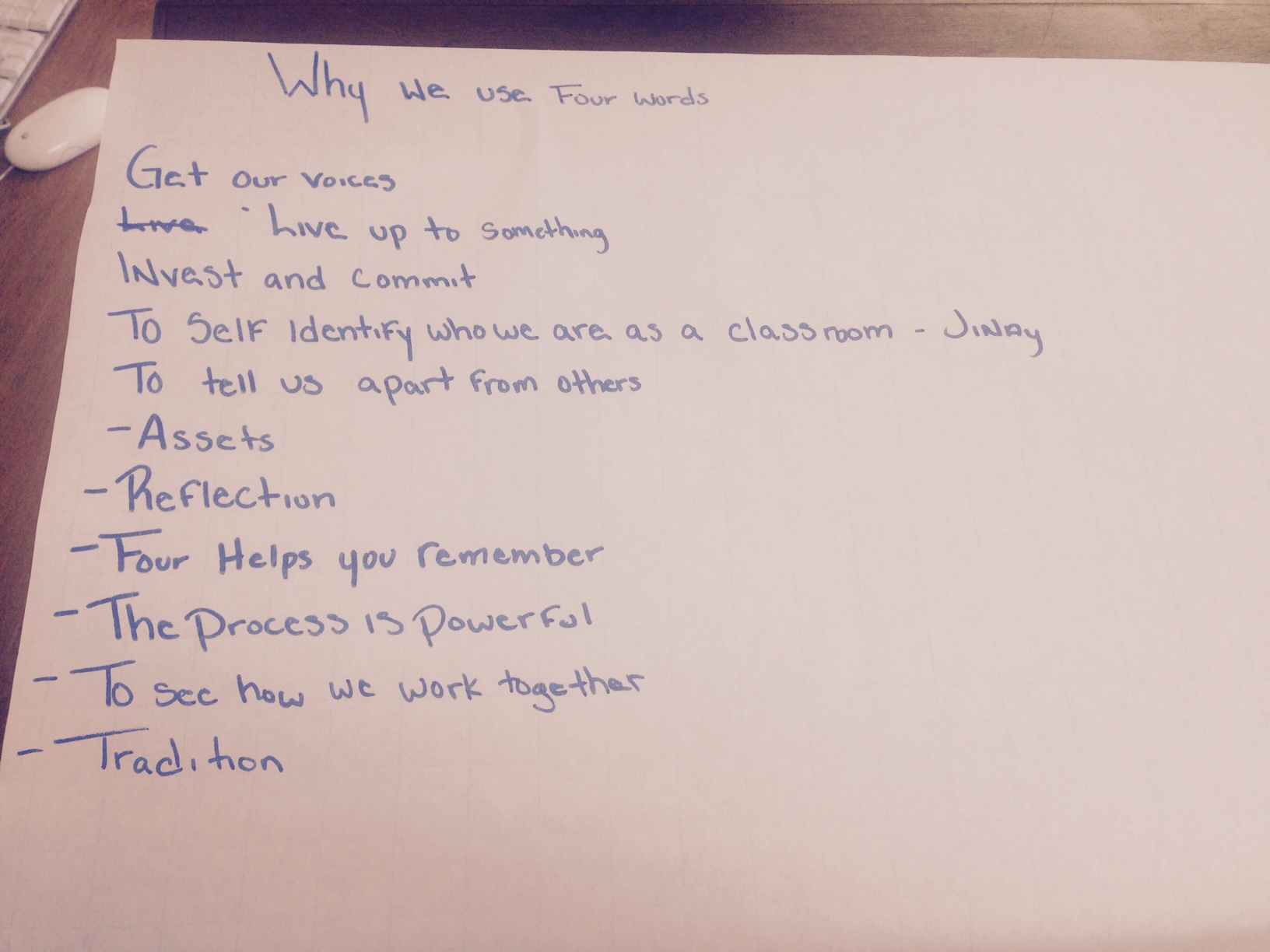
Anyway, this year I have eleventh graders and they’ve been through this process twice. Some poor souls have even been through it twice with me. One of our opening activities, then, was for them to identify the process they would like to use to come to the four words. We know that we only have a few days to get this done (September in the SDP will be an absolute mess) and I know that they’re not totally thrilled about doing this again. First, though, I asked for a volunteer to run the conversation (hard with 23) and a volunteer to write.  Why we do our four words:

FullSizeRender(4)

Only one of these is mine (see if you can guess).   TD quietly contributed reflection, which I thought was exceptional, as he said we could “use these words to reflect.”  I loved J’s idea too, that these words would help us forge an identity for our classroom.   And the fact that someone could see that this is a tradition, something we’ve done before and that maybe they will always do at our school…well, that was awesome.

A good first day.

Doing science

Like the idea of comparing grow lights. Same starts on both sides; one has LED at ~14″, the other has florescent bulbs at ~2″.

Untitled

1. Ferry-Morse Dwarf Blue Curled Kale Vale’s Strain
2. Burpee Acelga Swiss Chard Burpee’s White Giant
3. Ferry-Morse Collards Georgia Southern or Creole
4. Burpee Broccoli Bonanza Hybrid
5. SSE Dwarf Blue Curled
6. Territorial Flashy Trout’s Back Lettuce
7. SSE Scarlet Kale
8. SSE Endive Tres Fine Marachere Lettuce
9. SSE Gulley’s Favorite Lettuce
10. SSE Forellenschluss

I’m thinking I’m going to clear the front beds of Brassicas entirely as the white flies seem to have done those plants in.

Homework for Master Gardener Class

The speaker asked us to identify the plants growing near our house. We have three street trees in front of our house. I cut the concrete and dug the holes for each of them, I’d say at least twelve years ago.

Left:
Genus: Zelkova
Species: Zelkova Serrata
Cultivar: ?
Common name: Japanese elm?

Untitled

Center:
Genus: Acer
Species: Acer Griseum
Cultivar: ?
Common name: Paperbark Maple Tree.

Untitled

Untitled

Right:
Genus: Quercus
Species? That’s a good question
Cultivar:
common name: Some sort of oak tree. Scarlet? Pin? Red? (coccinea, palustris, rubra)

Untitled

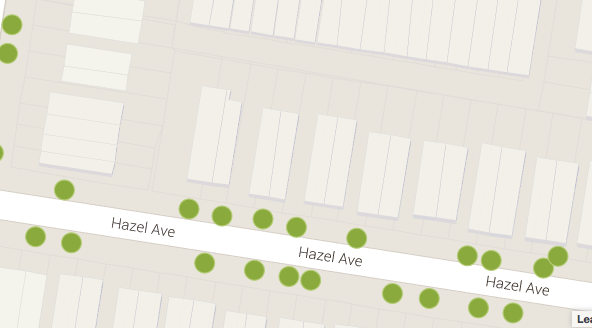
Then I went to OpenTreeMap for Philly and added these three. I’ll have to go do some measurements later.

Screen Shot 2015-09-01 at 6.38.04 PM

What we know, what we don’t know

“Michael Smithson, a social scientist at Australian National University who co-taught an online course on ignorance this summer, uses this analogy: The larger the island of knowledge grows, the longer the shoreline — where knowledge meets ignorance — extends. The more we know, the more we can ask. Questions don’t give way to answers so much as the two proliferate together. Answers breed questions. Curiosity isn’t merely a static disposition but rather a passion of the mind that is ceaselessly earned and nurtured.”

The case for teaching ignorance

The Sympathizer

Two quotes:

Nothing was so true, and yet nothing was so mysterious, for the questions of who the people were and what they might want remained unanswered. The lack of an answer mattered not; indeed, the lack of an answer 2was part of the power in the idea of the people that brought the men to their feet and the tears to their eyes as they shouted…Like salmon who instinctively knew when to swim upstream, we all new who the people were and who were not the people. Anyone who had to be told who the people were probably was not part of the people…

(p. 213)

No, because happiness, American style, is a zero-sum game sir…For someone to be happy, he must measure his happiness against someone else’s unhappiness, a process which most certainly works in reverse. If I said I was happy, someone else must be unhappy, most likely one of you. But if I said I was unhappy, that might make some of you happier, but it would also make you uneasy, as no one is supposed to be unhappy in America. I believe our clever young man has intuited that while only the pursuit of happiness is promised to all Americans, unhappiness is guaranteed for many.

(p. 246)

Nguyen, Viet Thanh. The Sympathizer (NY: Grover Press, 2015).