
Three kinds of Kale, Three kinds of Chard, Collards, and a few radishes. Everything is 12″ apart but I’m going to harvest the small ones with the goal of 21 strong plants.

Three kinds of Kale, Three kinds of Chard, Collards, and a few radishes. Everything is 12″ apart but I’m going to harvest the small ones with the goal of 21 strong plants.
The bad news — it poured all weekend and I could not get a single plant or seed into the ground.
The good news — it poured all weekend and there isn’t a single puddle on my raised beds.

The awesome folks at Treephilly have organized a yard tree giveaway and I’ve started clearing the perfect space for it in my backyard garden. There’s a huge space that’s currently occupied by an Azalea bush. It’s pretty but it’s too big and I’m tired of it sending large branches through the chain-link fence.
Because of the orientation of our yard, a tree in this spot won’t diminish the sun available to the various raised beds. I’m trying, too, to have everything growing to be edible.
Every gun that is made, every warship launched, every rocket fired signifies, in the final sense, a theft from those who huger and are not fed, those who are cold and are not clothed. This world in arms is not spending money alone. It is spending the sweat of its laborers, the genius of its scientists, the hopes of its children.
Dwight Eisenhower, 1953
1. Deborah Ellis, Children of War: Voices of Iraqi Refugees (Toronto: Groundwood Books, 2008).
A recent study has shown that if American parents read one more long-form think piece about parenting they will go fucking ape shit.
I pick up these sorts of books so that I can get re-energized around a topic. Again, Michael Pollan delivers.
Two quotes before I pass the book to the other side of the bed:
“To ferment your own food is to lodge a small but eloquent protest — on behalf of the senses and the microbes — against the homogenization of flavors and food experiences now rolling like a great, undifferentiated lawn across the globe. It is also a declaration of independence from an economy that would much prefer we remain passive consumers of standardized commodities, rather than creators of idiosyncratic products expressive of ourselves and of the places where we live, because your pale ale or sourdough bread or kimchi is going to taste nothing like mine or anyone else’s.” (pp.414-5)
“As a form of cooking (baking) seemed way too demanding — of exactitude and patience, neither a personal strong suit. Baking was the carpentry of cooking and I’ve always gravitated towards pursuits that leave considerably more room for error. Gardening, cooking, writing, all are roomy in their way, amenable to revision and mid-course correction.” (p.210)
1. Michael Pollan, Cooked: A Natural History of Transformation (New York: The Penguin Press, 2013).
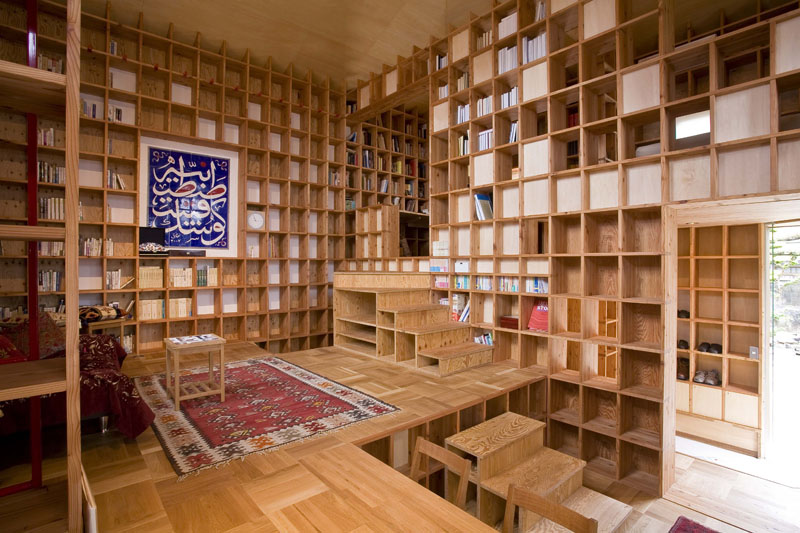
Architectural firm who built: http://morita-arch.com/archives/7801
The thought of trying to build such a system into my first floor is very appealing were it not for the crumbling plaster walls on one side and the crumbling plaster walls on the other side.
I had written a little while ago, just churning one night, about the nature of teacher grit. I really liked this piece and this ending quote:
So rather than trying to ferret out the grittiest teachers from a small pool of young people willing to teach, why not focus our efforts on designing schools to be places where all teachers can thrive?
“You have just dined and however scrupulously the slaughterhouse is concealed in the graceful distance of miles, there is complicity.”
Ralph Waldo Emerson
I encountered this quote while reading:
Pollan, Michael. Cooked: A Natural History of Transformation. New York: The Penguin Press, 2013.
Then I was reading a terrific review of Elizabeth Kolbert’s book in the NYRB where the reviewer, Verlyn Klinkenborg, cites an essay by George Orwell, Down the Mine, where he makes the following claim:
Our civilization, pace Chesterton, is founded on coal, more completely than one realizes until one stops to think about it. The machines that keep us alive, and the machines that make machines, are all directly or
indirectly dependent upon coal.
(Klinkenborg replaces coal with fossil fuels.)
Two good pieces for thinking about the costs of the decisions you make and for making the case about the necessity of a deep awareness of how things actually work. I will try the Klinkenborg with my students to see if I can get anyone excited about the possibility of reading Kolbert’s book.