Underneath it all, they do get it. Remember that.
Keep the faith. Don’t give up. It’s only a test. It’s only a test.

Underneath it all, they do get it. Remember that.
Keep the faith. Don’t give up. It’s only a test. It’s only a test.
Thinking about habits and motivation. Reading Charles Duhigg’s follow up book to the Power of Habit this weekend and took these two quotes as a starting point for today’s discussion:
If you can link something hard to a choice you care about, it makes the task easier…Make a chore into a meaningful decision, and self-motivation will emerge.
Moreover, to teach ourselves to self-motivate more easily, we need to learn to see our choices not just as expressions of control but affirmations of our values and goals. That’s the reason people ask each other “why” — because it shows them how to link small tasks to larger aspirations.
Good student thoughts later…
Duhigg, Charles. Smarter faster better (New York: Random House Books, 2017), pp.30-31.
Our evil genius program evaluator had the students complete a survey; responses from two questions below. (N=17, which is all but two of my advisees).
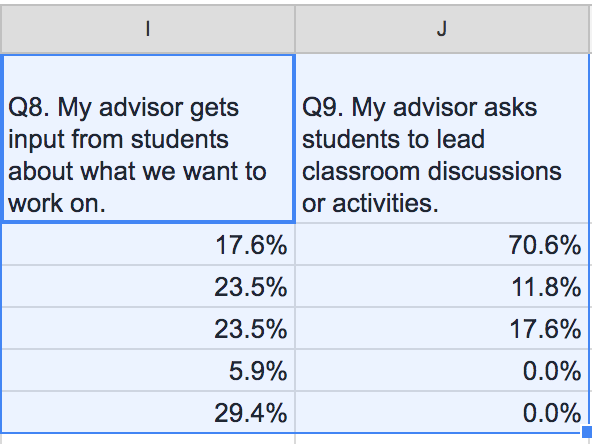
I thought the result from Column I was particularly interesting given that my advisory all passed Gateway and half of every day is taken up with a project they choose and that they design. I would hope that the result from the first column would look more like the second column, i.e., I feel like I’m taking their input all the time but maybe I’m not.
Am I giving them enough space to design and work on their own? Is my understanding of the structure necessary to complete a project being mistaken for actually overwhelming what they want to do? Is it a question of students working hard and me not appreciating it? Or is it a question of students misidentifying activity as actual work? Are my expectations too high?
Given that feeling, I figured I had to build a circle activity to hear what the students thought. Two writing questions:
How much freedom should an eleventh grader have in terms of their education?
Should there be any limits or restrictions?
Defending your work
Bit of a teacher jackpot this week: it’s the week before spring break and the first week of fourth quarter. The energy is all over the place. There’s some funny things being said: “I’m going glamping during spring break… that’s glamourous camping.” There’s some residual restlessness as the year draws to an end and seniors start coming to terms with their imminent departure.
So I’m trying to frame this week as defend your work week:
One, you have to defend, with evidence, your choice for next year. Are you going to continue to take college classes, pursue an internship, or work in the shop?
Two, you have to defend, with evidence, your goals for your fourth quarter self-designed project. What shows that this project is viable for a fourth quarter completion?
Three, we’re doing a combined investigative journalism and playwriting unit for fourth quarter. You will have to be able to defend your chosen story, be it the Phillies victory or a spate of overdoses, as worthy of exploration and of a play.
I like the idea of defending your work as the kids get it quickly. In a project-based school you have to be able to explain why you’re doing what you’re doing. The kids understand challenging each other on the relevance of their projects and most of the time they’re able to challenge in a respectful way.
The problem with the idea of defending your work is that it relies on students actually engaging in the defense; you can’t defend something you don’t care about. Similarly, if you don’t care about the process (or the outcome) then defending your work will be a hard road. I also have to tread carefully with making sure that kids understand that you’re not defending this to the death; that the goal is to go through a rigorous process that allows your work to improve.
Anyway, it’s the best way I could think of to frame a crazy week from the school calendar.
In talking about the role of the teacher in making outstanding work, where should the arrow point? Where does responsibility/accountability lie? With what work and what situations does the arrow move?
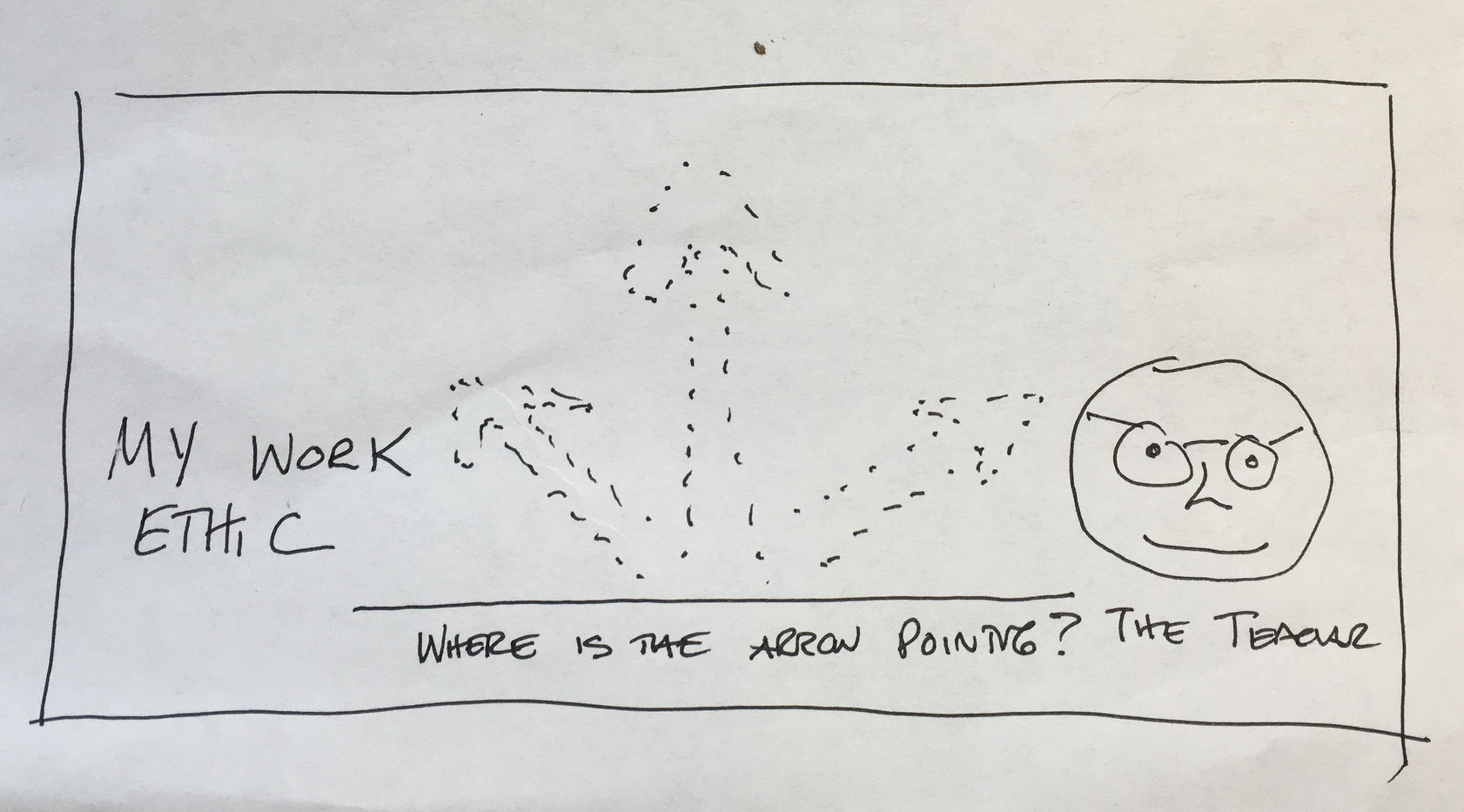
I’m going to include this in the the third quarter letter that I’ve almost completed.
This would have been perfect at the beginning of our compost design unit.
Great find AS.
One: A phone call to my cellular provider. Nausea at what I was paying. Cut bill significantly.
Two: Compost tea. Will be ready in thirty-six hours. Did not add molasses. Hope this can be fertilizer for plant starts.
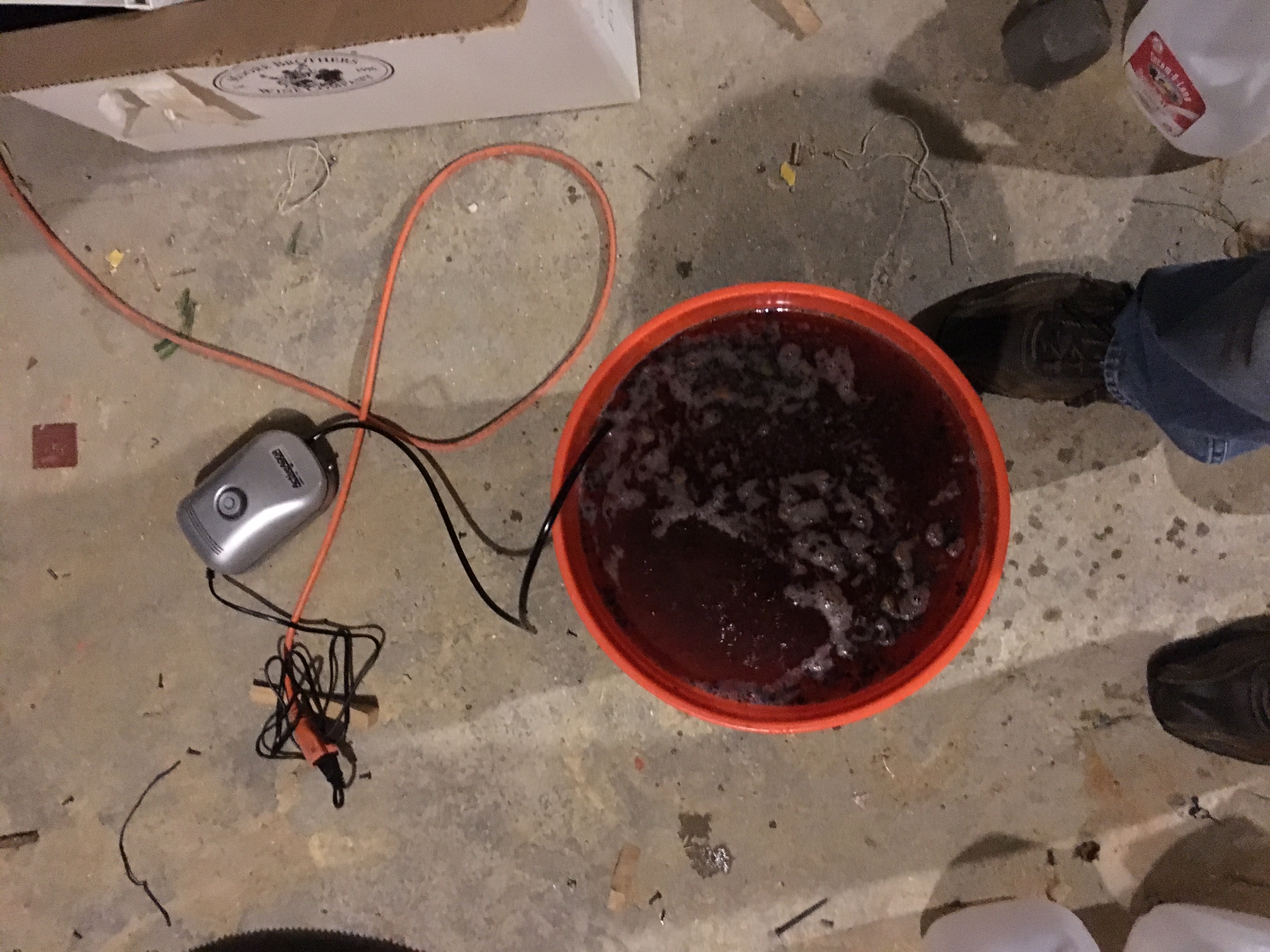
Three: Bracket for FIFA2016 Champions League. Played three games. Barca won Champions League after two Bayern players sent off in last match.

Four: Ribs, KT style, Eight hours in oven at 250 degrees after extensive rub and refrigeration.

I watched the inaugural speech with my students. I’m hoping that Garry Wills will have a close analysis of the text as there were numerous moments that a serious scholar will be able to explain better than I will, i.e., Donald Trump using the verb “join” — “We, the citizens of America, are now joined in a great national effort to rebuild our country and restore its promise for all of our people ” — mirrors the opening lines of Martin Luther King’s I have a dream speech, which leaves me vaguely nauseated.
King’s words, “I am happy to join with you today in what will go down in history as the greatest demonstration for freedom in the history of our nation”, are worth reading again, then, particularly as a counterpoint to Mr. Trump.
I’m more interested, though, in this part of the speech:
“When you open your heart to patriotism, there is no room for prejudice.”
First of all, this makes more sense if you invert it, i.e., When you open your heart to prejudice, there is no room for patriotism. If (and I’m dubious) his point was that a true patriot cannot be prejudiced, then my version makes more sense, simply because I’m not sure how one opens one’s heart to patriotism. I can open my heart to another. I feel like I grew up listening to Catholic masses where I was asked to open my heart. Madonna sang about opening her heart too. Don’t click on this at work.
Patriot, though, looking at the OED, shows three threads:
One: Someone who loves their country. This is the definition I’m most familiar with and it’s the one that you’ll hear claimed as a way of excluding others. I’m a patriot (so you must not be). Within this definition, though, at the OED, they note that “Good Patriot” only began after 1680, that before that you were either a patriot or not.
Two: There’s a second ironic strand, too. Apparently Patriot took on a derogatory meaning in the early part of the 18th century. Here’s the full definition, which rang true today:
“A person who claims to be disinterestedly or self-sacrificingly devoted to his or her country, but whose actions or intentions are considered to be detrimental or hypocritical.”
Three: A freedom fighter — if you believe you are in an occupied country, then you can claim an identity as a patriot.
I would like to see the trajectory of this term. I’m sure someone has done it already.
Under construction but more coming today.
Tonight when they submit the films, we’ll start creating links to their films.
Update, 8:35 AM: The School District of Philadelphia has blocked my student’s ability to upload their videos.
Update, 10:00 AM: The School District of Philadelphia unblocked the website.
In the end of the quarter trap as we try and finish strong. I have to provide enough structure so that things don’t fall apart but not so much that I’m adding even more pressure. If at this point they don’t know the impact of not completing, there’s very little I can do.
So we began by making self portraits that featured the cheesiest motivation slogan they could come up with and three ways they can help others.
Examples below:


