
Our school is highlighted about 2/3 of the way through the video. Definitely a cool overview of an important topic…
Category Archives: Articles of Note
Where do we hear each other?
This article describes how one reporter has struggled with the ways in which Americans communicate with each other at this point. There were a number of killer insights but several stuck out:
In recent years, in my reporting, I’ve come to uncool conclusions. For one thing, I’ve begun to think that instilling public purpose into private communities is the hardest thing in the world.
I’ve increasingly found myself a supporter of messy public process: the legislation pushed through government slowly, in curtailed form; the interminable, fruitless-seeming town-hall meeting; many of the government’s lumbering, error-prone efforts at regulation. These processes are cumbersome, often wasteful, and inevitably infuriating. But at their best they have the virtue of occurring in a common arena, the place where all parts of a population meet. They force us, if we hope to get anything done, to translate our values and thoughts into language that communicates broadly. The more I observe, the warier I grow of privatized efficiency: in time, it indulges clannish thought. Let’s drive our language out of private circles, back toward the public sphere.
What I appreciate about this latter idea, particularly as a teacher, is that Heller is trying to move us back to the circles where you have to get something done. For example, if you want safe water, you’re going to have to meet with a lot of different stakeholders. Getting all of those individuals and institutions to agree on something let alone change their behaviors and policies is going to require a lengthy process, one that’s, in Heller’s words, cumbersome, often wasteful, and inevitably infuriating.Or you can retreat to a closed, private space, say an on-line community, where you can develop your own language and vision in essential isolation and then lament why nothing seems to change.
David Brooks: Right and wrong
I don’t always like but once I’ve read his stuff I end up thinking about it.
“…which shows that while some teachers are good at raising their students’ test scores, other teachers are really good at improving their students’ school engagement. Teachers in the first group are amply rewarded these days, but teachers who motivate their students to show up every day and throw themselves into school life may not even realize how good they are, because emotional engagement is not something we measure and stress.
Teachers are now called upon not only to teach biology but to create a culture: a culture of caring criticism, so students feel loved while they improve; a culture of belonging, so fragile students feel their work has value. Suddenly, teachers must teach students how to feel about their own feelings; how not to be swallowed up by moments of failure, anger and sadness, but to slow the moment and step outside the emotional spiral.”
All true and well-said. However, very few teachers of any sort are “amply rewarded” at this point. The best you might say is that raising test scores frees you from a visit from a coach or a misguide principal with a clipboard.
Have to read this article with students…
It links to yesterday’s conversation about what it means to be ready for 12th grade. There’s several tensions with our current eleventh graders that we should be able to process in writing. And it’s a minefield for a lot of reasons.
1. The turn it on, turn it off nature of life; too many humans operate on the “when I get to place X, I’ll turn it on and I’ll be fine” model. This is an illusion for all but the most lucky and talented. It runs deep.
2. The deep worry we all have about where kids start college and face the frustration of remedial courses. Even in a project-based model, where passion and interest fuel the work (on good days), there’s still much to be done to “catch up.” College, even done badly, is hard work and I think too many educators create a picture of it as a kind of nirvana. I am guilty of this because having the opportunity to read, write, and argue all day sounds pretty good to me but I loved all those things even when I hated school.
3. Such an article and such a discussion shouldn’t be seen as a personal attack; rather it should be seen as a way of understanding what the students will be up against. Like any teacher (and parent), I have moments where I present information in what I feel is a non-threatening, thoughtful way only to have my children and students ask why I’m coming at them. Why I’m always coming at them. ALWAYS COMING AT THEM.
4. The dawning reality that many kids start to face in eleventh grade…the real world is coming and it’s scary for more than a few of them. Analogy: it’s the start of a long walk on the plains. You can see the mountains in front of you but they’re going to be far, far away. And you can see the other hikers who are days, even weeks ahead of you. You can do it. But it’s going to take a lot of effort of a sort you’ve never put forth before. It might just be easier to stay where you are.
Monday morning…
Remembered this cartoon today
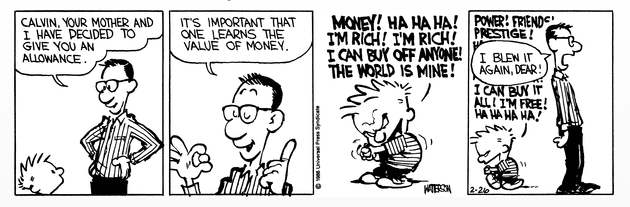
Parenting 101
Source: here
“Learn Different” from the New Yorker
I read this piece on Sunday and this paragraph has stuck with me all week:
The point of the hackathon was to sketch out in code potential solutions to “robot tasks”—routine aspects of a teacher’s job that don’t require teaching skills. Kimberly Johnson, the head of product success and training, addressed the team. “Basically, what we have told teachers is we have hired you for your creative teacher brains, and anytime you are doing something that doesn’t require your creative teacher brain that a computer could be doing as well as or better than you, then a computer should do it,” Johnson said.
I’ve been racking my brain all week trying to come up with a “robot task” I do that consumes more than ten-fifteen seconds. Some robot tasks are also things that students should learn to do as part of daily life: organizing their work into a table of contents or plugging up computers or taking care of the room. And most “robot tasks” I like to use as a break from intellectual work: taking attendance or passing back the initial pile of papers for kids to sort themselves.
None of these add up to even five minutes over the course of a day.
Editorial
Friday afternoon, as I was sitting in a seminar pondering how I might write an editorial based upon my research, I failed to realize that Bob Herbert had a piece in that morning’s Times describing the need for new school buildings.
The only thing I might have added would have been a paragraph or two outlining the ways in which new schools could be used to re-make portions of the educational landscape and the inequality that characterizes American education. Why not guarantee federal funds to districts that want to use school construction to integrate communities or who want to erect multi-use buildings that can provide both education and jobs? Hard to imagine what such a bill would look like or how you’d close loopholes, but it seems like a decent way to address the issue of infrastructure, which as we all know, is forever crumbling.
School Budget Announced
So a new budget has been announced. Two curious paragraphs from the Inquirer’s coverage of this development:
There’s also a cut of about 0.5 percent in individual schools’ discretionary budgets.Asked if principals had been notified of the cut, which amounts to a savings of about $1.2 million, Masch said: “I hope so.”
Michael Lerner, president of the principals’ union, said his members had not heard a word.”They have neither been notified nor consulted on the budget cuts,” said Lerner.
Second snip, which will undoubtedly show up in the casework of a special education attorney:
Masch said the district was able to reduce costs by dismantling some “self-contained” classrooms and putting those children into regular education classrooms with teachers able to teach students at multiple levels.
Poverty and film
I liked these two paragraphs from A.O. Scott’s review of Precious and The Blind Side:
Both movies tell stories that suggest a way out of poverty, brutality and domestic calamity for certain lucky individuals while saying very little about how those conditions might be changed. For all their differences, they ultimately occupy a common ground that is both optimistic and, at the same time, curiously defeatist. Both locate the problems facing their main characters in the failure of families — of mothers in particular — and find solutions in better families, substitute mothers (Ms. Rain and Leigh Anne), whose selflessness and loyalty exorcise the biological monsters who have been left behind. The fact that “The Blind Side” is based on a true story lends credibility to this sentimental idea.
Snipping a bunch to get to this line:
We believe she (Precious) will be all right because we would rather believe that than confront the failures of institutions, programs and collective will that leave so many other Preciouses unrescued.
One more reason why The Wire rules.
Gordon Wood
So I found this article a few days ago, a brief essay by Gordon Wood describing the “choices” made by historians about writing analytic vs. narrative histories. And it got under my skin a bit…he writes:
“Instead, most (new historians) have purposefully chosen not to tell stories; that is, they have chosen not to write narrative history.”
While I have great respect for Professor Wood’s work, he’s not really being fair here. There are many graduate students and scholars who would love the opportunity to chose to write narrative history. But those sorts of books will not get you tenure at many, if not most, places. The initial choices made by “new” historians are those that will best serve them if they want to remain university based historians. He’s also fails to acknowledge the historians who can do both — write a book within an analytic framework that still offers a compelling narrative. Two recent books, Lisa Levenstein’s A Movement without Marches and Hilary Moss’s Schooling Citizens, manage this quite well. And both books are written beautifully.
Either way, why isn’t there at least a paragraph on the ways in which scholarship is evaluated in the university? And why isn’t there a paragraph asking why senior historians, who have tenure, don’t chose to write larger narratives? Or why those that do are not always successful?


