
Poor naked wretches, whereso’er you are,
That bide the pelting of this pitiless storm,
How shall your houseless heads and unfed sides,
Your lopped and windowed raggedness, defend you
From seasons such as these? O, I have ta’en
Too little care of this! Take physic, pomp,
Expose thyself to feel what wretches feel,
That thou mayst shake the superflux to them
And show the heavens more just.
Category Archives: Quotes
Quotes from stuff I’m reading that I don’t want to lose.
Frederick Douglass (1894)
Call to mind the sublime and glorious truths with which at its birth, it saluted a listening world. It announced the advent of a nation based upon human Brotherhood and the self evident truths of liberty and equality. Apply these sublime and glorious truth[es] to the situation now before you. put away your prejudice, banish the idea that one class must rule over another, recognize the fact that the rights of the humblest citizen are as worthy of protection as are those of the highest and your problem will be solved.
Wendell Berry
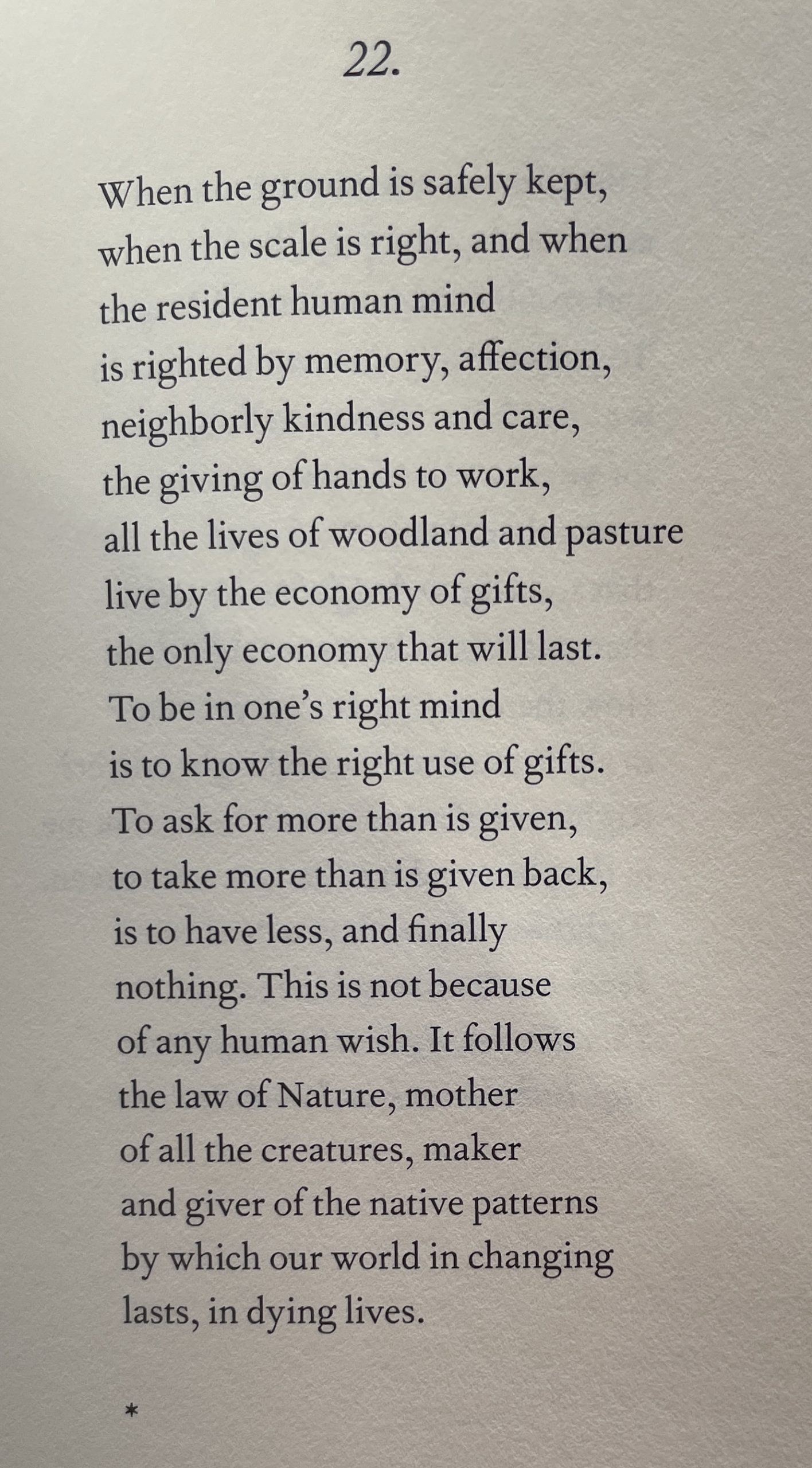
Berry, Wendell. Another Day: Sabbath Poems 2013-2023 (First Counterpoint edition. California: Counterpoint, 2024),59.
Verlyn Klinkenborg
“A garden is just a way of mapping the strengths and limitations of your personality onto the soil. It would be too much to bear if nature didn’t temper a gardener’s ambition or laziness with her own unsolicited abundance.”
Klinkenborg, Verlyn. The Rural Life. (1st Back Bay pbk. ed. Boston [Mass.]: Back Bay Books, 2004), 33
Thurs
Finished Adam Bede
For me it seems it’s the same with love and happiness as with sorrow — the more we know of it the better can feel what other people’s lives are or might be, and so we shall only be more tender to ’em, and wishful to help ’em. The more knowledge a man has, the better he’ll do’s work; and feeling’s a sort o’ knowledge. (482)
The beginning of hardship is like the first taste of bitter food–it seems for a moment unbearable; yet, if there is nothing else to satisfy our hunger, we take another bite and find it possible to go on. (458)
08022024: Obama Quote
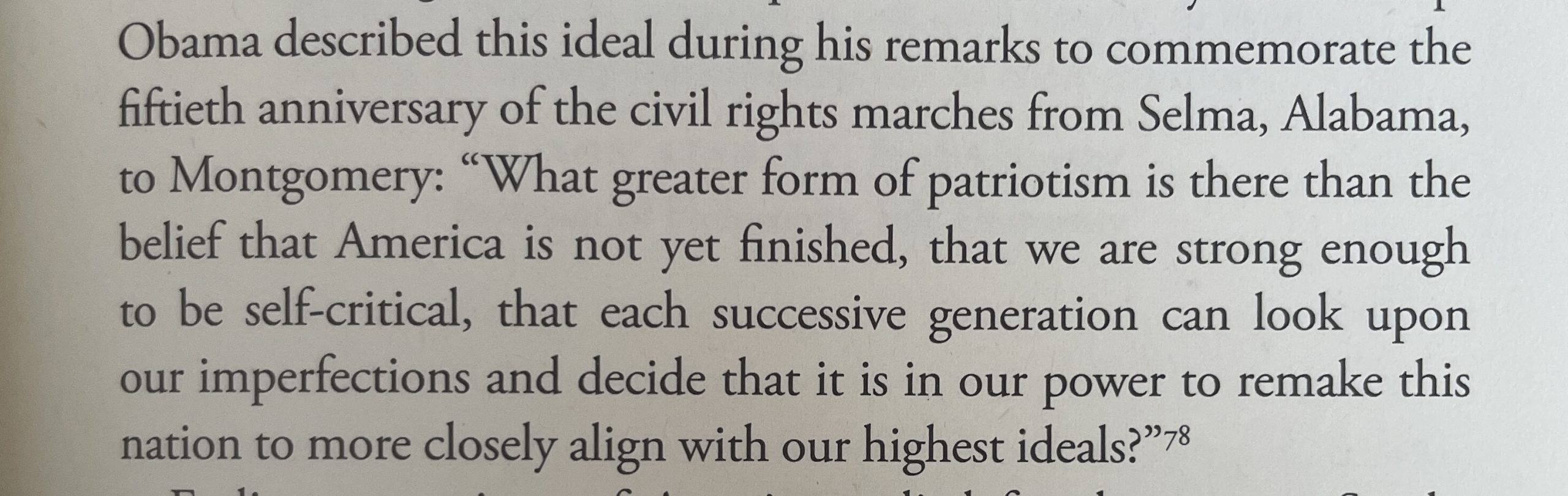
From one of the ten thousand books in this room I’ve checked out about misinformation and disinformation. Will find the citation later but like this as a conversation starter for the first history unit.
Silas Marner
Finished this, vaguely weepy, in the 52nd Street branch today.
Start with this one:
In old days there were angels who came and took men by the hand and led them away from the city of destruction. We see no white-winged angels now. But yet men are led away from threatening destruction; a hand is put into theirs, which leads them forth gently towards a calm and bright land, so that they look no more backward, and the hand may be a little child’s.
Eliot, George. Silas Marner: The Weaver of Raveloe. (Portland: Mint Editions, 2021), 127.
Wendell Berry, Andy Catlett
First passage:
Starting with those conversations so long ago with Aunt Sarah Jane, I have learned to understand the old structure of racism as a malevolent convention, the malevolence of which is hard to locate in the conscious intentions of most people. It was a circumstance that was mostly taken for granted. It was inexcusable, yet we had the formidable excuse of being used to it. It was an injustice both accommodated and varyingly obscured not only by daily custom, but also by the exigencies and preoccupations of daily life. We left the issue alone, not exactly by ignoring it, but by observing an elaborate etiquette that permitted us to ignore it. White people who wished to think well of themselves did not use the language of racial insult in front of black people. But the the problem for us white people, as we had finally to understand, was that we could not be selectively complicit. To be complicit at all, even thoughtlessly by custom, was to be complicit in the whole extent and reach of the injustice. It is hard for a customary indifference to unstick itself from the abominations to which it tacitly consents. But we were used to it. What is the hardest to get used to maybe, once you are aware, is the range of things humans are able to get used to. I was more used to this once than I am now. Berry, Wendell. Andy Catlett: Early Travels. ( Emeryville, CA: Counterpoint, 2006) 75-76.
Second passage:
Increasingly over the last maybe forty years, the thought has come to me that the old world in which our people lived by the work of their hands, close to weather and earth, plants and animals, was the true world; and that the new world of cheap energy and ever cheaper money, honored greed, and dreams of liberation from every restraint, is mostly theater. This new world seems a jumble of scenery and props never quite believable, an economy of fantasies and moods, in which it is hard to remember either the timely world of nature or the eternal world of the prophets and poets. And I fear, I believe I know, that the doom of the older world I knew as a boy will finally afflict the new one that replaced it.
The world I knew as a boy was flawed, surely, but it was substantial and authentic. The households of my grandparents seemed to breathe forth a sense of the real cost and worth of things. Whatever came, came by somebody’s work.
Berry, Wendell. Andy Catlett: Early Travels. (Emeryville, CA: Counterpoint, 2006), 93.
Protests and movements
Taylor Branch from yesterday’s paper:
“A movement is different from a demonstration,” said Taylor Branch, a historian of the civil rights era.
“It’s not automatic — it’s the opposite of automatic,” he said, “that a demonstration in the street is going to lead to a movement that engages enough people, and has a clear enough goal that it has a chance to become institutionalized, like the Voting Rights Act.”
Here is Ibram Kendi from How to be antiracist:


Ibram X Kendi, How to Be an Antiracist (New York: One World Books, 2019), 215-216.
Chalkboard in the fall
“The artist is nothing without the gift, but the gift is nothing without work.” —Émile Zola


