Category Archives: Quotes

Quotes from stuff I’m reading that I don’t want to lose.

GS, Again

I have read this story with my eleventh graders over the past three years.

Long passage below:

When you reach a certain age, you see that time is all we have. By which I mean, moments like those overhead geese this morning, and watching your mother be born, and sitting at the dining-room table here waiting for the phone to ring and announce that a certain baby (you) had been born, or that day when all of us hiked out at Point Lobos. Those baby deer, the extremely loud seal, your sister’s scarf drifting down, down to that black, briny boulder, the replacement you so generously bought her in Monterey, how pleased you made her with your kindness. Those things were real. That is what (that is all) one gets. This other stuff is real only to the extent that it interferes with those moments.

Now, you may say (I can hear you saying it and see the look on your face as you do) that this incident with J. is an interference. I respect that. But, as your grandfather, I beg you not to underestimate the power/danger of this moment. Perhaps I haven’t told you this yet: in the early days, I wrote two letters to the editor of the local rag, one overwrought, the other comic. Neither had any effect. Those who agreed with me agreed with me; those who did not remained unpersuaded. After a third attempt was rejected, I found myself pulled over, up near the house, for no reason I could discern. The cop (nice guy, just a kid, really, from my perspective) asked what I did all day. Did I have any hobbies? I said no. He said, Some of us heard you like to type. I sat in my car, looking over at his large, pale arm. His face was the face of a kid. His arm, though, was the arm of a man.

How would you know about that? I said.

Have a good night, sir, he said. Stay off the computer.

Good Lord, his stupidity and bulk there in the darkness, the metallic clanking from his belt area, the palpable certainty he seemed to feel regarding his cause, a cause I cannot begin, even at this late date, to get my head around, or view from within, so to speak.

I do not want you anywhere near, or under the sway of, that sort of person, ever.

Camus, again

But again and again there comes a time in history when the man who dares to say that two and two make four is punished with death. The schoolteacher is well aware of this. And the question is not one of knowing what punishment or reward attends the making of this calculation. The question is one of knowing whether two and two do make four.

Great Memoir

A memoir from a psychiatrist after forty years of treating people in Genoa. I had so many quotes I loved.

This is terrific advice for any new teacher:

Giulia, don’t plant your words in dry land,
in the wrong season
or when the field is covered in crows.
Store your words away for when the land is humid,
the season opportune and the crows faraway.

This is advice for all those looking for someone or something to blame:

How nice it would be to have a culprit at hand for all my problems.
But if you are born a cat, is it by any chance the fault of your
parents who are cats?
Being a cat is a tragedy, like so many other facts of life.

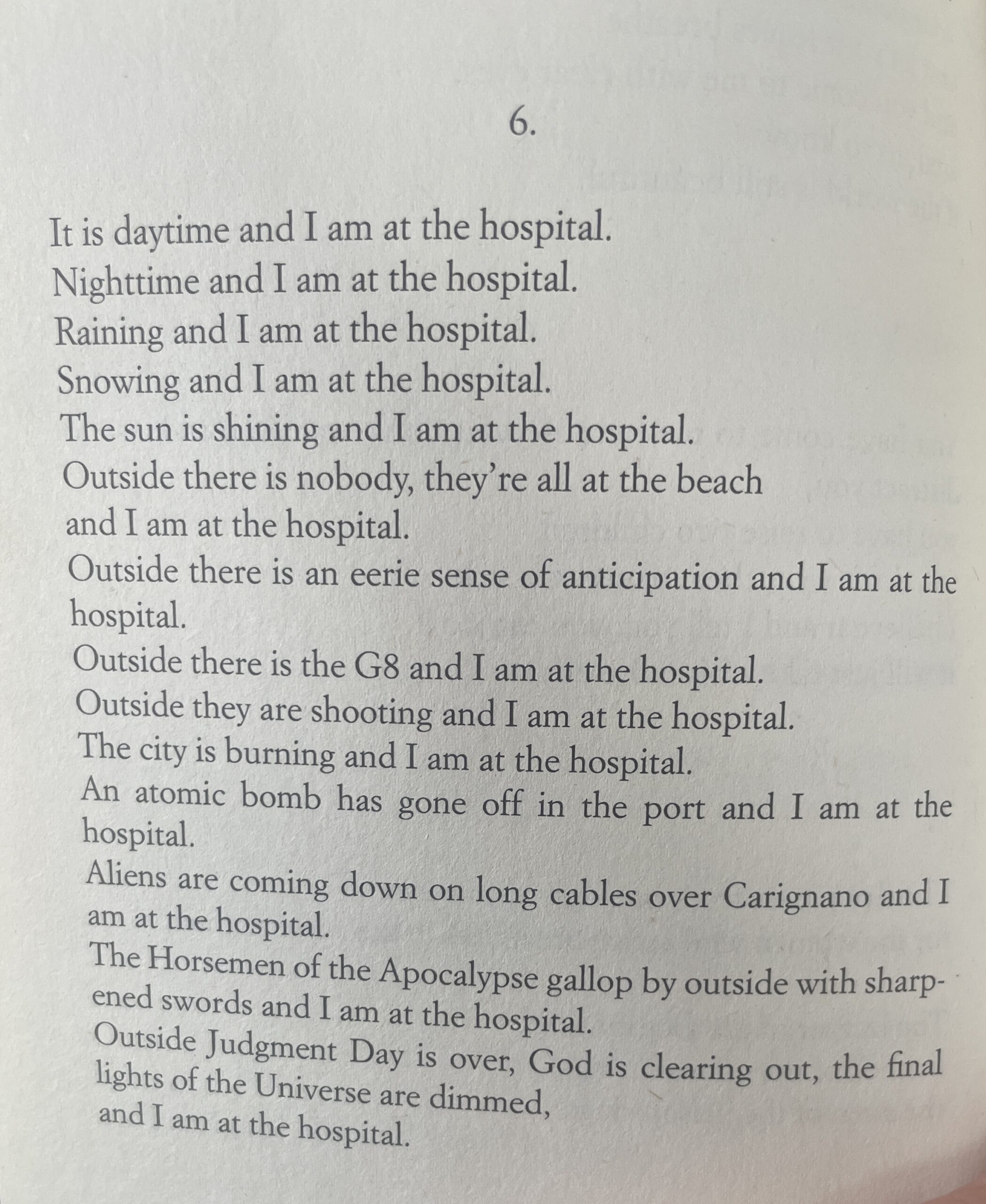
Finally, this section on being at the hospital could easily be written by any teacher. Too long to type, photo of text:

Milone, Paolo. The Art of Binding People. Translated by Lucy Rand. Europa Editions, 2023.

Two quotes from Aflame

This book made me uneasy. I liked a lot of what he had to say about silence and what one might learn from it. But who gets to have these experiences? Who can just drive down to Big Sur for a month? He knows this — it’s part of the book — but I just couldn’t stop thinking about it.

First quote: “When one keeps quiet, the situation becomes clear.” This quote is from Albert Camus.

Second quote, and maybe this goes to what I was saying above:

I’m lucky indeed to the have the time and money to go on retreat, I know, a luxury that most might envy. But riches are not so simply defined. Traditionally, the historian R.H. Tawney reminds me, humans were spiritual beings who, for prudence’s sake, took care of their material needs; nowadays more and more of us are material beings who, for the sake of prudence, attend to our spiritual needs.

I’d turn this into a series of questions: when you think about this moment (or day or week), what are you doing to take of your spiritual needs and what are you doing to take care of your material needs? What is the balance between the two? How much of your day is taken up with each? Do you have a choice in the matter or not?

Iyer, Pico. Aflame: Learning from Silence. New York: Riverhead Books, 2025.

From The Sorrows of Young Werther

All the high-flown schoolteachers and tutors agree that children do not know why they want; but that grown-ups too tumble around like children on the face of earth, not knowing where they come from or where they are going, acting as little from true purpose, and just as ruled by biscuits and cakes and birch rods: no one really wants to believe that, but it seems to me something you can grasp with your hands.

Goethe, Johann Wolfgang von, and Burton Pike. The Sorrows of Young Werther. New York: Modern Library, 2004.

Stone Yard Devotional

“I used to think there was a ‘before’ and ‘after’ most things that happen to a person; that a fence of time and space could separate even quite catastrophic experience from the ordinary whole of life. But now I know with a great devastation of some kind, there is no before or after. Even when the commotion of crisis has settled, it’s still there, like that dam water, insisting, seeping, across the past and future. “

Wood, Charlotte. Stone Yard Devotional. Crows Nest, New South Wales: Allen & Unwin, 2023.


Gloucester

These late eclipses in the sun and moon
portend no good to us. Though the wisdom of
nature can reason it thus and thus, yet nature finds
itself scourged by the sequent effects. Love cools,
friendship falls off, brothers divide; in cities, mutinies;
in countries, discord; in palaces, treason; and
the bond cracked ‘twixt son and father.

This villain of mine comes under the prediction: there’s
son against father. The King falls from bias of nature:
there’s father against child. We have seen the best of
our time. Machinations, hollowness, treachery, and
all ruinous disorders follow us disquietly to our
graves.

Act 1, Scene 2, 104-115.

Lear Again

Poor naked wretches, whereso’er you are,
That bide the pelting of this pitiless storm,
How shall your houseless heads and unfed sides,
Your lopped and windowed raggedness, defend you
From seasons such as these? O, I have ta’en
Too little care of this! Take physic, pomp,
Expose thyself to feel what wretches feel,
That thou mayst shake the superflux to them
And show the heavens more just.

Frederick Douglass (1894)

Call to mind the sublime and glorious truths with which at its birth, it saluted a listening world. It announced the advent of a nation based upon human Brotherhood and the self evident truths of liberty and equality. Apply these sublime and glorious truth[es] to the situation now before you. put away your prejudice, banish the idea that one class must rule over another, recognize the fact that the rights of the humblest citizen are as worthy of protection as are those of the highest and your problem will be solved.

Full speech here

Excerpts here

F Douglass Papers