1998

Woke up at 3:10 AM.  Damn.

Cleared the inbox, planned a bit of the day, paid the bills.  Then the internet got me and I started digging around on the old website.  Found an on-line journal from my teaching at WPHS (ca. 1998).  Here are the four quotes I featured on the opening page:

“The interest of the oppressors lie in changing the consciousness of the oppressed, not the situation which oppresses them.”
Paulo Freire

“Knowledge emerges only through invention and reinvention, through the restless, impatient, continuing,  hopeful inquiry human beings pursue in the world, with the world and with each other.”
Paulo Freire

“The displacement of the idea that facts and evidence matter by the idea that everything boils down to subjective interests and perspectives is — second only to American political campaigns — the most prominent and pernicious manifestation of anti-intellectualism in our time.”
Larry Laudan, Science and Relativism (1990)

“We must learn to enter the classroom “whole” and not as “disembodied spirit.”
bell hooks, 1994

Three thoughts

We often have guests through our building.  Sometimes it feels like too many guests.  It’s always a good moment, though, as a teacher/co-founder when the students describe our place in such awesome ways:

“Don’t make them do the work, make them want to do the work.”

“It’s easier to learn when you feel good.”

We’re “actually connected to our community through our projects.” 

It’s funny, too, that students describe our place as a community but focus on the fact that we do a weekend update every Monday as the way of describing how we make a community.   To me, it’s simple humanity — how was your weekend — and the other daily activities are much more valuable in building the community.  The way we learn to talk and listen to each other, to respectfully agree and disagree, to debate and deliberate… all that occurs during the work.  And because we’re “actually connected to the community”,  these conversations become real because they actually  matter.


It’s working

Monday.   Mondays suck.

We’re beginning the new process of designing our own projects.   There’s a group of thoughtful young men who want to do a video that explores police brutality and the interactions they’ve experienced with the police.  It could be an amazing project.

Last year we wrote plays.  (One of the plays was a first place winner in a regional playwriting contest).  Before we started the plays, though, we had to research the topic it would be based on.   We constructed “dossiers” of their research that they then used to write their play.   It was hard work and most kids struggled with it.

But today, today, today, one of these fine young men said the following:

“hey, what if we made a dossier for this project.  We could collect all our research there.”

If all they took from last year was that it’s important to gather your research in one place and then synthesize it before you start a project…I can live with that.


Why we do this work this way…

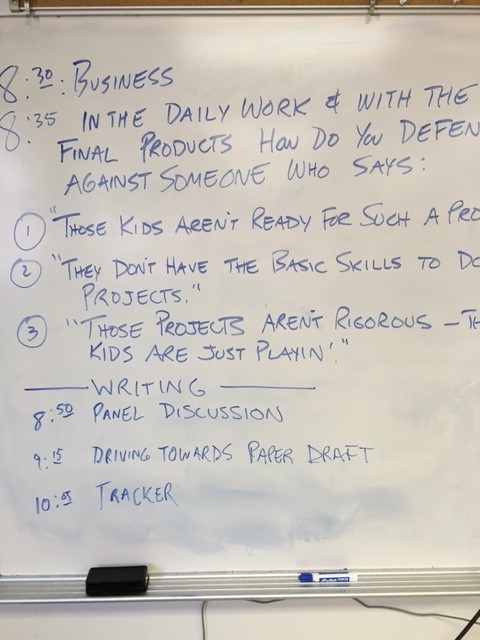
As their self-designed projects slowly round into shape — second drafts due tomorrow — we did some writing in defense of the project process followed by a debate where they had to stand up against the curmudgeons of the world.   Here are a number of great quotes from their writing:

If you think that project work is just playing, come spend a day there and you will most definitely see differently.  JH

We know how to solve real world problems and how to handle difficult situations.  JJ

The only issue (with creating their own projects) now is motivation.   ES

The only way (students)’ll learn is by experience and with that experience they can produce even better projects that will not only represent themselves but the school as well.   JR

The (students) who play do not define the students who don’t.  JR

Words don’t mean anything unless you can show proof.  TD

If we have an idea, (the teachers) help us turn it into reality.  JG

Look at the trackers to see what they did that day.   TC

Your mom isn’t ready for this project.  IB

IMG_4651

My answer to the second question (always do what you ask the kids to do!)

That’s true.  Many of the students are missing basic skills.   But the only way kids “catch up” is when they want to catch up, when they realize how far behind they are.   You can’t give or install basic skills; they develop when folks are motivated.   School, then, becomes a place where they realize the basic skills they might lack and try and build them because they need them in service of a project.


The twig

The books you read as a kid never leave you.  I read and re-read Lloyd Alexander’s Chroncles of Prydain.  I still find them in my kids’ rooms and read them over, mostly books four and five.

There’s a critical scene in book five when a small group turns away what was supposed to be an unstoppable army.   In a sad moment, a dying man notes that they were “the twig that turned the flood.”

Sometimes I feel like I’m Kevin Bacon in Animal House getting trampled.  Some days though, some magical days, I’m standing at a river that I’ve managed to turn with a small twig.

Confucius via Wendell Berry

“If a man have not order within him, he cannot spread order about him.”

I gather this comes from Ezra Pound’s translations, although I’m not familiar enough with this literature to tell if this is real.

Great mantra for teachers thinking about their own practice, though.


Kids say the darndest things

Yeah, so it was a radio show and then a television show and then a show hosted by a disgraced Philadelphia comedian. Today, though, I was thinking about the kinds of comments students start to make when the work begins to get difficult.  There’s always a grace period, a honeymoon period, a fun “hey this project is cool” period at the start of a project.  As Dr. Malcolm notes,

“Oh, yeah. Oooh, ahhh, that’s how it always starts. Then later there’s running and um, screaming.”

Today was one of those days when you felt the tension of the work becoming real and difficult.  I wrote these on the board as I heard them and on random scraps of paper.

“I don’t like words.”
“I know, I know, but that’s hard.”
“But I’d have to do that after school!”
“I’m not doing that.”
“I know I should, but that’s hard.”
“That’s like extra work.”

It’s a measure of my growth as a teacher that I can hear some of these statements and not lose my mind.  Some of these are attempts to push buttons and I can feel them as such (and ignore them).  Some of them, though, are real statements of frustration as students realize that this is past the worksheet, past answering the odd problems, and past just pleasing the teacher.

And it’s real. Any work that’s not just following a recipe or a repetitive task creates the same angst.

Part of the way we’re trying to solve this problem is by orienting the work towards the outside world.  I wrote papers in high school because my teacher told me to and because if I didn’t, I’d get a bad grade.   You can’t eliminate this part of school.  The difference for us is that if we’ve made the project as authentic as possible, as focused on the real world as possible, then the student feels (or hopefully feels) the pull of doing something that actually matters.   For this project, if we do it right, they will have begun a catalog of community organizations that ninth and tenth graders can read about and formulate possible projects.  We’ve made clear that their work will be shared with the entire school as well as the organizations they’re writing about.  If successful, they have something they’ve made, something that might make the school and maybe even the world a bit better.