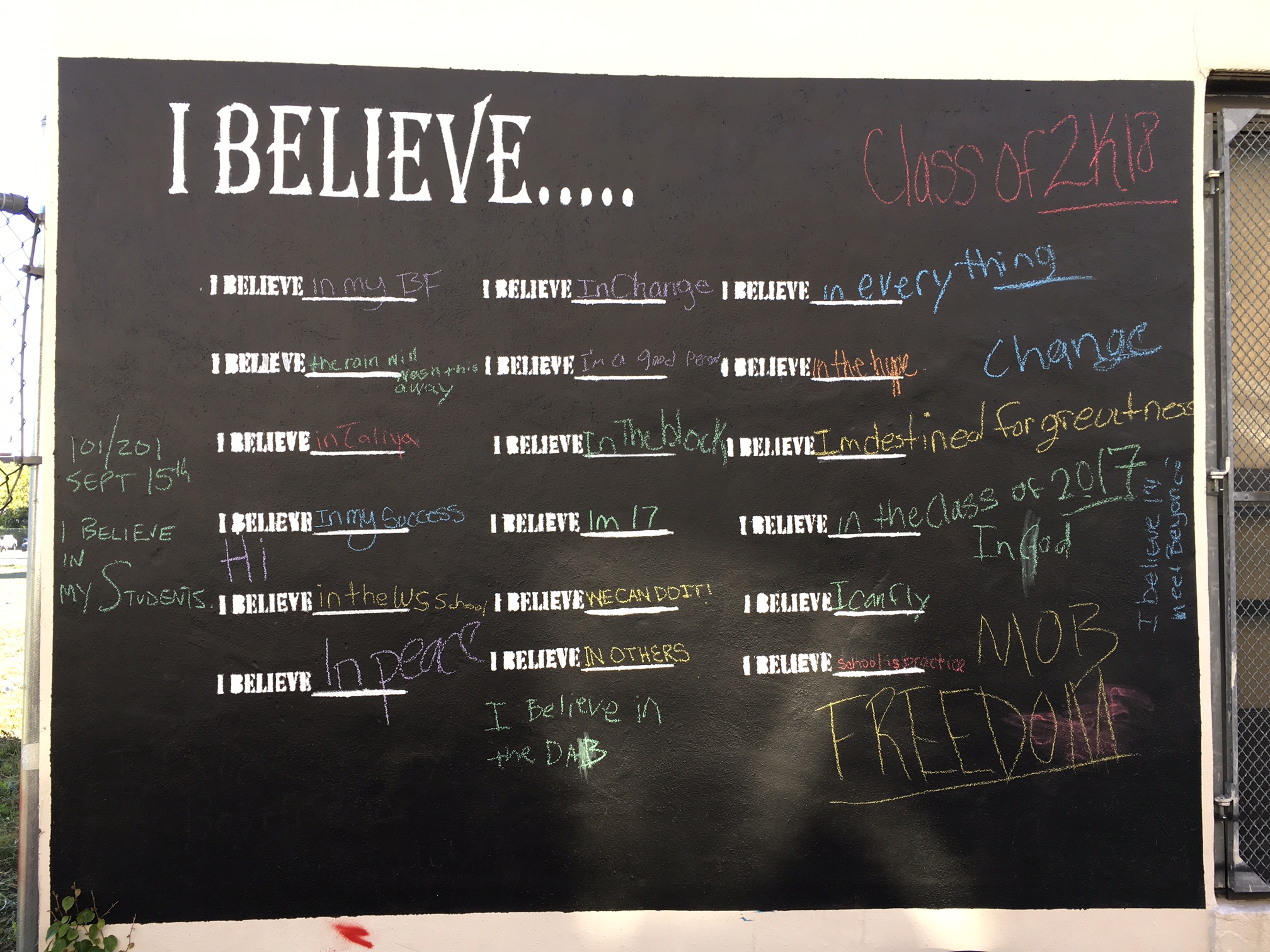
Last year Senior CR constructed an “I believe” mural on the outside of our building. It was the centerpiece of this morning’s circle.
What you want from your work together: things that get used over and over again.

Last year Senior CR constructed an “I believe” mural on the outside of our building. It was the centerpiece of this morning’s circle.
What you want from your work together: things that get used over and over again.
I was thinking this morning about my group and the weeks we’ve had together so far. You live long enough and you do enough different things and you realize how rare it is to be with a group that shares a common purpose and cares about each other. As such a group develops, it makes the hard work, the crappy but necessary work, that much easier.
I had a few classes like this in high school (thank you Jean St. Pierre) and a couple more in college and graduate school. More often, though, when I had these experiences it was a club, a so-called extracurricular activity, or a post-work activity.
Teaching, though, means that I have to find ways to foster deep and authentic intentions regarding the work. I know that the more purpose I felt — let’s make this team awesome, let’s play out as a band, let’s build this organization — the easier it was to grind through the hard parts.
And I have to make sure that the group coalesces in a way that they start to pick each other up by reminding them why we’re doing what we’re doing.
“Human beings doing something cool together” sums it up.
Our school is highlighted about 2/3 of the way through the video. Definitely a cool overview of an important topic…
This article describes how one reporter has struggled with the ways in which Americans communicate with each other at this point. There were a number of killer insights but several stuck out:
In recent years, in my reporting, I’ve come to uncool conclusions. For one thing, I’ve begun to think that instilling public purpose into private communities is the hardest thing in the world.
I’ve increasingly found myself a supporter of messy public process: the legislation pushed through government slowly, in curtailed form; the interminable, fruitless-seeming town-hall meeting; many of the government’s lumbering, error-prone efforts at regulation. These processes are cumbersome, often wasteful, and inevitably infuriating. But at their best they have the virtue of occurring in a common arena, the place where all parts of a population meet. They force us, if we hope to get anything done, to translate our values and thoughts into language that communicates broadly. The more I observe, the warier I grow of privatized efficiency: in time, it indulges clannish thought. Let’s drive our language out of private circles, back toward the public sphere.
What I appreciate about this latter idea, particularly as a teacher, is that Heller is trying to move us back to the circles where you have to get something done. For example, if you want safe water, you’re going to have to meet with a lot of different stakeholders. Getting all of those individuals and institutions to agree on something let alone change their behaviors and policies is going to require a lengthy process, one that’s, in Heller’s words, cumbersome, often wasteful, and inevitably infuriating.Or you can retreat to a closed, private space, say an on-line community, where you can develop your own language and vision in essential isolation and then lament why nothing seems to change.
We have no shortage of green/nitrogen waste. There are leaves for a portion of the year but I can’t count on them and I’m not a huge fan of the dust that’s on our street.
So I shred the daily paper and dump into into the compost. I was worried about any toxic components but here’s what the research/ google search revealed:
Newspaper is safe to compost, but it breaks down quite slowly because of its high lignin content. (Lignin is a substance found in the woody cell walls of plants, and it is highly resistant to decomposition).
Most newspapers today use water or soy-based inks. Although these may contain small amounts of toxic compounds, the trace levels are not of significant toxicological concern.
Planet Natural, considering the same question.
I’ll continue to do this. I like the idea of digesting the news twice…
My dad often sends me boxes of stuff from my childhood. As he apparently saved everything, a tendency I’m not unfamiliar with, I got all of my report cards from 7th and 8th grade, every single note written home (teachers had great penmanship and wrote incredible thank yous), and every newspaper article that mentioned me. As the Reading Chronicle tended to list every child in every event, from basketball to cub scouts, from drama to school band, there’s a pretty big pile.
In this pile of stuff was this xeroxed sheet. Don’t know where it came from. Don’t know how or why it got into my junior high pile. But it’s a pretty great image for a teacher who does project based learning for a living.
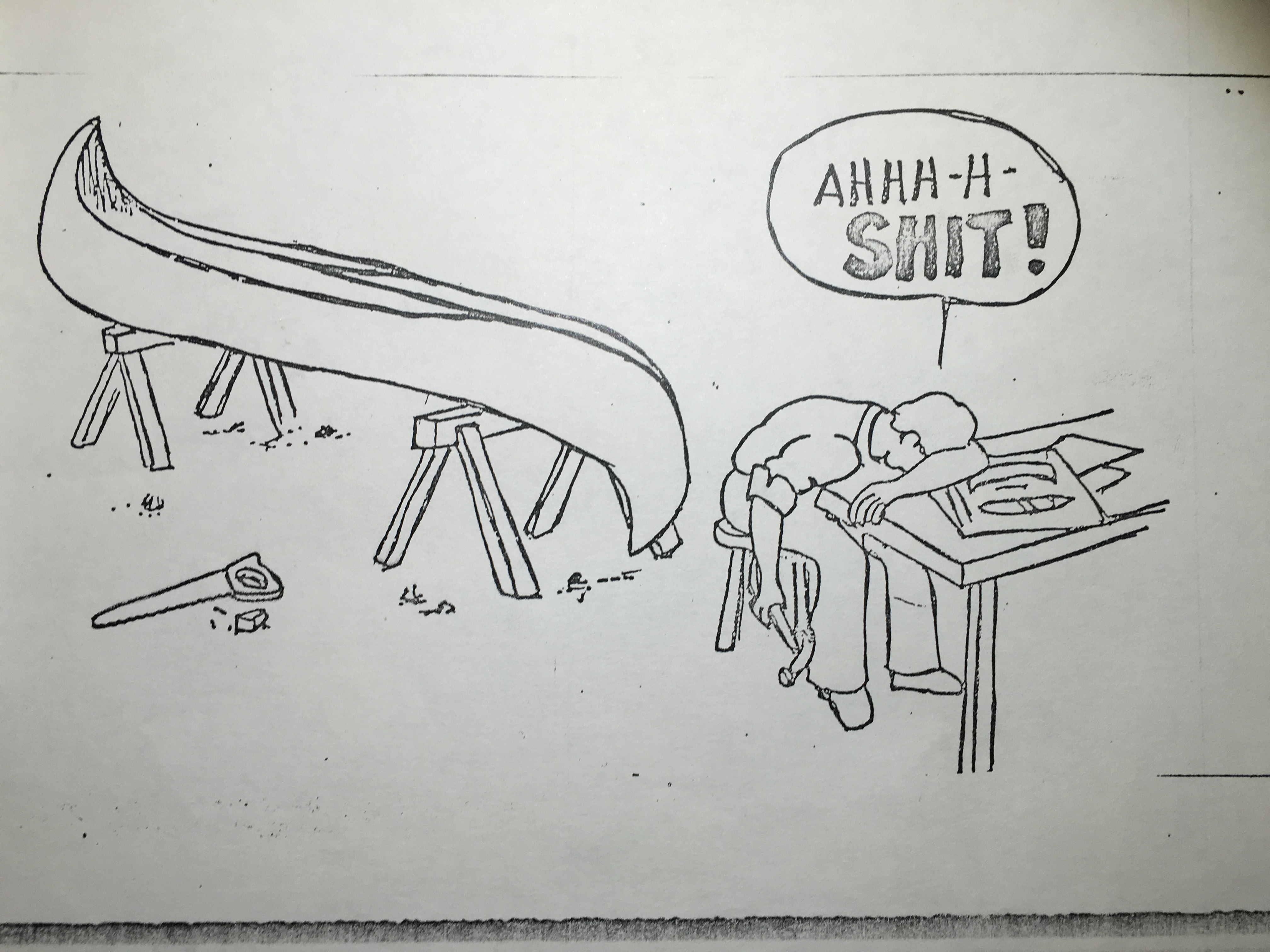
How many times have I had my head down and lost track of the big picture? How many times have I mixed directions up and thought it can’t be that big a deal? How many times have I turned to look at a “finished” product only to see total disaster?
Love it. Thanks Dad.
From 1871 Scribner’s. Hooray Google Books!
About twenty years ago I bought a bike from a friend of my brother’s. He was trying to get a custom frame shop off the ground and he built me two frames from Columbus El/OS steel.
Great bikes. Many fun miles.
I realized that my seat was not moving up and down as well as it should this weekend. I also realized that I hadn’t greased the seatpost in too many years.
Pulling it out was difficult. Really difficult. Really difficult.
Here’s the rub. I have a Thompson seat post (SP-E124) 28.6mm x 410mm, model number 12263.
The seat tube opening, no compression, is at 30.25mm. (The clamp ring is welded onto the frame.)
Problems:
The current shim is 50mm long. From what I’ve read, you want the shim to extend past the joint of the seat tube and the downtube. This isn’t even close. I need a longer shim, say 100mm.
The current shim has walls that are 1.3mm thick, which I think is the major problem. If the post is 28.6 and the shim adds 2.6mm, I’m at 31.2mm. No wonder it’s tough to get in and out. I need a thinner shim, one that takes me from 28.6mm to 30.25mm; basically one that adds 1.6mm to the post.
Looking at various bike supply sites, a post at 28.6mm seems to have gone out of style (they’re not made any more), so it doesn’t seem as though I can buy a ready made product. I’d also note that Thompson seems to be pretty clear that they don’t recommend using a shim with their posts but that ship has sailed.
Question: what would be the problem with buying this product? It would get me really close to the right width (30mm). Would it be wide enough? Would clamping make up the difference? Would it rattle in the frame?
I realize I’m trying to solve a problem created within the design. But I really just want to ride my bike without worry.
It’s that time of the year where your curriculum and proposed projects shine, untouched by actual students or the reality of life in school. We start working with our staff tomorrow, starting the community building process and introducing everyone to the Workshop Cool Aid. Oh yeah.
I’m going to begin with an icebreaker/circle activity where the group answers the following questions:
What’s your name,
what’s your grade/Position,
where have you been,
and where are you going.
I’ll make clear that they can answer any way they want, from the most literal — I’ve been to the coffee shop this morning — to the most figurative — I’ve been to the mountaintop. After we’ve gone around once, I’ll ask for a few folks to talk about the role of the Workshop School in one or both.
If one of the primary points of the opening day is to underscore how our place is different, I hope this activity asks participants to think about how they got here. Short trip? Long trip? Bumpy ride? Smooth ride?
Also part of this process is the question of how our place will help students (and staff) think about how this school will help them get where they’re going.
I like these questions so long as I make clear that they can be as high-stakes and low-stakes as people want them to be; anyone can answer and feel like they can answer without feeling vulnerable (the opposite of what was the last great book you read or questions like what was the biggest challenge you face?) Everyone has a chance to participate in the circle.
Variation one: Play Johnny Cash version of Hank Snow song, I’ve been everywhere. People would then make as long a list as they could of where they’ve been.
Variation two: Play JC song and then have folks make a list of all the schools they’ve attended, one after another.
Variation three: Have people make the list of where they’re going in the future, place after place.
Variation four: After each person says where they’re going, the person next to them describes how they’re going to help them get there.
Variation five: Have a map for folks to put a pin on all the places they’ve been. Give them one pin for a place they’d like to go.


