
Monday Morning Walk





This is what I have been thinking about while walking to school over the past week.
It is advice. This is just that. Portions of it are stuff you already know. Portions of it might be reminders of things you know but need to learn again and again. Portions of it will seem totally irrelevant. Portions will seem feel grimy as you’re like, oh, right, gotta do that. No matter how clever the SNL writers are, don’t succumb to y’all won. At least not yet.
Fault line one: I’m as tired as my students
“I’m just tired and bored with myself.”
This is the time of the year where all of the rituals you’ve built pay off. The habits and classroom culture that you’ve inculcated and created are humming along and ensuring the successful work within the space.
Others structures have failed and you’re having that dreadful, “damn, I’m still dealing with this” feeling. You know it’s coming.
You’re not going to fix anything right now. I said this to someone yesterday about the culture in my four classes: three are planes that I got to 40,000 feet and if we’re experiencing some turbulence, well, that’s just the way it goes. We’ll be fine and I have lots of margin of error. The other stream is dusting tree-tops and one bad move is going to take us to the ground.
Each year of teaching I get better about the rituals and routines. And each year of teaching, there will be holes that are readily apparent. When the holes are visible in September, I can patch them. In December, it’s that much more work, but I have to do it then, or I’m in for a rough year. In May, I have to breathe through it, because I’m going with what you got.
You know when a team makes an improbable run to the World Cup semis or finals? Alas, by the time they get to the final game, they’re down two or three key players on injuries or cards, and they’re not a deep team anyway? They don’t give up — they play the game and hope for the best. That’s where we are right now. (Wow, in this morning’s edition of “let’s practice our cliches” I’m getting an A.)
Fault line Two: The grade situation
3 Bs —> am I really earning an A?
3 Bs —> am I really going to drop to a C?
3 Fs —> am I really going to pass?
There are more versions of this problem but it boils down to the dilemma of the cumulative grade. Our school has a policy that if you earn three points, you pass for the year, so a kid can earn a B first quarter and do nothing for the rest of the year and still pass. Or a kid can do nothing for the first three quarters and then try to build a case for a D by earning a B. This produces strange bits of stress as kids who have been disengaged all year about the work suddenly turn into Eddie Haskell, making sincere (and insincere) requests about their grades. There’s usually just enough of this that you need to have some mechanisms to contend with it.
Fault line Three: The schedule situation
All manner of garbage gets dumped on schools and teachers at the end of the year: trainings, standardized testing of all sorts, weird schedules. Then there’s the positives — proms of all sorts, inside your building and out, graduation, and general celebrations of one kind or another. And when everyone in the building is doing their own special thing, it makes for wonky scheduling if things aren’t coordinated. Some of this goes back to the “you’re as tired as they are” problem as administrators are every bit as exhausted and have their own ashtrays to drink from. But these aren’t the days of November or March where you have long stretches of five day weeks where you’d give molars for a break; it’s the opposite problem as you keep watching days get picked off in big ways (testing, sorry, nothing today) or small ways (hey, do you mind if I pull eight kids from class with no notice to do something really cool? Yeah, I’m making it so that you have too many kids for a quiet work period but enough are out that you can’t really move forward. Sorry about that.)
Remedies
In offering remedies, I know I’m doing the old “rub some butter on it” thing. And I know that each of them has a low enough success rate that you have to try all of them. With each of these, I’m trying to think about them as different hats I might wear while knowing that the hit-rate is going to be low, low, low, and that I’m just trying to do the best I can.
Being a motivator and an inspiration
One thing I try and do all year is to complete the same projects the students are doing. I hope that by doing it next to them or near them, I’m modeling the point of the project. I can talk of my own frustrations, how I’m managing roadblocks, and illustrate one annoying bald man’s approach to the work. Doing this also allows me to see how kids might get stuck on various problems.
It’s not in my nature but I try, I try, I try to remain as positive as I can in urging kids towards the finish line. For all of those with negative wiring (cast as Hamlet and asking who writes this shit?), please, please, be aware of it, and censor your commentary. Clapper, I’m talking to you — this is the time of year where your commentary can have a nasty edge on it so keep your remarks to yourself.
Trying to appeal to the nature of the work
(live the life of the mind or don’t)
In a project-based space, underscoring the authentic nature of the project — hey, we’re doing something real, something that scholars and activists would recognize — can serve as a kind of motivation. This will not work in social situations, especially in large group situations, as kids are easing their way into the end of the year process of either golden aging things — remember in first quarter when we were doing real projects — or fouling their nest — this class just sucks — and in each case the larger social setting will generally skew negative. A large portion of students still want to have cool conversations with you alone and have excellent work to talk through and that same student will be publicly declaring they’re going to drop out.
Setting up the work in more of a checklist form, such that if you complete the checklist, you’ll always have something and the kids who want to do more can do more.
If you’re building out projects, you offer multiple pathways to success, and you provide lots of support along the way. And you do your best to create projects that foster engagement, that kids actually want to do, that even the most reluctant learner can see some value in doing it.
However, this is the time of the year where your assignments have to be as clear as possible so that kids can at least try and checklist things, and then you can hope that this will give them momentum to take it somewhere else. For some kids, breaking things down this far allows a kind of relief — ah, I have to work forty minutes and then I’m done — and for other kids it creates a starting point that they will swiftly blow past it once they get started. You’re just hoping that they get started, as if a project is the top of a slippery hill and if they get a little push, the project itself will gain momentum.
Clarity on grades
I don’t like appealing to grades. It doesn’t feel great and it doesn’t usually do much. The kids who are living in transactional world, where they’re just trying to figure out how much they need to do to earn an A or a B, well, most of the time those aren’t particularly enjoyable conversations. I also don’t have much interest in the “you’ve failed all year so let me give lots of my limited energy to you now to try and get you across the finish line” conversation. I hope most schools don’t engage in this sort of thing — hey, you’ve done nothing for three quarters, fog a mirror in the fourth quarter and we’ll give you a D — but I think most do.
There’s a small group where this will work, particularly in the “let’s get you from three Bs to an A” crew. The real point, though, is to remember that it’s worth checking in every other week to make sure that the students are on the same page as you are, i.e., your Canvas grade is an 84%, which is a B, not an A, and not a C.
Get it in writing
For a portion of this year, I was convinced I had long COVID as I couldn’t remember anything. Maybe it’s stress, maybe it’s age, but I cannot keep track of conversations these days. (My children make fun of the fact that I cannot park the car with loud music on.) In September, but especially in April and May, insist on students sending you any and all requests and concerns in writing. If possible, insist that they cc advisors and/or parents.
I know, I know: between emails and Canvas notifications and comments on documents, your inbox is completely overrun and unmanageable. I know. But the alternative is worse, when kids ask you to do things and you simply don’t remember because forty kids asked you to do something that day.
Being as organized as you can knowing that they will not be.
I’m doing a great job right now with the final deliverables. But I’m day-to-day on the classwork and homework.
Whiny disclaimer — it’s because I try and revise each year.
Appropriate rejoinder: that’s not an excuse, you should be two to three weeks ahead in Canvas.
Enraged response: with what time? When is that happening?
(This is why people cross the street at 7:18AM when they see me on the sidewalk talking to myself.)
Starting next year’s folders
This helps you the teacher, but only helps the students inasmuch as you are not trying to dramatically shift this year’s class, just thinking about a different map for the following year. Who isn’t a great teacher when the year hasn’t yet begun? Doesn’t a clean folder structure make you feel better about the world?
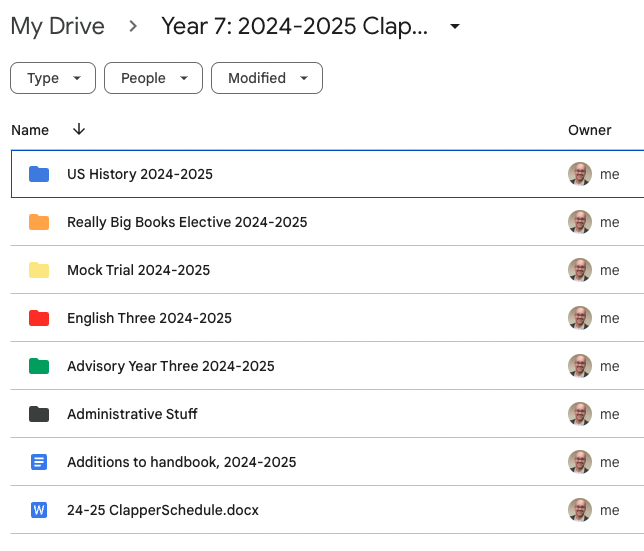
One document I start each year is the “additions to handbook” piece where the guide to a particular class, the expectations, etc., are all laid out. You can’t change this midyear and certainly not at the end of the year, but as schooling and your children evolve, you have to come up with new things. And there are gaps that you’ve realized you need too fill. If you have a running document that you’re adding to, it’s a helpful for the following year, and it helps you avoid the temptation of trying to take that on in the moment, which will certainly not serve you well. Another thing writing in these documents does is help you not to address things that are going wrong when you’re tired and bored with yourself.
Celebrating as much as you can
If you do authentic work, it’s not easy. Point this out as often as possible: we’re not doing busywork, we’re not doing word searches, we’re not memorizing with the intention to forget what we’ve memorized the next day. We’re trying to do real tasks together so let’s get it done.
Last Thoughts
None of this solves how hard the end of the year is for students and teachers. But it’s what I’m thinking about this week on my walks to school.



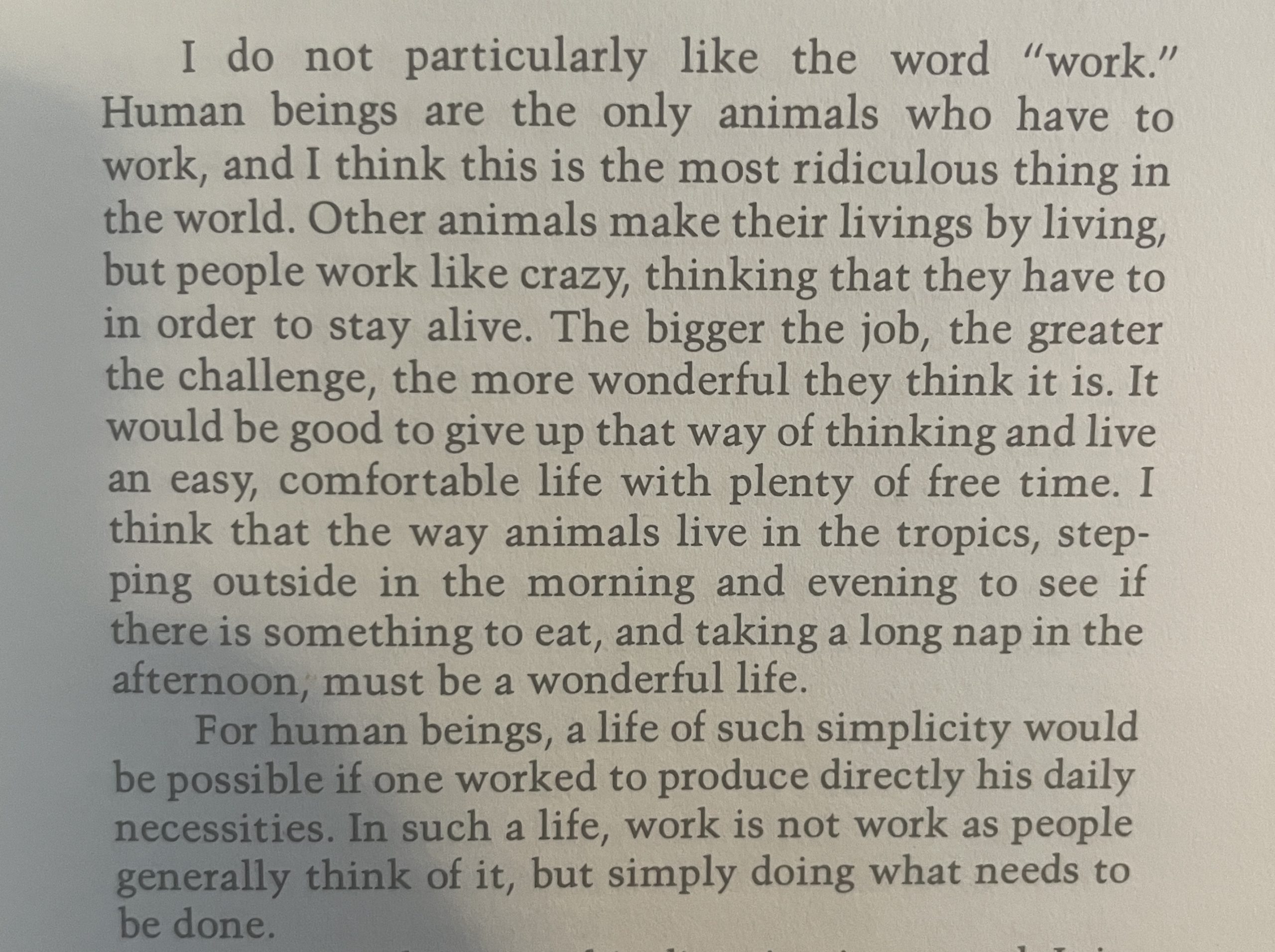
“Treat one strand of straw as important and never take a useless step.”
Fukuoka, Masanobu. The One-Straw Revolution: An Introduction to Natural Farming. Edited by Larry Korn. Translated by Chris Pearce and Tsune Kurosawa. New York Review Books Classics. New York: New York Review Books, 2009.


