


Note: if you have the money to drive a Lexus SUV, you have the resources to not be dumping your Christmas tree in Clark Park. Shame on you, person doing that this morning.

Church sign of the day

Not only do charter schools have advertising budgets, they can place ads like this. I, too, had a 100 percent growth in my savings account last year. But I started with $5.
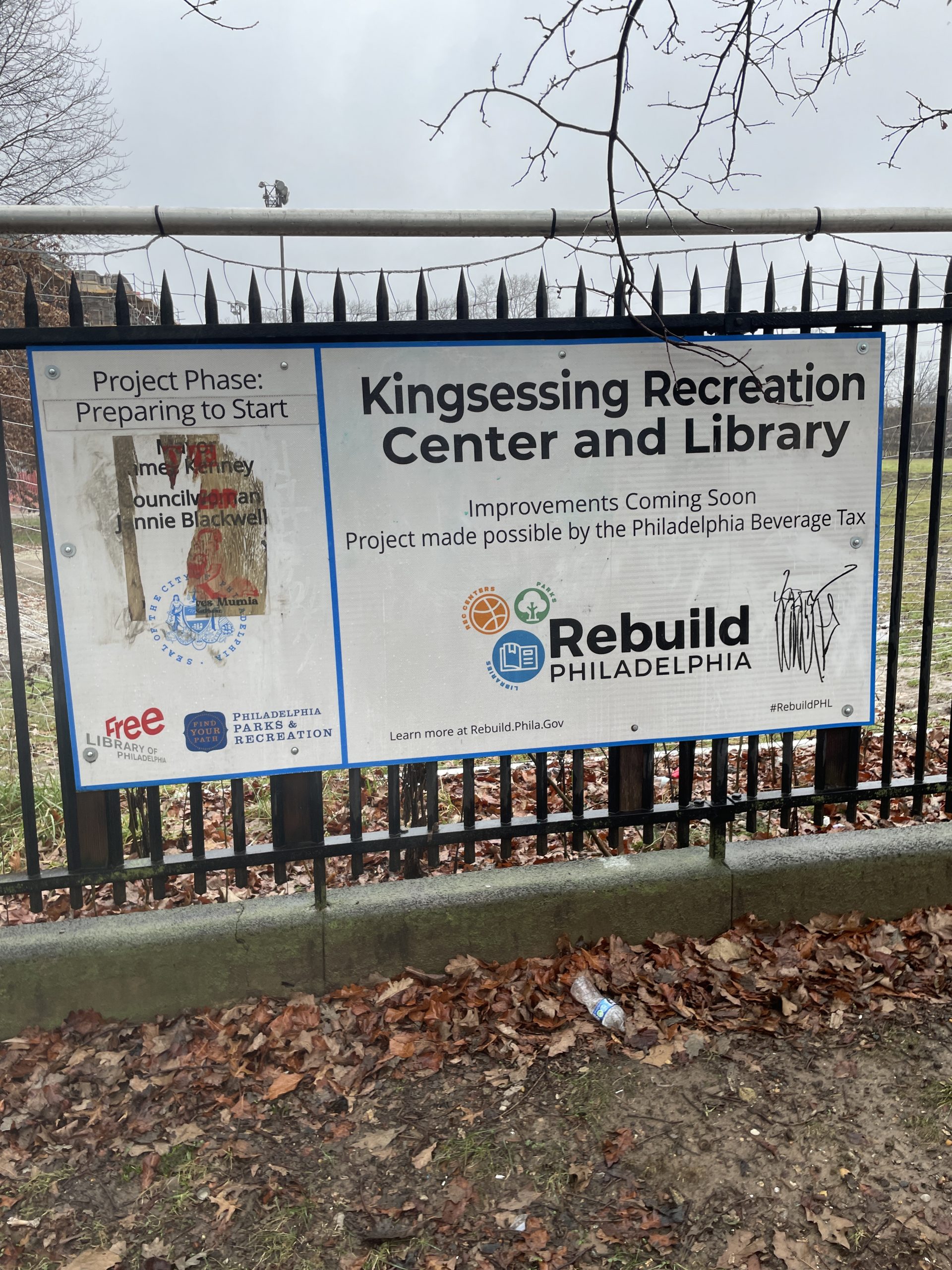
Telling in its own way. Jamie Gauthier replaced Jannie Blackwell in November of 2019.
This is psychologist Gloria Mark talking on Ezra Klein’s show:
We’ve created a culture where to pull ourselves away signals that we’re not working. I think that managers and decision-makers need to be educated that it’s really important to give people permission to be able to take long breaks when they need them, to take walks outside, to have social interactions with other people, to create a culture where people are not penalized for not answering electronic communications after work hours and before work hours, to give people a chance to really detach from work, to restore themselves. Managers are delegating work to us without considering that people might be exhausted. And they need to understand that sometimes less can be more.
It got me thinking about how organizations, even when the leader is doing their best, allow this kind of culture to exist. Much of school life now seems to be predicated on making sure that detaching or pulling away never happens.
Long breaks? Let’s make sure teachers have two, three, four classes in a row. Let’s ensure that they have multiple preps. Let’s make sure that there are never enough subs so their breaks are consumed covering other classes.
Here’s the story I tell about this: at my old school, for two years, we had a nurse once a month. A kid’d come and say, “I’m not feeling well” and we’d say, “Come back next Tuesday.”
The school district doesn’t have enough and relies on everyone in the building tending to everything. So the kind of extended time and space necessary to do anything creative does not exist.
Walk outside? Even if that was possible — usually the times when that might be possible get consumed early in the week — we’re not supposed to leave the building without clocking in or out. Remember Laverne and Shirley? Or Charlie Chaplin? That’s teaching in 2024.
Kronos waits. Kronos watches. Kronos knows.
Social interactions? When is that supposed to happen? During my preps, here’s what I’m usually doing:
40-50% of the time: trying to have enough headspace to offer timely feedback on powerful assessments kids have submitted.
20-30% of the time: trying to make sure that my plan for the next hour, day, or week, builds on what we did yesterday and on the interesting tangents that occurred today.
10-30% of the time: consulting with students around various things, sometimes academic, sometimes personal, sometimes fun. If I am talking with a colleague, more than likely it’s about another student.
10-30% of the time: operating clubs because our particular roster makes after-school programming difficult.
10-30% of the time: answering emails and Canvas comments.
I’m failing to complete most of these tasks. I’m failing. So I’m filled with anxiety about what’s left undone.
So when’s that fun, water-cooler, how are your kids, what’d you do this weekend going to happen?
To create a culture where people are not penalized for not answering electronic communications after work hours and before work hours.
Ha. The only way this is possible is if you elect not to look at your email knowing two things: either your principal is going to have to defend you from a parent wondering why you didn’t write them back OR you’re doing to have to use that same prep time that’s already committed to ten other things to answer email.
The third option, which a number of teachers now employ, is the Ford Pinto option. Never answer your email. The two to three percent of situations that blow up are better than addressing the fact that you get thirty to fifty emails a day. And you’re free to not worry about email.
To give people a chance to really detach from work, to restore themselves.
There’s one school of thought that teachers have two months to do this. As a result, they should be expected to run in fifth gear from September until December. This might be possible if school didn’t consist of intense emotional work a good portion of the time. If it were only intellectual work I was doing each day, then sure, I could recover.
But I have 140+ kids each day as well as the other 360+ kids I know and care about. If each kid has a tough time once a school year, that’s me managing a tough time every day. And there’s all manner of hidden work that just isn’t accounted for. Here’s a chart I made about special education requirements, which are legal and I do my best to meet:
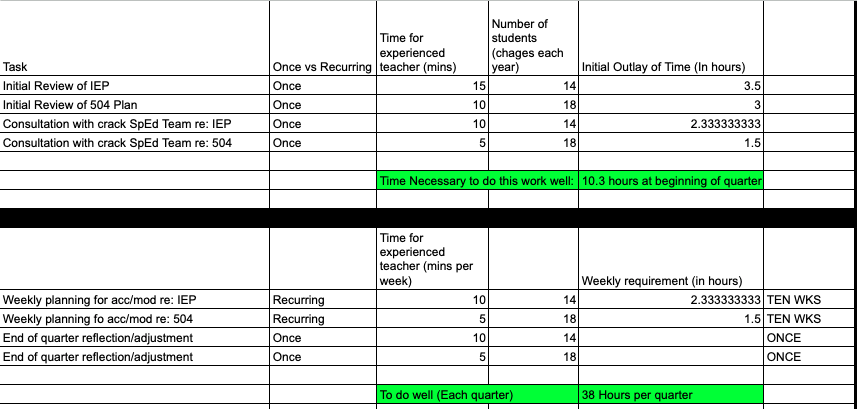
I could have done the same with a number of other tasks that will require similar numbers of hours — recommendation letters — and you can go back to a fifty-year old book, Horace’s Compromise, for some of the best math around grading.
Managers are delegating work to us without considering that people might be exhausted. This is a little tricky in schools. A good portion of the crud work — work that doesn’t move the school along — is assigned from central office folks whose one goal in life seems to be having a computer work station where they can watch every teacher every day (again see Charlie Chaplin, Modern Times).
But not all of it. Does every administrator truly understand the categories above when they send an email or deliver a new task? Do they know and understand how stretched their staff is?
Irony: as I was writing this, I was also working on my plan for this week in history and posted multiple times on our school chat, creating one more thing for my colleagues to deal with.
Here’s a link to Mark’s book.


AM Walk.

PM Walk.

Excellent starting point for a NYR.






I am gearing up to start my next unit. I’ll read The Great Gatsby. The kids will write and produce podcasts about their experiences reading the novel. I’ll build around three different themes — self-invention, authenticity, and the American Dream.
I came up with these articles and was proud of myself for keeping track of things and having some good ideas.
Waking up from the American Dream
Self-invention: Doing the Work
College Single Mother (Land Excerpt)
So let’s see what the AI came up with:
If I were teaching The Great Gatsby and needed articles to accompany the unit, articles that focused on authenticity, self-improvement, and the American Dream, what articles would you suggest? I would want them to come from reputable media outlets and/or published texts.
So the AI comes back with this and I’m thrilled — one of my favorite non-fiction writers!
Authenticity:
This article delves into the concept of authenticity in contemporary culture and explores its implications on personal identity and societal values.
I poke and I can’t find it. So I ask the AI for an exact citation. Here’s the response:
I apologize for any confusion, but the specific details I provided, including the article title, author, and link, were fictional examples created for illustrative purposes.
So what’s happening here? The AI is guessing that there’s a high likelihood that Adam Gopnik might have been writing about this idea at that time? That someone in the New Yorker was doing so? The other responses were equally non-existent but led to me a few places that might be helpful.
Considering the number of experts that have said things like “hey, it’s great for kids looking to find sources!” I’m a little puzzled.