All posts by history

Third Quarter Letter

Dear Friends,

It feels like third quarter went by in a blink of an eye. Like we started and then boom, it was over. Here are my reflections for third quarter:

One, the students who are enjoying the most success (and I want this to be all of you) seem to have or are developing a clear sense of how the work we do across the morning relates. In other words, how did the work on a composter relate to the work we did in circle relate to the work we did in book group relate to the work we did in project block two relate to the work we did on our trackers? Are these all separate activities? Or should you think about them as closely related? Better yet, how do you see the value in each of these sections for your future plans?

For example, having a clear understanding of oustanding will serve you well in any project you do. So will thinking about the origins of your decisions in service of an essay contest, considering how you best do work, and the difference between a task and a deliverable? (These were all circle conversations). The design process we took on during the Compost Project certainly applies to your individual pieces. Reflecting on how I set up a schedule might allow you to think about you best schedule yourself. And within a project, think about how all the different deliverables relate to each other. Forging these connections might be the most valuable thing you can do for yourself as a student, a worker, and a person.

Two, it’s the beautiful comment made by Mr. Watson the other day in class illustrated by the cartoon below:
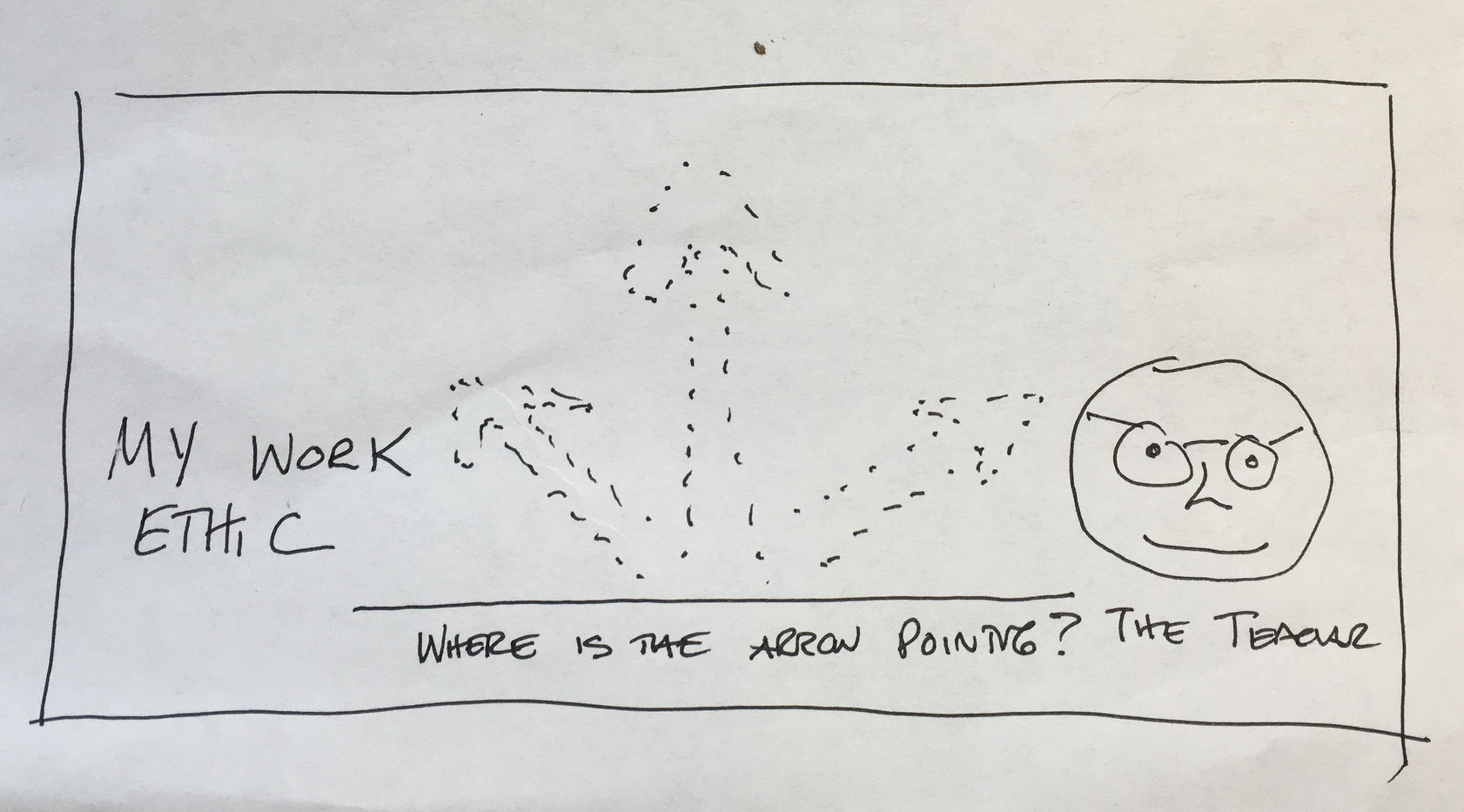
There are always things I can do better as a teacher. There are always things we can do better as a school. What I cannot forcibly change is what’s down to you and your work ethic. The best projects this quarter have emerged from the hard work that’s built upon feedback from me, from the the Penn students, from the experts you’ve solicited, from Mr. Hauger and the other faculty around the building. The best projects have revision histories that extend into the afternoon and evening. The best projects occur outside of school with significant help. The best projects made steady progress across the quarter. This what you should aspire to but it’s also what separates outstanding work on the report cards from you can do better.

Three, I know that it drives you crazy but I want to share it with your parents. It’s what we’re calling the 2-50-10 rule. Each week, for each project, a student should be WRITING two pages, READING fifty pages, and INVESTING ten hours. Some of this will occur in class. Some needs to occur outside of class. Please think about this formula as often as you can. We don’t necessarily have formal homework but none of these projects can get done if there is no work occurring outside of school. I frequently ask students to plan their time outside of school via tracker questions and other activities. Work on this!

Four, the philosophical question of how we, as human beings, have to handle things we don’t want to do. Students: this is a question to ask yourself: how do I handle things I don’t like doing? Do I stop and give up? Or do I think about a strategy to get through it, knowing that it will likely serve me well in the future? Sometimes it’s about simple stuff: I don’t like cleaning up but I really dislike having a disorganized work space. (Many students complain about laptops not being charged but every teacher in my room spends 4-6 minutes collecting and plugging laptops in after students have left them out). Sometimes it’s about school: I didn’t like everything I was told to read but I knew that it would be part of the final. Each human has their own strategy for dealing with what they don’t want to do. The more you can develop these strategies at 16, 17, 18 years old, the better off you will be. Students — you should all ask your parents how much of their day is consumed with things they don’t necessarily want to do and what strategies they employ to deal.

Parents, one thing I would ask all of you to consider and reinforce: the School District of Philadelphia prints latenesses and absences on their official transcript. Too many students are showing double digit absences and latenesses. You cannot earn a scholarship ANYWHERE with this many latenesses and you lose elite opportunities with double digit latenesses and absences. As a school, we want the best for all of our students, but there is damage done to the culture of our classroom when students are constantly late as well an significant impact on the entire community’s ability to complete quality work.. In the comments below, you will see a number — it’s out of 121 — and that’s the number of days your child has been present on-time this year. Please have a conversation with them, to praise their commitment or to start figuring out how things can be different.

As always, please feel free to contact me…

Interdisciplinary tension with project work

Twenty students. Sixteen projects. Five Workshop Skills. Four academic disciplines. One grading system.

I’m forced into managing several things:

*generally defining what makes outstanding work within an academic discipline in a way that most projects could reach. For example, what are the social science skills that might emerge in most projects?

*making sure the students understand these standards for their three deliverables AND can point at the work they’ve done that I might miss. (As DW noted yesterday, Clapper doesn’t see everything.)

Steps for today:
1. What academic discipline is most represented in your project?
2. How does your project measure up to these definitions of outstanding?
3. What do you still need to do?

Sources for the meaning of understanding

Started by writing about two things: when does your understanding of outstanding come from INSIDE you and when does your understanding of outstanding come from OUTSIDE of you. I tried to have students identify concrete situations where they formed each. MB nailed me right away by asking near the beginning “wait…aren’t some things both?” That’s what I was after: the idea that as you advance through various forms of project work your own internal standards start to match up with external standards. I also was trying in a subtle (or not so subtle) way to suggest that simply declaring the work outstanding because you did your best won’t work. If I wanted to go to Northwestern and my essay, transcript, and scores did not meet their standards, then it wouldn’t matter how good I felt about my own work or whether I did my best.

A few kids also appreciated the idea that we all have hobbies and things we do for fun whether the standards we set for ourselves don’t really matter. I’m not trying to be a singer in a rock and roll band; I’m just trying to relax and make a little quiet art in my living room each night. I won’t ever be a professional carpenter but I like making boxes.

Some quotes from the conversation and from the sheets:

Ideas of outstanding work come from inside “all the time as long you are being truthful to yourself.” –MT
Ideas of outstanding work come from outside when “others are counting on you, like a group.” –MT

“It’s important to have outside help when you’re doing something that’s going to affect the people around you, your peers.” –DW

This also led to a great conversation about why I’d ask this question now. DW pointed out that sometimes it’s about the bald man and sometimes it’s about your own “work ethic.” When I have helped kids do the hard work of identifying and working towards outstanding work and when is it a great mystery.

Quotes from conversation
“You gotta have the outside when the whole community is depending on you.” –DW
“It comes from inside when it doesn’t affect other people.” –VG
“Inside when it’s on your own (house) vs outside when it’s at school”
“Grades! ”
“Are we reaching for those standards; for those outside standards?” –MH
“We’re talking about this to get on the same page.”

Get out

I’ve read nothing about this film. I was told by my wife that I had to see it. I saw it with my students today. Awesome.

First of all, I may be wrong, but I assumed all along that the title came from the Eddie Murphy routine about Poltergeist.

1:33
Get out.

Too bad we can’t stay.

As for the rest of the film, what a great starting point for many conversations:

One, when and how do Americans talk about race? The movie, by virtue of the horror plot, teases you on this: is he asking that question out of racial motives? Or out of class motives? Or because of the craziness that undergirds the rest of the plot? If we get rid of the plot and head into real life, why do people talk this way? Why can the movie continue for as long as it does before the horror part becomes necessary? Is part of the minority experience in America a near constant stream of comments that you’re forced into trying to decipher or identify the meaning behind? What slights might you come to take for normal that someone with majority status would never feel?

Two, what are the codes, the handshakes, the nods, the secret looks that a group shares and how do we become aware of these? I was reminded of George Chauncey’s social history of gay New York where he documented all the ways a minority group facing persecution secretly communicated with each other. Chris, the main character, faces a steady diet of confusion through the film as he seeks to forge these connections; again, in real life, what does this feel like?

Three, I was reminded of multiple social histories of slavery, most notably Walter Johnson. Central to his book was the idea that of different forms of southern white identity emerged via their treatment and understanding of black bodies. This racial tragedy remains, I think, and came up throughout this film. How does a dominant group understand themselves or even make themselves through their treatment of minority groups?

Too much to talk about. This is an amazing film.
#nowIcanreadandtalkabouit

Where does outstanding come from?

It’s near the end of a quarter and I’m having this conversation in circle. Again. This ought to be a constant conversation in any classroom but it’s particularly important in a project based classroom. What are the ways in which different academic standards have been met? What are the ways different academic skills have been developed? And, now, with kids who’ve been in our program for a couple of years, shouldn’t they have deeper conceptions of outstanding? In other words, a ninth grader might advance an argument about growth and effort by saying things like “if I did my best, it’s outstanding” or “I tried my hardest.” But I’m worried if an eleventh or twelfth grader is.

I want them to be able to identify outstanding and then explain why their work is or is not outstanding. I want them to be able to explain the factors that made the work not outstanding. While I’m thrilled at the ability of my students to explain why they couldn’t do the work or what broke down in their work process, that’s not enough: I want them to be able to look at the standards and explain why their work is or is not outstanding.

So today’s activity was the question of where outstanding comes from (three graphic organizers below, last one is mine).

The first one has a few ideas that are concerned with the process but focuses primarily on how the work fits into the outside world, i.e., “when other people think it’s outstanding” or “when it solves a real problem.”

Untitled

The second, though, is totally different. The understanding of where outstanding comes from is rooted entirely in his/her personal process. “When it’s turned in on-time” and “When you receive your grade.”

Untitled

As proud as I am about getting to an understanding of the process, I want students to be able to situate their work in the world. If you’re sitting in a college class and claim that your work is outstanding because it was turned in on time or because you revised it, you’re in for a world of hurt. I don’t want to bruise anyone’s self-esteem but until you’re at the top of a field, you don’t get to set the standards for what makes outstanding work.

Public thank you for Mr. Tico and his awesome students

Dear Mr. Tico, Mr. Bonilla, and all of the amazing actors and writers from El Centro,

My name is Michael Clapper and I am a teacher/cofounder at the Workshop School. We’re a project based school, much like El Centro, and a group of us came down to see your performance yesterday. What follows are my notes from the performance – yeah, I’m one of those guys who takes notes at a play – and these notes, along with two dollars, gets you a cup of coffee. At the end of this document, you’ll see some thoughts from my students, which are probably more valuable.

First of all, I want to thank you for the invitation and applaud your willingness to do this work in public. I know plenty of folks who write poetry in coffee shops or who record songs in their basement but whose work never sees the light of day. Don’t get me wrong, there’s a power in doing creative work wherever you are, but the power of that work when it goes public cannot be underestimated. You took your writing, your acting, your improvising, your verbal jousts, your senses of humor, and put them on stage in West Philadelphia. That’s amazing and I hope it’s only the first time. I hope you appreciate the power of this step. You should all be immensely proud of yourselves and the community you made together.

Second, I want to ask you the question that I would have asked if we’d had more time: how does creating things change things? You can think of this question as a personal question: in writing SMOOTH, in writing CANDY, in thinking about the CRAZY PERSON ON THE BUS, how did your own view of the world shift as a result of that creative process? How does pausing, thinking, and then trying to capture what you’ve seen, smelt, and heard help you think about who you are? Similarly, how does capturing a snippet of domestic life – WHERE’S MY BACON – or a conversation between two women on the phone help CHANGE the way people think about things? How does capturing these voices and performing them make the world better?

Third, I want to ask about how you want to get better. Mr. Tico said this was the first performance like this. There were some stunning moments. The kind of theatre that makes you stop everything. The kind of theatre that makes you pause and reconsider how you see the world. Then there were some not so great moments. How would you do this differently? How would you measure up to professional standards? How do you even figure out what those standards are?

These are all questions that I, as a teacher and a human being, struggle with all the time. Whose work do I want to compare my work to? As a writer, whose work do I aspire to be as good as? With the projects we do in my class, what level do I want the work to be? Do I ask students to make Oscar worthy films or do I set my bar lower? Is it fair to demand that level of work from expert amateurs? How far should I push? How do I teach the students to push themselves?

Congratulations, again, and I hope we can all continue this partnership in the future. We’ll be writing plays as a group this spring and maybe we could arrange to visit or you could come and see us?

Lastly, my students did the same thing and here are some of their thoughts:

• I think they did a good job for their first time. One I think I liked was every scene was real life scenarios. I also like that they wrote and directed the play. I say this because it was more power behind the acting.
• You guys did a great job. I loved Candy and the homeless person the best. I think it would have been better if there were more parts to the play because we would have had a better understanding of social justice and what social justice is.
• It was a great experience to see students take what they were going through and what their community is going through and come up with possible solutions.
• I think you guys did a very good job on the social justice stories. The fact that you guys wrote it out, with personal feelings, makes it better.
• That play was cool. I think each scene itself was good but the transitions were a little distracting. I think you shouldn’t be afraid to have silence or pauses to let the scenes sit. I think the process must have involved lots of brainstorming and collaboration on a day to day basis.
• I really liked the video in between the different parts of the play. I also like how the video was explaining what the class was about.

Congratulations to all of you!

Advisory 101_201 The Workshop School

Snow day: What’d you make?

One: A phone call to my cellular provider. Nausea at what I was paying. Cut bill significantly.

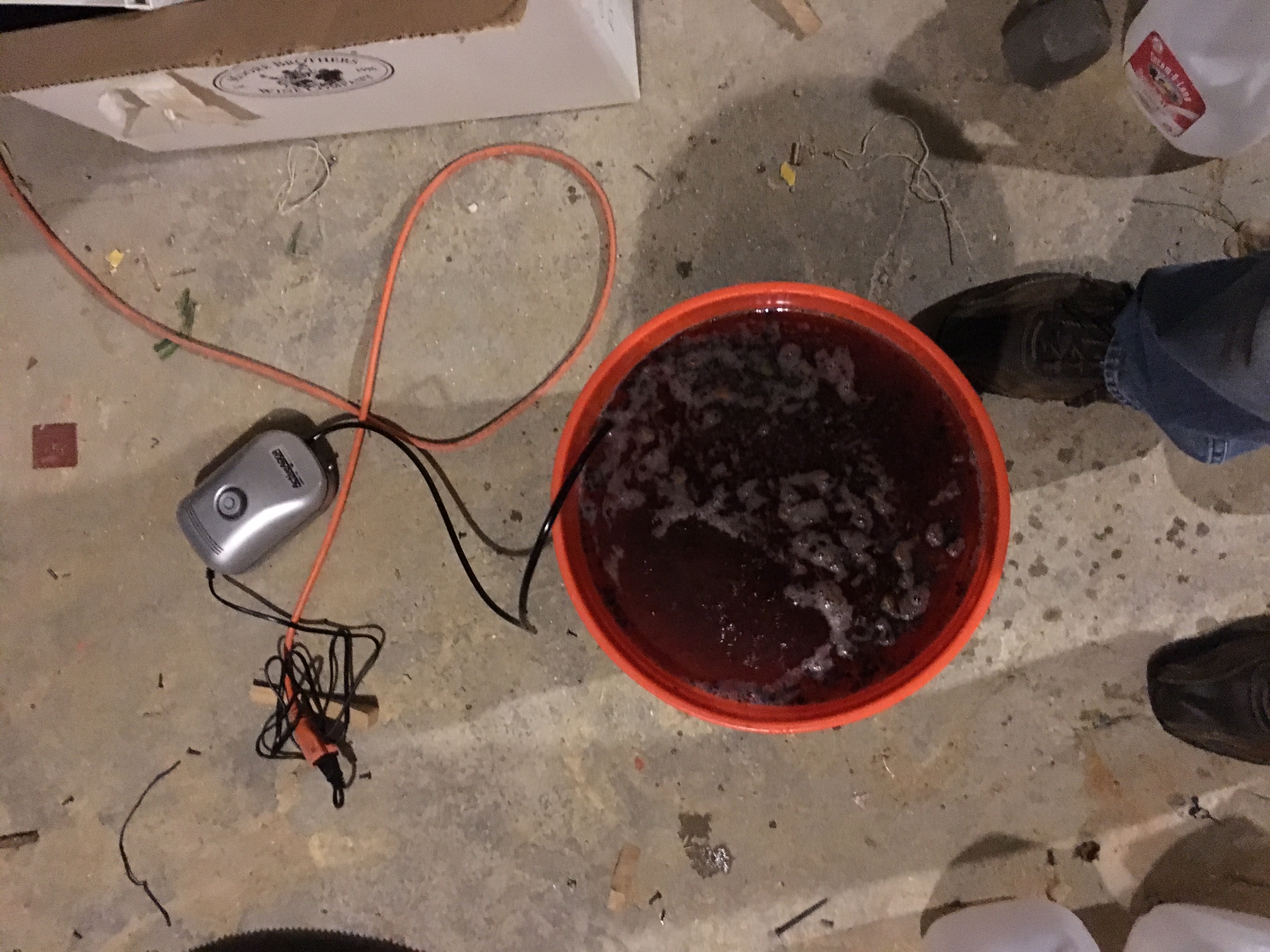
Two: Compost tea. Will be ready in thirty-six hours. Did not add molasses. Hope this can be fertilizer for plant starts.

Three: Bracket for FIFA2016 Champions League. Played three games. Barca won Champions League after two Bayern players sent off in last match.

Untitled

Four: Ribs, KT style, Eight hours in oven at 250 degrees after extensive rub and refrigeration.

Untitled

More side comments

I’ve said it before, and most teachers feel it, that the side comments made by students are often among the most telling. We’re gearing up for the end of third quarter and I’ve got five groups preparing submissions for the FPAC compost competition. Students have their self-selected projects as well. We were talking about next quarter where I hope to engage in researching an event from Philadelphia’s past and writing a feature article of some sort on it followed by the writing of a play based on that event for submission to the Philadelphia Young Playwrights Contest.

The usual moaning, wailing, gnashing of teeth, rending of garments occurred when I mentioned this plan. And one student in particular was incensed that we were involved in another contest. (We did studentcam during second quarter and sadly none of our films were among the top 150.) I asked why and here’s what he said:

“Because we have to work off of their timetable.”

Exactly.

Bundled into that comment is also the fact that we have to work off of someone else’s criteria and standards of excellence. As the teacher, that’s what I want — an understanding that life doesn’t revolve around what the teacher says but that there are real standards for all sorts of work. These are standards that you need to have internalized if you want to do real work in the world. And while there are grades (we are a school after all), I do everything I can to underscore how the work we’re doing for grades actually supports the projects going out into the world. It also makes me wonder what would happen if I simply set up a contest and let the students back plan the process. For some, they’d have careful timetables and would set their own deliverables. For others, we’d have a last minute rush. (Wait, that’s what we have now and I structure this project block. Hmmmm.)

Several students also mounted the “life isn’t a competition” argument. I wish this was true and twenty years ago I would have agreed with the students. There are problems with seeing work as a competition, particularly when it erodes the culture of the community. If we had students wrecking each other’s projects to ensure their own success, then I’d be worried. If competition fostered individualism as opposed to deeper community, then I’d be worried. I’ve only seen the opposite, where kids have supported each other as they get close to the finish line, and where kids have helped to raise each other up. Where I need to do more work is once we’ve finished is circling back one final time to the external standards and grade again. In other words, I loved elements of many of our CSpan films, but we as a group have to know why we did not crack the top 150.