Category Archives: Books

Writing (Klinkenborg)

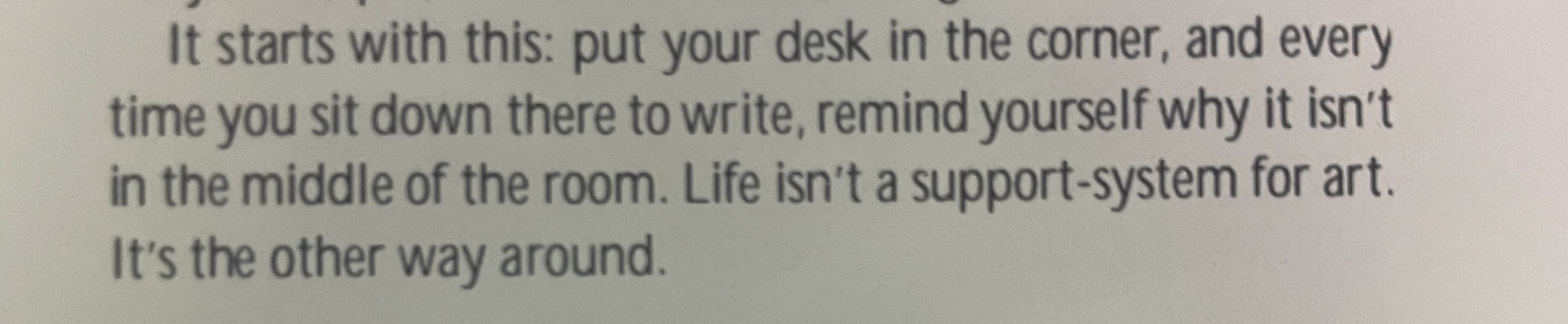
Writing doesn’t prove anything,
And it only rarely persuades.
It does something much better.
It attests.
It witnesses.
It shares your interest in what you’ve noticed.
It reports on the nature of your attention.
It suggest the possibilities of the world around you.
The evidence of the world as it presents itself to you.

Proof is for mathematicians.
Logic is for philosophers.
We have testimony.

Klinkenborg, Verlyn. Several Short Sentences about Writing. First Vintage books edition. New York: Vintage Books, a division of Random House, Inc., 2013.

Thurs

Finished Adam Bede

For me it seems it’s the same with love and happiness as with sorrow — the more we know of it the better can feel what other people’s lives are or might be, and so we shall only be more tender to ’em, and wishful to help ’em. The more knowledge a man has, the better he’ll do’s work; and feeling’s a sort o’ knowledge. (482)

The beginning of hardship is like the first taste of bitter food–it seems for a moment unbearable; yet, if there is nothing else to satisfy our hunger, we take another bite and find it possible to go on. (458)

Adam Bede

“There’s nothing but what’s bearable as long as a man can work,” he said to himself, “the nature o’things doesn’t change, though it seems as if one’s own life was nothing but change. The square o’four is sixteen, and you must lengthen your lever in proportion to your weight, is as true when a man’s miserable as when he’s happy; and the best o’working is it gives you a grip hold o’things outside your own lot.”

I’m early in the book — 100 pages or so — so the only caveat I’d add for the 21st century is that Adam Bede is a craftsman. He’s not talking of work that’s crud work for someone else or mindless work in service of nothing…

Last lines of Middlemarch

But the effect of her being on those around her was incalculably diffusive: for the growing good of the world is partly dependent on unhistoric acts; and that things are not so ill with you and me as they might have been, is half owing to the number who lived faithfully a hidden life, and rest in unvisited tombs.

Middlemarch

“That depends,” said Caleb, turning his head on one side and lowering his voice with the air of a man who felt himself to be saying something deeply religious. “You must love your work, and not always be looking over the edge of it, wanting your play to begin. And the other is, you must not be ashamed of your work and think it would be more honorable to you to be doing something else. You must have a pride in your own work and learning to do it well, and not be always saying there’s this and there’s that — if I had this or that to do, I might make something of it. No matter what a man is, I wouldn’t give two pence for him” — here Caleb’s mouth looked bitter, and he snapped his fingers “whether he was the prime-minister or the rick-thatcher if he didn’t do well what he undertook to do.”

(p.527 from the 2015 Penguin edition.)

Middlemarch

“Our passions do not live apart in locked chambers, but, dressed in their small wardrobe of notions, bring their provisions to a common table and mess together, feeding out of the common store according to their appetite.”

Middlemarch

“Oh, I have an easy life–by comparison. I have tried being a teacher, and I am not fit for that: my mind is too fond of wandering on its own way. I think any hardship is better than pretending to do what one is paid for and never really doing it.”

Mary, early in book.

There’s a set of questions here, though: what happens if what you got into teaching to do diverges dramatically from what your school is asking you to do?

What if the kind of teaching you’re asked to do does not allow your mind to wander?

What happens when you want to create transformative experiences for your students and instead you’re being asked to drain their souls?

Eliot, George, and Ronjaunee Chatterjee. Middlemarch: Authoritative Text, Backgrounds, and Contemporary Reactions, Criticism. Norton Critical Edition. New York: W.W. Norton, 2024.