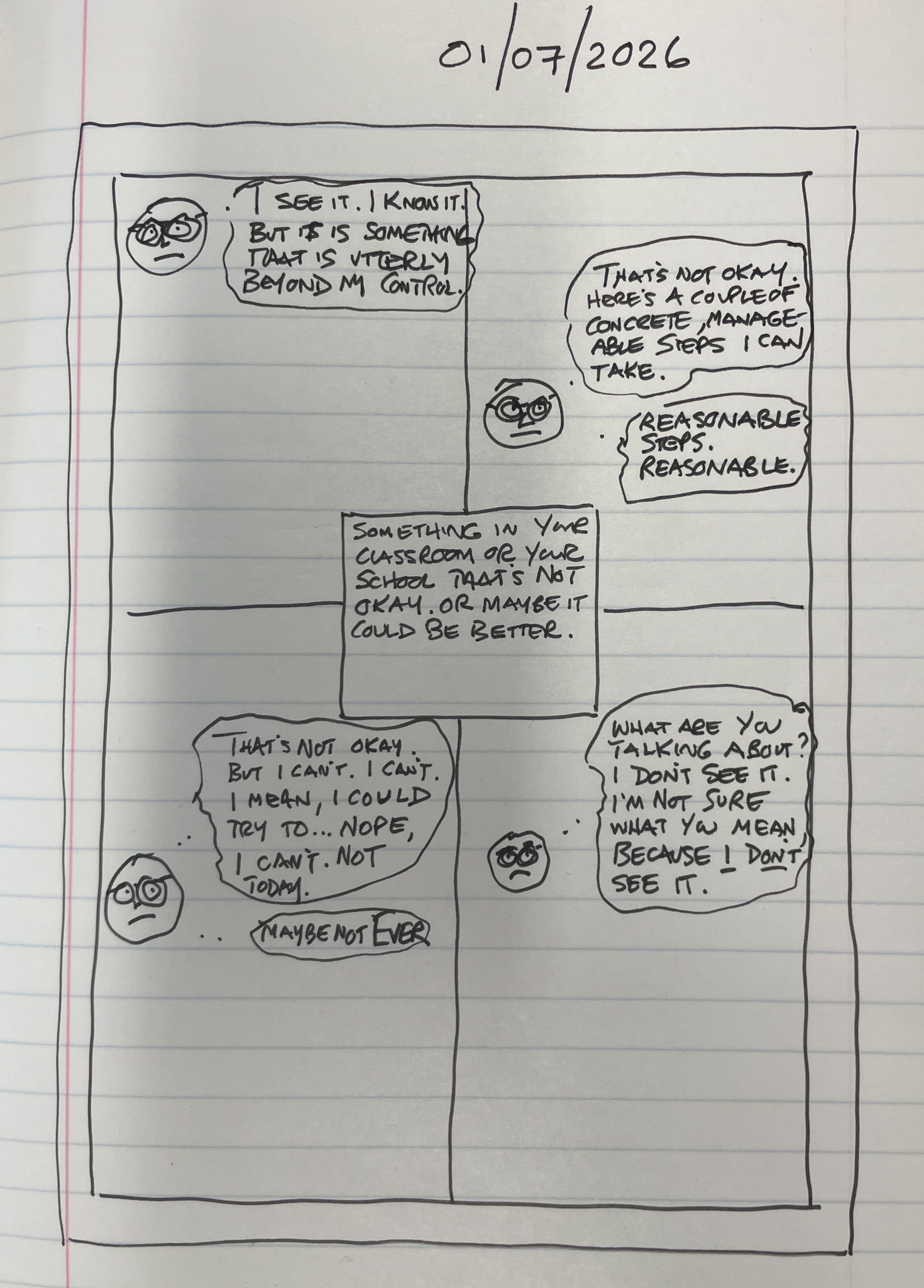
Discussion in 2026: “Wait, is this English class or therapy?”
My favorite moments of all time in English Three were literally any discussions we had, whole class or even in groups. The reason why these were some of my favorite moments is because I felt like everyone had an opinion and when there were any disagreements, we would talk them out and everyone would explain their point of view on why they think what they think.
— From feedback form at end of the year, June 2025, English Three
I really liked our class discussions especially with real time issues with Trump or the Charlie Kirk situation. Being able to voice our own opinions and talk to each other like adults on serious topics was very interesting. Also I liked making Mr. Clapper irritated with Katherine.
— From feedback form at end of the year, June 2025, American History
I run my high school classes with discussion. It’s the primary activity during our sixty-five minutes together. Over the past ten years, for two hours each Tuesday afternoon, I’ve used the same approach with my university class. With all the options open, I believe that you can run discussions in a way that everyone learns something and appreciates the experience. Well-run discussions provide shelter from much of what’s going wrong in the world and a model for how to make the world a better place. So I’ve spent a month this summer describing my process for setting up, fostering, and documenting discussions, which also gave me the opportunity to explain (and evaluate) my pedagogy in 2026 and to think about my goals for next year.
For all of my classes — English Three, American History and Urban Education — I arrive with a question or set of questions. It’s a question that you must grapple with if you’re going to be able to complete the final project for the class. It’s a question that represents something that humans ought to consider. It’s a question that I can usually trace to something I’ve read, studied, or heard. It’s a question that usually flows directly out of whatever homework reading they did the night before, although sometimes it doesn’t seem like that and midway through the discussion a kid is like, hey, this reminds me of what we did for homework, at which point I usually say something like it’s time for me to retire.
Before the discussion begins, though, I usually have the students write or draw in response to the question for five minutes or so. This sort of free-write or free-draw or free-associate spurs some thoughts and sets the intellectual bar for the day. My high schoolers are used to this “do-now” kind of thing; college students are more self-conscious — aren’t we beyond this — but the activity remains effective. When I’m organized at the end of a unit, I ask students to circle back and employ some of these drawings/writings. I almost always do the activity myself, trying to approach the question with new eyes and often reminding myself of what I hope to get from the conversation. This kind of spiking the punch activity ensures that everyone has at least one thing to say.
Then we dance. They talk. I talk. They talk. I talk. We move through different topics related to the question. In my mind, I usually have two or three places I’d like to go. Almost every day we get to those places; almost every day we go in a direction I hadn’t anticipated or a new idea comes up.
Some days I don’t have to ask who wants to talk.
Some days I have to use every randomizing element I can to think of ways to call on students.
Some days I cold call on students and almost every time they bring something to the table. (More on this later — please don’t think this is the 1970s embarrass/humiliate kids kind of cold-calling. Often before the conversation begins I ask students to underline one sentence they would read if an annoying bald man were to call upon them so they have a safety net.)
I do this laughable thing where I collect initials of people who have raised their hands and then make words out of it. A, W, O, L, and I exclaim AWOL! By writing their initial down, it creates a record of who talked and helps me, in my notebook, to keep track of who said what.
Some days I am a counterweight to their comments, where a student talks and then I talk, such that the rhythm looks like this (where the students are individual letters and I am the X):
A-X-G-X-M-X-R-X
In my university class, it very much looks this way.
Some days, though, I’m in the conversation but every third, fourth, or fifth comment, i.e.,
A-B-C-X-G-L-R-S-Z-X. When I let students run the conversation, I can often drop out completely.
Sometimes discussion is the primary activity for the day. Sometimes it becomes the primary activity for the day. Sometimes it feels as though the discussion sets up the next part of class in a seamless way and there’s an easy transition. Sometimes there’s obvious relief — Thank God we’re done with that — and sometimes there’s disappointment that we have to move on to something else. My biggest planning issue is almost always that the discussions take longer than I want them to. My second biggest planning issue is that I get overly excited during the discussion and it runs past the time allotted. In other words, sometimes it’s my fault, but not always.
I’ll end by asking two or three folks if they want the last word. Most days I’ll ask why we had this conversation and make clear that they can’t say “because you couldn’t think of anything else to do.” I have to ask this question as a kind of barometer for the room — did we get anywhere? Was there any substance to the discussion? Most days when I end with this inquiry, I get great answers. I should also note that if I detect any kind of frostiness, any friction, during the discussion I will pass out note cards and ask students to write down their impressions of the conversation and what questions remain for them. (In 2026, especially if you are new to the profession, you will want to do this regularly.)
Nothing new here. I watched Jean St. Pierre do this across 1985 and 1986 in my favorite high school classes. I watched Rachel King-Davis, Marsha Pincus, and Bob Fecho do it better in 1996, when I was learning to teach at Simon Gratz High School. Or that the Philadelphia Writing Project helped me understand more. I watched many of my amazing colleagues at West Philadelphia High School do it well and that Simon Hauger or Matt Riggan and most of our Workshop Team can’t do equally as well. For that matter, a good number of hallmates at SLA are marvelous at this approach.
Yet here’s something important about doing this kind of work well in 2026, which is why I’m writing this piece for the eight people who read my blog regularly. I think discussions are the antidote for much of what’s wrong in 2026, both in terms of learning and as a model for how much humans can do if they didn’t have immensely powerful computers in their hands most of the time. Any discussion-based class is a response to the older chalk-and-talk or spray-and-pray models of teaching. It’s a movement away from a teacher-centered class and towards a community based, student-centered space. Still, bald man, you say you’re running a student-centered classroom built on student voices but you’re the one gluing the conversation together. Sounds like it’s your show, not theirs.
Maybe. Part of the work is to draw as many voices as possible into the conversation, through pleading, charm, insistency, crabbiness, love, anger, sadness…pretty much any way you can to pull kids into the discussion. One thing I’ve occasionally tracked in my high school class but I definitely track in my university class is whether or not I’ve heard every voice. I can look at my notes and see how many kids get into most conversations — usually it’s more than twelve and I do have those perfect days where everyone weighs in at some point. I had an SAT one year (SLA has seniors act as student assistant teachers) who tracked when kids participated.
I think about the effectiveness of discussion a great deal, especially because I’ve gravitated towards longer and longer discussions the more time I spend in the classroom. I support the democratic impulse towards everyone’s voice ought to be heard. I do not support the idea that all voices or points are equal. I support the idea that we, as a community, need to work hard to hear different perspectives. I do not support the idea that anyone can say anything. As the leader or facilitator or paid professional, I have to make sure that each person who wants to weigh in can, and that we respectfully consider each point. We don’t have to agree. The more perspectives, the better, and if there’s one thing I learned from my six years at a Jesuit school is that your job as a teacher is to fill in all of those perspectives you’ve not heard in the discussion.
Real strengths that flow from the diversity of our school. We are diverse across almost every metric you can imagine. And we’re not diverse in the transitional way, where you look at a school statistics for ten years and say wow what a diverse place when all that’s happening is the transition from diversity to another form of segregation. Diversity, though, means that everyone comes to class with different expectations about what class will mean and what class should mean. They may have an idea that comes from previous classes — more on this later, when I talk about teaching eleventh graders and undergraduates — and they certainly have ideas from their own homes. (My parents thought they were having a discussion with me and I thought they were yelling at me.) Most kids haven’t yet reached workplaces where there’s all that much collaboration or discussion; most of my jobs in high school and college consisted of being told what to do and then being told how I wasn’t doing it right. Schooling in the United States, from home schooling to schools whose traditional pedagogy my Great-Aunt would recognize from her time teaching in the 1930s to schools with the most precious (and generally effective) progressive teaching practices imaginable, means kids arrive with very different ideas of how to discuss an idea. And yes, their own identities, race, class, gender, sexuality, exceptionalities, all play into making discussions. It’s actually one of the great things that can happen when you have discussions all year: kids start to say or feel or voice things like, oh, Clapper isn’t saying that because he’s bald, he’s saying that because he’s Clapper, and that’s how baldness works with him.
It being 2026, most days I have to offer a disclaimer or two about a perspective I’m describing that may not be mine. I do not speak for all bald people or for that matter all good-looking people. Or sometimes, in both university and high school, I try to carefully and respectfully lay out an intellectual position that runs counter to the way the class seems to be moving that day. One of my favorite, go-to questions is always “how would someone disagree with you?” I talk of my relatives and ascribe positions to them, hey, you know my uncle or cousin or niece has a word for what you just said. I offer positions that I’ve grappled with, often with a disclaimer, hey, I definitely have dark moments where I start to understand this position. Or here’s a position that I wish were true.
Last year we had a moment where a student inched towards and then stake out such a position. They claimed that if they were an attorney and they were getting paid enough, they would defend anyone, no matter what they were accused of. The class quickly joined the fun, offering wilder and wilder scenarios, until we got to a proposition that required my intervention. It’s always interesting — sometimes kids believe an idea like this. Sometimes they start to make their claim and then folks challenge them and then they dig in and then they’re defending a position they couldn’t possibly believe. (I’ll talk about the social implications and how I try to manage them later.)
I have to carefully distinguish between the line in the text, the author’s voice, and how I read it; I feel this a lot with Ta-Nehisi Coates. I’ve read Between the World and Me enough times and heard him talk enough times that I have a sense of his argument. But I have to be very, very clear that I’m not speaking for him, only offering my own take on his argument. I’ve now read two different Celeste Ng books with my students (I got to meet her this spring!) but I have to offer multiple disclaimers about how it’s my take on the text. It’s funny, I feel no such trepidation speaking for Walt Whitman or William Shakespeare, although I have to carefully explain how I got to my position.
I know I am lucky to teach eleventh graders. Very lucky. Partly because it’s a great age and partly because they’ve had two years in our school and have an understanding of what it means to discuss things in a group of thirty or more people. I can give general ideas about how a discussion works in the opening weeks and then course correct on an individual level. Are there days where I have to remind them of the point of a discussion? Certainly. Are there days where I go right up to the edge of saying things like, “wait, y’all would rather do worksheets or listen to me do all of the talking?” I think in the coming years I need to be as explicit as possible about this model. Some of the work gets set up in the opening days but like pretty much everything, you have to maintain things and go back to the expectations a lot.
With some classes, as the year progresses, I can turn it over to students to run the discussion. I give participation points for this leadership. Oftentimes I am doing this so that the driving force behind the discussion gets claimed by a student; it also allows a different rhythm of our talks, where if we’d had too much me, the students can (and take such immense joy in doing so) ignore my raised hand. I need to be better about this, though, if I want it to become systematic. In other words, if I don’t give immediate positive feedback, then it won’t develop as part of the class. Some classes love this approach, embrace it, and I have facilitators through the year. That being said, there were points this past year where kids elected to volunteer as a facilitator to settle grudges or to select their friends. I don’t have that much meanness in my room but there were definitely one or two moments I can remember where the leader of the discussion took revenge on their classmates. This also allows students to present their best Clapper imitation, which is fine with me, as it allows them to try various ways of connecting a conversation and adapt those approaches for themselves. I may be awkward. I may be absurd. But these imitations always seem to capture how hard I’m working to keep a conversation going.
And because I like to believe we’re always dwelling on important topics, many of which aren’t easy for folks to talk about, I would argue that there has to be humor or randomness within the conversation. By making jokes, I hope I keep things light enough that we can balance some of the heavy topics. Or maybe not jokes. Maybe it’s enthusiasm. Hey, it’s hard to talk about race in America, but look, look, we’re doing it. Even the heaviest play — Hamlet or King Lear are the ones I’ve taught most recently — have multiple moments where things lighten up. Those moments have to be there, especially for teenagers, if you’re going to sustain a conversation for more than five minutes.
My Penn class meets thirteen or fourteen times. I can count on at least one discussion session being stale, uninspired, and just unable to get moving. It’s usually one of the dreaded Penn weeks where everyone has four exams, five papers, six projects, four problem sets, three labs, and they’re all due at the same time. I end up providing most or all of the energy and it’s just the price of this pedagogical approach. In high school, it can be different. Some days my discussion provides the bridge to the next round of activities and as I take the temperature of the room and realize that we’re too hot or cold to move forward, I can jump to the next thing. In these moments, it’s important that I can point at something — a powerpoint, a note on Canvas, a discussion board post — that highlights what I’d hoped to get out of the conversation even if it never happened. I have to watch myself as I can get snarky — hey, this is what we would have talked about if y’all weren’t stewing about your physics test — and I also have to watch it if my plans for the day aren’t as through as they could be and I’m pissed about that.
But there’s an added dimension. I teach the way I teach for reasons that I’ve thought a great deal about. It’s not for everyone. It wasn’t even for me, at least for the first part of my career.
My first job was running discussions with young men as part of a school-based drug and alcohol prevention/intervention program. We’d meet in a tiny office and talk about things. I had just finished a degree in history and so I asked many (too many) questions about neighborhoods and spaces and how they might influence their choices. My next teaching gig was at West Philadelphia High School. I spent a lot more time making creative things to start class, little activities. I had the habit of small starting activities that would then become something for all of us to talk about during those years. This was many years ago but my biggest issue here, particularly with the younger grades, was being willing (and/or able) to build the structures within the room to support discussion. If you have ninth graders who’ve only done worksheets or experienced class as being yelled at until you are compliant, then it takes time and work to get them to a point where you can learn from a discussion. (In some ways, this is where I learned to employ discussion when people aren’t necessarily engaged with the material and/or aren’t necessarily engaged with school. Indeed, I would say I began my career as an adjunct as counterbalance to this world — running a discussion with people who have done the reading and, for the most part, care deeply about their education, is much, much easier work. That has changed in the past fifteen years.)
Our life at The Workshop School centered on full-time advisories and much of that time was spent in discussion. The advisory model is predicated on community and community-based discussions. With long blocks of time together, the challenge was knowing when you wanted to situate a discussion within your project time. Here, I think I refined and got good at opening free write activities. There’s also the mix of advisory and instruction that in this model completely overlaps. So there are discussions to process questions like — who are we as a community — and then discussions that focus on our next steps for a project.
SLA has advisory, but like any school that has an advisory model, there’s a wide range of practices within each room. No shade, but you’re not going to be able to count on certain things happening in every room. I only say this because I will end up doing discussions in my content classes that might belong more in an advisory space, a question like how do you push through the end of project blues or the end of the semester crush (our school calls it Benchmark Season.) And SLA prizes a kind of verbal student and expressing themselves is a great strength of many of our students. Again, I’m lucky to teach eleventh grade where they have had two years of our community norms that make my job much easier.
I just finished reading this terrific novel — Transcription — by Ben Lerner. In it, there’s mention of a father who, when confronted with a question or issue by their son, turns to telling stories, parables, and random anecdotes that will eventually lead back to the question. Sometimes. This can suck if it’s all you do as a parent (I immediately asked both my children if this is something I do and if they don’t like it) but it’s often the best part of a discussion, how the free-associations that everyone brings can enrich what we’re talking about. On the university level, students will bring up something they read in another class (or something they talked about in another class) and they’ll do so, usually with an apology or a disclaimer. Now, if this is all they’re doing, well, that sucks; the hope is that they’re bringing things from the reading. As a teacher, intellectual, and curious human, these are often the most interesting things said each day; for me, too, a good discussion allows me to bring in all of the stuff I’ve been reading and thinking about in service of the project.
And you have the general criticism of the Liberal Arts — all that talk. The best university discussions flow out of the readings; in my high school space, I try and celebrate every time someone brings up the readings, which you have to do more and more, as college kids read less and less. I go over the top with the celebrations when high school kids do it, especially if they reference something they wrote in their homework. I highlight great things said and keep track of them on two different boards in the room. And, in both high school and college, you have kids who prepare a smart comment that they quickly insert into the conversation and you can literally watch them push the clutch in and take the car out of gear for the remainder of the class. University kids do this in a much more subtle way. You’re not ever going to get total engagement with any method of teaching. Ever.
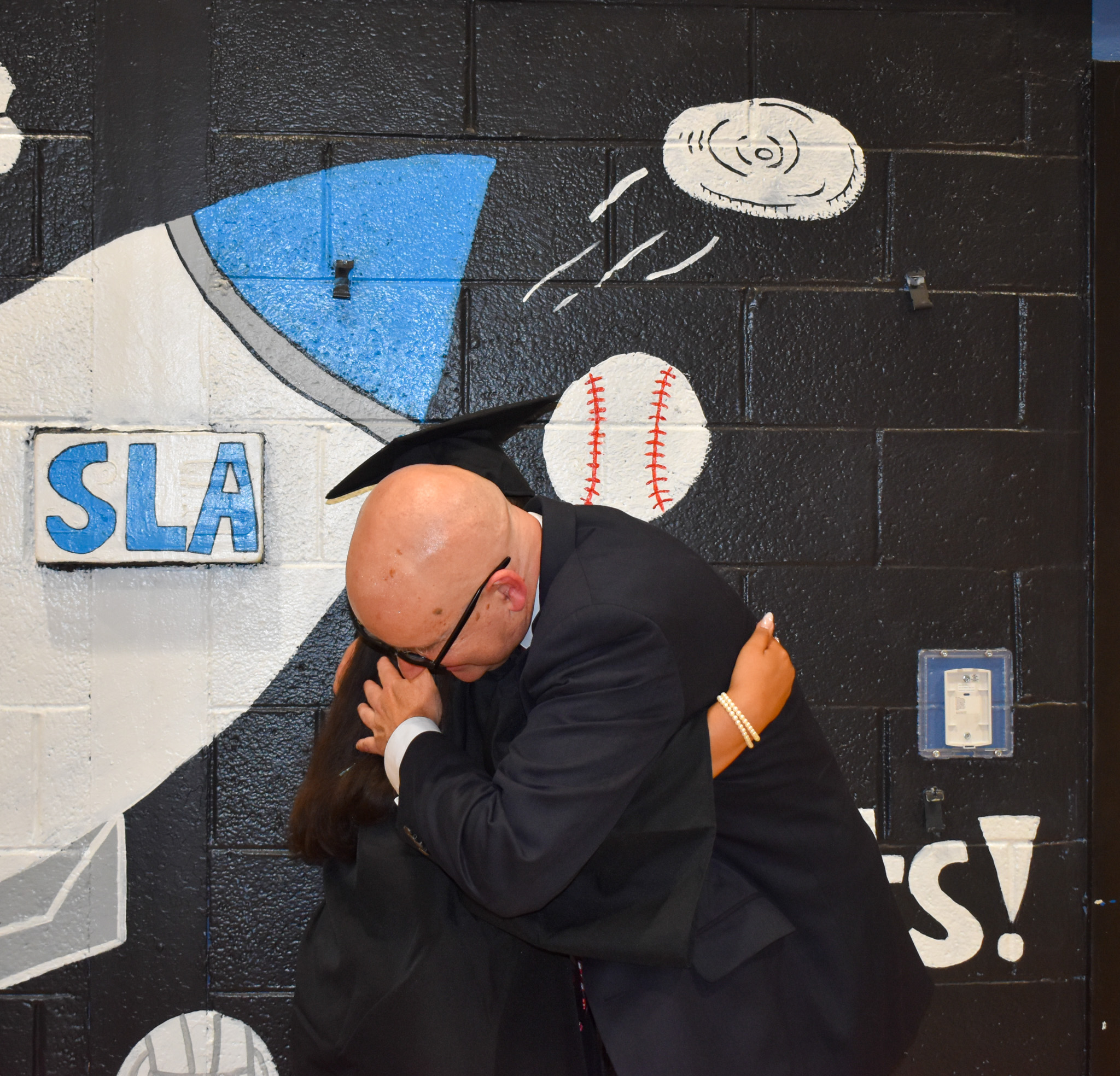
In a lecture hall, everyone is safe from everything except boredom. In a discussion, when everyone is encouraged to speak and where kids start to feel more and more comfortable, keeping everybody safe starts to matter much more. An old friend of mine used to talk about non-negotiables and I think about this a lot in any academic activity that involves social risk. You have to know what things cannot be said and which things mean you have to respond to publicly, in that moment. You have to know which things can be addressed with a whole group, hey, let’s all think carefully about the ways in which we’re describing things, and which things need to be called out immediately. And how one calls a kid out while not embarrassing or alienating them. Probably two or three times a year I have to pull a kid back after the conversation to address a comment they made; mostly just to ask for clarification. Here’s what I wrote down; what did you mean by this. (Remember, teachers, there’s a huge difference between quietly motioning to a kid to hang out after class and the public sort of statement like, “hey Clapper, why don’t you hang back so we can talk?” Sometimes you have to do the second so that everyone in the room knows that you’re having the conversation.)
Cold calling is one thing. Interrupting kids is another. Who are you willing to interrupt? What standards do you have in your head about when you should interrupt someone? Are you keeping track? Are you interrupting some kids and not others? That being said, as the year moves along, I will start to interrupt kids more and more. One easy one: when a kid is saying, verbatim, what someone else said minutes before. I will interrupt and ask how is your point different from so-and-so’s? I will also introduce a thirty-second rule. This does a couple of things: it forces folks to think about what it is they are trying to say; more importantly it keeps the conversation going. The mini-lecture serves no one. And we all know and work with folks who have gotten in the habit of making their point in the longest, least coherent way possible. I hope my class helps kids learn to think about how to make a great point, concisely.
These are some of the short-term wrinkles in teaching this way. Yet in my end of the year survey from 2025-2026, the term discussion came up forty-one times and the term conversation fifteen. Clearly the students understand what I’m trying to do. What’s truly funky is how many kids who weren’t the stars of the discussions who indicate, on the end-of-the-year survey, how much discussions meant to them. In other words, kids who hardly spoke or who if they spoke, it was because I cold-called on them. Yet they report, again and again, that this was their favorite part of class.
If this is my primary mode of instruction, what do I need to do to carry it through the year? There are small things I have to contend with, to build the culture for discussion. While it’s one thing to do it in a university class that meets twelve to fourteen times, it’s another thing to do it twice a week for forty weeks. I have a number of things I believe are critical for the students to understand.
From the beginning of the semester and the beginning of the year I have to be explicit that this is the way we’re going to work here. For university students, I make clear that this is not the seminar where you arrive, open your laptop, and occasionally nod at the professor who is still talking. For high schoolers, though, you have to outline, over and over, again about what’s expected in a conversation. Some kids get this — if you’re raised in a hyper-verbal family where everything is debated, they’re primed and ready to go. Some kids get the point of discussing things, but see it only as win or lose. Sometimes strategies that work in other settings need to be addressed; the way you discuss things in a restaurant or at lunch — those are great. But we’re not at a restaurant or at lunch. What human hasn’t been in a work setting where the boss wants to “discuss” something but what they really want is to spend time churning on things until they get to where they would like to be.
The remnants or artifacts of a good discussion also have to be central to the rest of the work you’re doing in the class. Whether it’s a transcript or a quote from a student that you write on the board, they have to know and understand that you are paying attention. In both places where I teach, I show the students my notebook so they can see me tracking who is talking and how I’m capturing their points. Most importantly, I do tend to use these notebooks to set up the following day’s activities at which point kids see just how much what we’re doing with discussion is shaping what’s happening in class. They also have to feel that the work in class has a real intention and directly supports the project. One way I did this was during third quarter when we read King Lear and then kids ran book groups on their own based on four novels. They used the app Otter to record and transcribe their conversations. They then had to use portions of the transcription in the final project and any classmate whose comments were cited earned additional points in their paper.
As I am lucky to have two sections of English and History, I often will use my notes from the previous class as a way to shout out other students and to bring in different points. It’s corny, but I’ll say something like, “Are you all familiar with the brilliant eleventh grader, ____ ____? They made this point earlier today, which I think is worth thinking about.” This does a couple of things — it reinforces to all of the students how closely I’m listening, it highlights that many of the best ideas are coming from students (it’s not just me as a pez dispenser of wisdom, and it creates a cool positivity when students arrive later in the day and say “hey I heard you were talking about me.”
Again, humans have been using discussion, dialogue, arguments as a mode of instruction for a long time. But I believe this method has particular importance in 2026. There’s just not nearly enough open discussion being had in our world. I’m hard-pressed to think of a place where a group of individuals gathers to mull over an idea together. And being a good conversationalist, a good discussant, means you have a number of eminently teachable skills. There are methods that can be taught. There are essentially cheat codes, like jotting down a kernel of what someone said so you can use it to make your point. There are awkward teacher tricks that feel weird but urge you towards being better in discussions. One example — I will make kids say things like “damn, (name of a student who just spoke), what a brilliant point, and here’s how I want to take it further” before they’re allowed to carry on. I do this once or twice a quarter and you can feel the way this idea comes back into later conversations.
Sadly, there also aren’t nearly as many clubs where you can do this kind of work. Extracurricular activities — whether clubs or at school — can’t necessarily welcome all students and then have the same mix of dedicated and check-cashing adults. And school is still school, where there are classes where they do some discussions, classes where they never do discussions, and classes where there are “discussions” that are actually lectures or time fillers. Families in 2026 have all the issues that everyone has written about; the delusion of family dinner eaten each night where everyone talks in long paragraphs about their favorite Jane Austen novel has always been a delusion. And the utter connectedness of phone life where you are in constant contact with the entire world with none of the (necessary) immediate human feedback, i.e., when you try to explain your point in class and you realize from looking at a friend’s face that no one in the room has any idea what you’re talking about and have to change course. Or the realization that you’ve overstepped or misspoke.
And don’t forget, it’s still school, it’s still compulsory. The argument about how you always have a choice isn’t really much of an argument when you’re seventeen; you have to be in class. Anyone who lives in the city has had the experience of going to a community meeting about something fairly important only to find that all the whackadoodles have come to shout everyone down or that the meeting isn’t really a meeting but a “listening session” designed to offer the sheen of democracy. Or my least favorite, when you’ve come to be organized and every effort is designed to channel you into saying “yes, yes, we are all individuals and we all agree.” When it’s done well, discussion can deal with the compulsory nature of school — you can see kids being pulled into it, no matter what kind of day they’re having. You can pull this off with well-designed activity — a puzzle, a challenge, something that piques kids’ interests. But read the room when a discussion is humming; kids may not be talking but they are totally present. And, then, with the written stuff that comes in later, you realize just how closely they were marking things (even if they had their best teen stoneface on.)
In other words, given all of the ways schools can operate, is discussion the best way to manage a space where people don’t necessarily want to be there. Funky, too, because discussion, a I (and every other human bemoaning the lack of community bonds in 2026) isn’t really something people opt into in real life anymore.
Like everyone else, I deal with all manner of online nonsense and poorly written emails, where people write things they would never say in person. This notion of saying something, owning it, putting it out there for others to chew on; it’s something you have to learn to do. Knowing that you’re not chained to a statement, to learn to say something that allows for exploration, that you can back away later, that you’re aware that your thought might be incomplete. A well-run discussion will let someone change their mind because they’ve heard something new. What a luxury or a privilege, to be in a space where you can change your mind, to be able to take a concept, dig into it, knowing that you can take some risks around it, and people aren’t waiting to say, “got you, you racist, sexist, homophobic, classist, ablist piece-of-shit.” Internet connections, conversations, threads, comments, they don’t matter in the same way as twenty to thirty-six people sitting vaguely in a circle trying to make sense of something together. It’s not the same.
Learning to say something out loud to a group of human beings matters. You get to practice different ways of talking. You get to learn how to make a point in a clear and concise way. You get instant feedback — am I going too long or have I lost the thread? I was talking with my daughter who is midway through her college career and is slowly learning how to succeed in interviews; she mentioned last night, the moment where you’re in an interview and realize that you’ve talked long enough to lose the thread of whatever it was you were trying to say. This will happen to everyone, but how do you learn to cut yourself off, to see that you’ve headed a down a blind alley? And once you know it’s happening, do you have an exit strategy? Just as everyone who talks in a group comes to know the feeling of saying something and facing total quiet; did you just say something monumentally stupid? Or did you say something wise enough that everyone is thinking about it?
The work that the community does to keep each other safe is a key part of this process. What happens when the kids start to feel safe enough to process things in English class? That’s the quote I opened this essay with and a similar question gets posed most years. Some of it is because they’ve not had the kind of discussions we’re having in class — here’s something academically substantive, now how does it relate to your own life — so kids find themselves, once they’re safe, talking about things they probably have not talked about much publicly or at school. And the themes of American history and literature should help you make sense of these ideas in your own life.
My kids both played baseball and softball. Both of these sports, like discussion, are anti-phone, anti-technology, and antidotes to the world of a new stimulus arriving every half-second. You have to get into the slow rhythm of the game, knowing that there won’t always be tons of action, knowing that even if you’re playing out there in deep right field where there’s little or no chance of a ball being hit to you, you still need to be ready. Discussion does something similar. It’s not basketball or soccer or hockey where most players are moving most of the time. It’s a slow moving sport, where everyone needs to learn to be ready at all times even when there’s not a firehose of stimulation. Helping them to understand that this is the way and if they struggle with this way, they have to come up with strategies — taking notes, doodling, whatever works for them — to be part of the work.
One of my goals, then, for 2026-2027 is to document as many of these discussions as possible. I want to see if what I’m arguing here is true. I want to assess, as much as possible, what students get out of this approach. And I want to have a more thorough documentary record of these discussions. My SATs will be charged with this process. They’ll be expected to have their own notes but also to gather, grade, and publish the student notes onto the Canvas discussion board. I’ll also have a link within the SAT handbook (where I keep my expectations for them as well as the punchlist for the year) for all of the discussion notes. My job will be to put my own notes in there as well so that we have multiple records of how the discussions are proceeding.
I have this book manuscript I’ve been working on for too long about why people should become a teacher. One reason why I think everyone should become a teacher is because these sorts of discussions are just so damn fun, so damn rich, so damn rewarding. So much ground gets covered. So many things get said. So many new perspectives emerge. I may have thought about some of these questions for years but pretty much every class someone says something I’ve never heard before. And some of these questions, these conversations, are my way of marking the years, of seeing how the world has changed. I can and do get this from their writing, but this is a public, communal way of learning from each other.
Works I come back to when I think about discussions
Fecho, Bob. “Is This English?”: Race, Language, and Culture in the Classroom. Teachers College Press, 2004.
Gopnik, Adam,
Kay, Matthew R. Not Light, but Fire: How to Lead Meaningful Race Conversations in the Classroom. Stenhouse Publishers, 2018.
Lee, Carol D. Culture, Literacy, and Learning: Taking Bloom in the Midst of the Whirlwind. Teachers College Press, 2007.
Schultz, Katherine. Listening: A Framework for Teaching across Differences. Teachers College Press, 2003.