
Liking this book…Perkins is not overclaiming, not trying to kill you with the scholarship, and carefully offers some things to consider in framing a teaching practice.
Four things:
1. The question I’ve been churning on is “what makes something hard ?” He frames this out to help separate normal stuff that all humans contend with (I’d rather eat cookies than steamed broccoli) so that you can consider when and where your students will stumble. It was helpful for me to think about academic/intellectual stumbles and trying to identify the exact spots where they’ll need help.
2. In this section, he references an article I need to track down, where the authors discuss what can go wrong when kids don’t have enough structure or scaffolding in doing project based learning/problem based learning/inquiry learning.
Kichscner, PA, J Sweller, and R.E. Clark. “Why Minimal Guidance during Instruction Does Not Work: An Analysis of the Failure of Constructivist, Discovery, Problem Based, Experiential and Inquiry-Based Teaching.” Educational Psychologist 41, no. 2 (2006): 75–86.
3. There’s no reference to Grant Wiggins here. I like his books and thought Perkins travels many of the same roads; I might replace Educative Assessment with this book if I ever do teacher ed again. Just interesting that scholars can have similar conclusions and work in such similar areas yet you’d not know it.
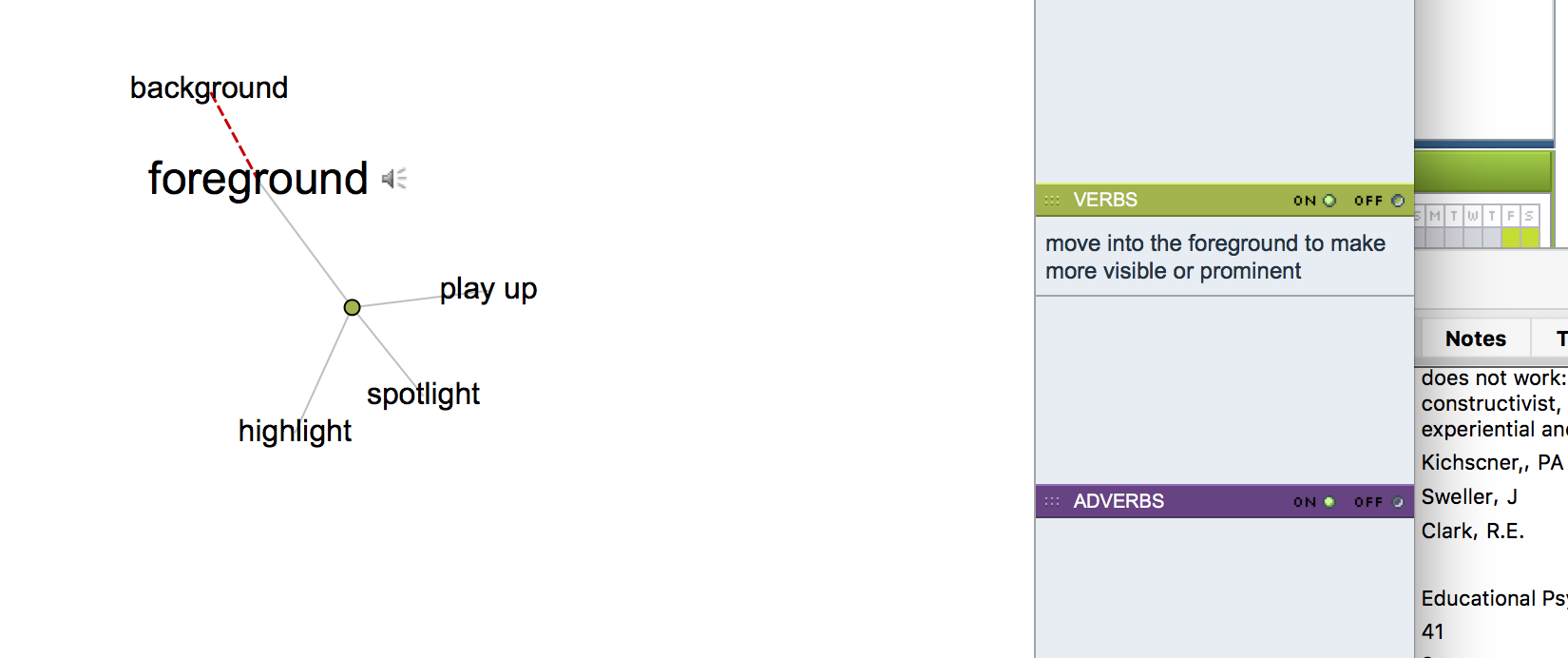
4.Perkins uses foreground as a verb. A lot. Nothing new there. Got me thinking…what words/expressions do I use, knowing that I once I made my list, I was going to visual thesaurus.
clarifies
highlights
puts forward
advances
demonstrates
VT jpg:
Perkins, David N. Making Learning Whole: How Seven Principles of Teaching Can Transform Education. San Francisco, Calif.: Jossey-Bass, 2009.


