Facing History Essay Contest

Here’s the contest again.

We started this process this morning. I’m going to use it as a circle activity but allow students to opt-in to the essay contest via bonus credit of some sort. The students will be designing the activities for the rest of the week.

I tried to come up with a circle activity to think about choices that we make (positive vs. negative) and compare it to choices we had no control over (again, positive vs. negative). Rather than going blue pill vs. red pill, I did it with doorways.

Pretty quickly we got to the “you always have a choice” conversation, which is what I think Wiesel was after. It’s surprisingly hard to come up with stuff, at least as an old guy, where I had no choice. There’s some medical events I never saw coming but that’s about it.

And there was one sophisticated counterargument rooted in urban American poverty: what happens when you’ve lost your ability to get employed because of an arrest and you have no other way of making money. Does that individual really have a choice?

Example one:
Untitled

Example two (best sense of humor ever)
Untitled

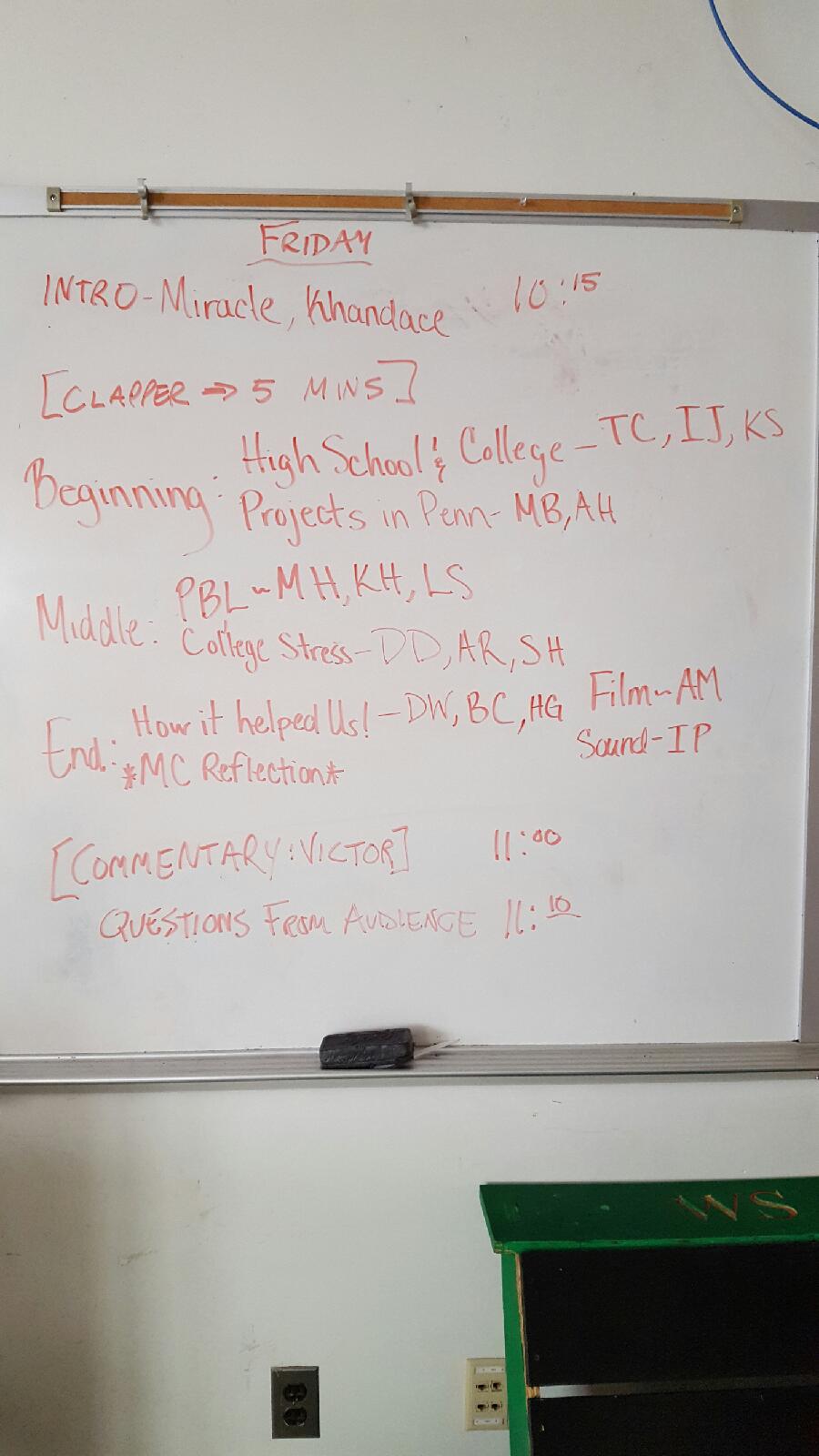
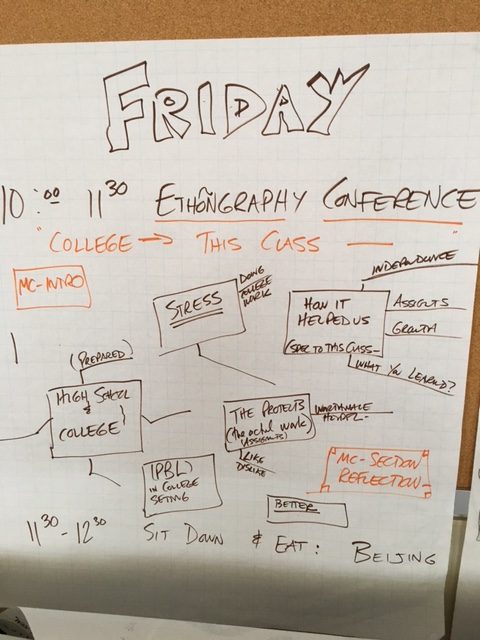
Tomorrow the students take over circle: TC (Tues), SH (Weds), KH (Thurs), and Friday is still open.
Project block two minimums

Trying to get this mantra tattooed into everyone’s head:

Two pages written, fifty pages read, ten hours committed.

This is what I ask as the baseline for a self-designed project. I’ve toyed with these sorts of requirements before but I’m trying to write this on every document and say it as often as I can. It also gives me a way of setting up questions for students about what they’re doing for a self-designed project. What are you writing? What are you reading? How are you using your time?

Part two: human behaviors to worry about with our composter

* people vandalizing it/graffiti/destruction
* carelessness (people putting the wrong thing in the wrong place)
* people not sorting things (browns vs. greens)
* keeping different sorts of compostables in different places
* kids playing on things and wrecking it; thinking it’s a toy.
* not knowing where things go.
* knowing where stuff is being stored, knowing when to add stuff.
* finding a way to get people to gather leaves/browns
* people misunderstanding the design
* understanding the people in the neighborhood.
* teaching folks about something they don’t know
* teaching folks how compost works
* what to do with finished compost
* too much green

Part three: What are two things you can do to address these issues?
1. Have clear labels and instructions!
2. Have stuff in the design to prevent negative stuff from happening.
3. Make a design approachable/have folks believe in it!
4. Do the project here at school so that it’s continuous!
5. Have a sign that’s eye-catching and creative; people should want to read it. (if the design already looks cool, then they won’t mess with it)
6. Easy to understand instructions Big Ass Sign
7. Incentivize for children; (negative consequence to make them feel accountable
8. Make it a contest — who gives the most, gets the most.
9. Meeting in neighborhood — what do they want? What do they like?
10.Give out posters/flyers to explain what it is. (Cute signs)

Design Principles

How do we use design to address human behavior?

MT: Make your object feel like it’s not work.
AH: Make it appealing to the eye; make them want to look at it.
AH: Make them laugh!
HG: Make it pretty/neat.
MH: Visually and intellectually engaging.
MG: Fun (whimsical)
KH: Make them conscious of what they’re doing.
SH: Negative impact of when they don’t do it.
VG: Make it social (imply that everyone is doing it)
KM: Make it relevant to their lives and the things they do.
TC: Make it simple to operate; does it stick out?


A solid list. Here’s what I wrote:
make them laugh,
make them see stuff that’s usually invisible,
make them stop in their tracks; surprise them, and
take advantage of things people do automatically.

Check out what the pros had to say. We did pretty well.

Great essay contest I think I’ll build a week of circle around

Facing History

“Let us not forget, after all, that there is always a moment when the moral choice is made. Often because of one story or one book or one person, we are able to make a different choice, a choice for humanity, for life.”

Please write an essay responding to Wiesel’s quote in 500 words or less. What story, book, or person has influenced your thinking about ethical decision making? What has it taught you about how you can participate as a caring, thoughtful citizen in the world around you?

Opens March 1st, closes March 17th.

thanks RC

Pre-test ritual

Sitting down to take part two of the MAP test — Reading — I ran circle by remembering times that they read well, closely, and with purpose. Once we’d come up with examples, the students set growth goals for themselves.

Some of the answers:

“I know that if you’re doing a project and you need to do research you will be reading with a purpose, which I have done a lot of.” –SH

*Long, long list of projects done.

* “Every project I’ve done I had to read with a purpose. That purpose was to get more insight on the true nature of the project.” –IJ

* For Gateway, I had to read the directions closely.” –AH


This was an activity that made me feel good about our place and hopeful for our students. It also helped alleviate the existential dread I feel when I’m charged with delivering a standardized test. They’ve done some amazing things that demonstrate authentic and deep literary practices.