
Dear Friends,
It feels like third quarter went by in a blink of an eye. Like we started and then boom, it was over. Here are my reflections for third quarter:
One, the students who are enjoying the most success (and I want this to be all of you) seem to have or are developing a clear sense of how the work we do across the morning relates. In other words, how did the work on a composter relate to the work we did in circle relate to the work we did in book group relate to the work we did in project block two relate to the work we did on our trackers? Are these all separate activities? Or should you think about them as closely related? Better yet, how do you see the value in each of these sections for your future plans?
For example, having a clear understanding of oustanding will serve you well in any project you do. So will thinking about the origins of your decisions in service of an essay contest, considering how you best do work, and the difference between a task and a deliverable? (These were all circle conversations). The design process we took on during the Compost Project certainly applies to your individual pieces. Reflecting on how I set up a schedule might allow you to think about you best schedule yourself. And within a project, think about how all the different deliverables relate to each other. Forging these connections might be the most valuable thing you can do for yourself as a student, a worker, and a person.
Two, it’s the beautiful comment made by Mr. Watson the other day in class illustrated by the cartoon below:
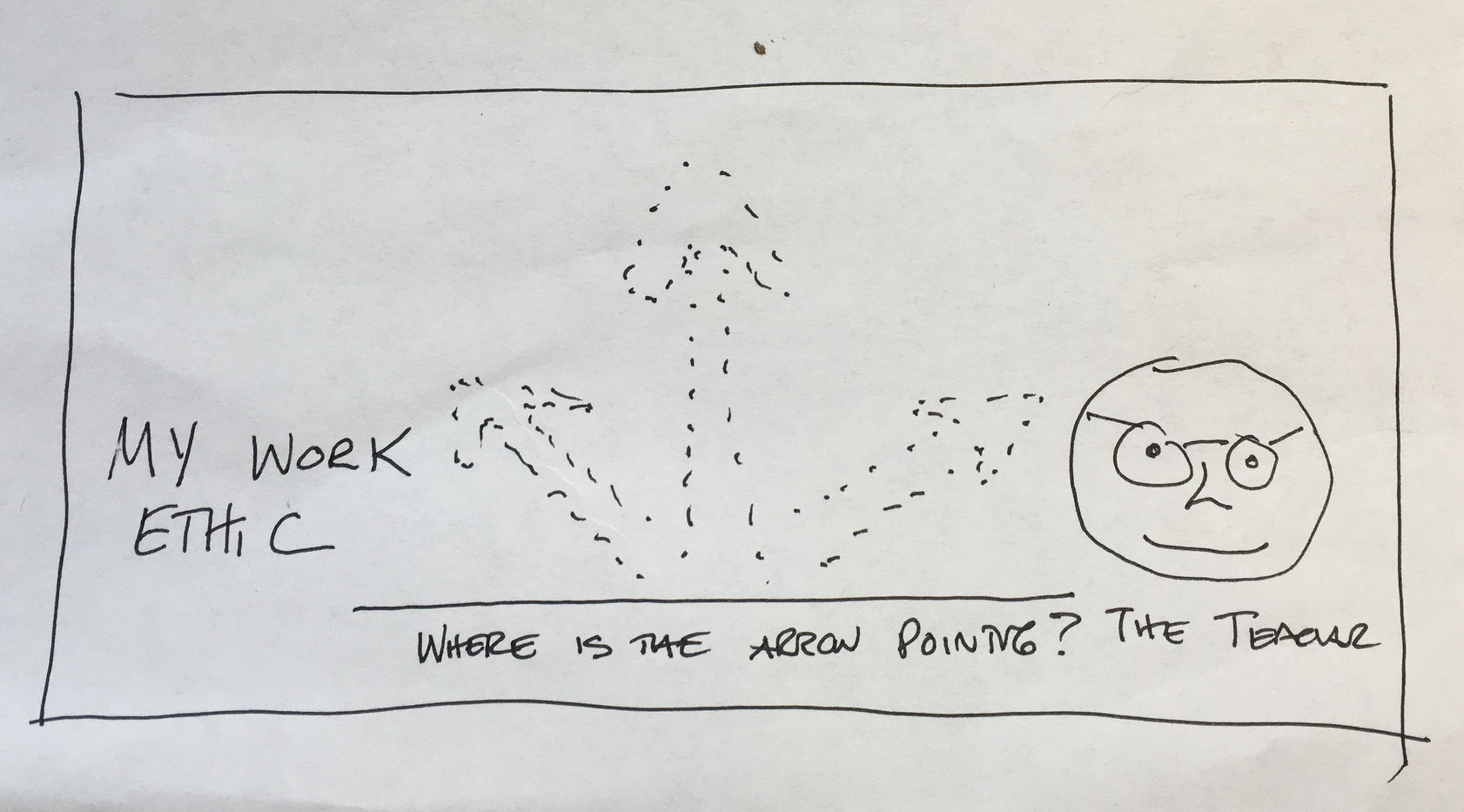
There are always things I can do better as a teacher. There are always things we can do better as a school. What I cannot forcibly change is what’s down to you and your work ethic. The best projects this quarter have emerged from the hard work that’s built upon feedback from me, from the the Penn students, from the experts you’ve solicited, from Mr. Hauger and the other faculty around the building. The best projects have revision histories that extend into the afternoon and evening. The best projects occur outside of school with significant help. The best projects made steady progress across the quarter. This what you should aspire to but it’s also what separates outstanding work on the report cards from you can do better.
Three, I know that it drives you crazy but I want to share it with your parents. It’s what we’re calling the 2-50-10 rule. Each week, for each project, a student should be WRITING two pages, READING fifty pages, and INVESTING ten hours. Some of this will occur in class. Some needs to occur outside of class. Please think about this formula as often as you can. We don’t necessarily have formal homework but none of these projects can get done if there is no work occurring outside of school. I frequently ask students to plan their time outside of school via tracker questions and other activities. Work on this!
Four, the philosophical question of how we, as human beings, have to handle things we don’t want to do. Students: this is a question to ask yourself: how do I handle things I don’t like doing? Do I stop and give up? Or do I think about a strategy to get through it, knowing that it will likely serve me well in the future? Sometimes it’s about simple stuff: I don’t like cleaning up but I really dislike having a disorganized work space. (Many students complain about laptops not being charged but every teacher in my room spends 4-6 minutes collecting and plugging laptops in after students have left them out). Sometimes it’s about school: I didn’t like everything I was told to read but I knew that it would be part of the final. Each human has their own strategy for dealing with what they don’t want to do. The more you can develop these strategies at 16, 17, 18 years old, the better off you will be. Students — you should all ask your parents how much of their day is consumed with things they don’t necessarily want to do and what strategies they employ to deal.
Parents, one thing I would ask all of you to consider and reinforce: the School District of Philadelphia prints latenesses and absences on their official transcript. Too many students are showing double digit absences and latenesses. You cannot earn a scholarship ANYWHERE with this many latenesses and you lose elite opportunities with double digit latenesses and absences. As a school, we want the best for all of our students, but there is damage done to the culture of our classroom when students are constantly late as well an significant impact on the entire community’s ability to complete quality work.. In the comments below, you will see a number — it’s out of 121 — and that’s the number of days your child has been present on-time this year. Please have a conversation with them, to praise their commitment or to start figuring out how things can be different.
As always, please feel free to contact me…


