Category Archives: Teaching 2016_2017

Circle: Time. Again. And Again.

We come back to time management over and over again. For my students it’s not really about time management, it’s about choices. Are you choosing to do the work or are your choosing to do something else? Are you choosing to revise your work or are you choosing to wait until the last day and then write it in one setting? Do you understand that feedback allows improvement or is revision a process of clicking “resolve comment.”

(I can’t get things to paste into the WP application right now so the picture will have to wait.)

Here was the prompt:

Humans.
They know they only have so much time.
They know good work takes lots of time.
They know they need to use their time well.
But they don’t always do so.

What helps you raise up?
What gets in your way?

IMG_7365

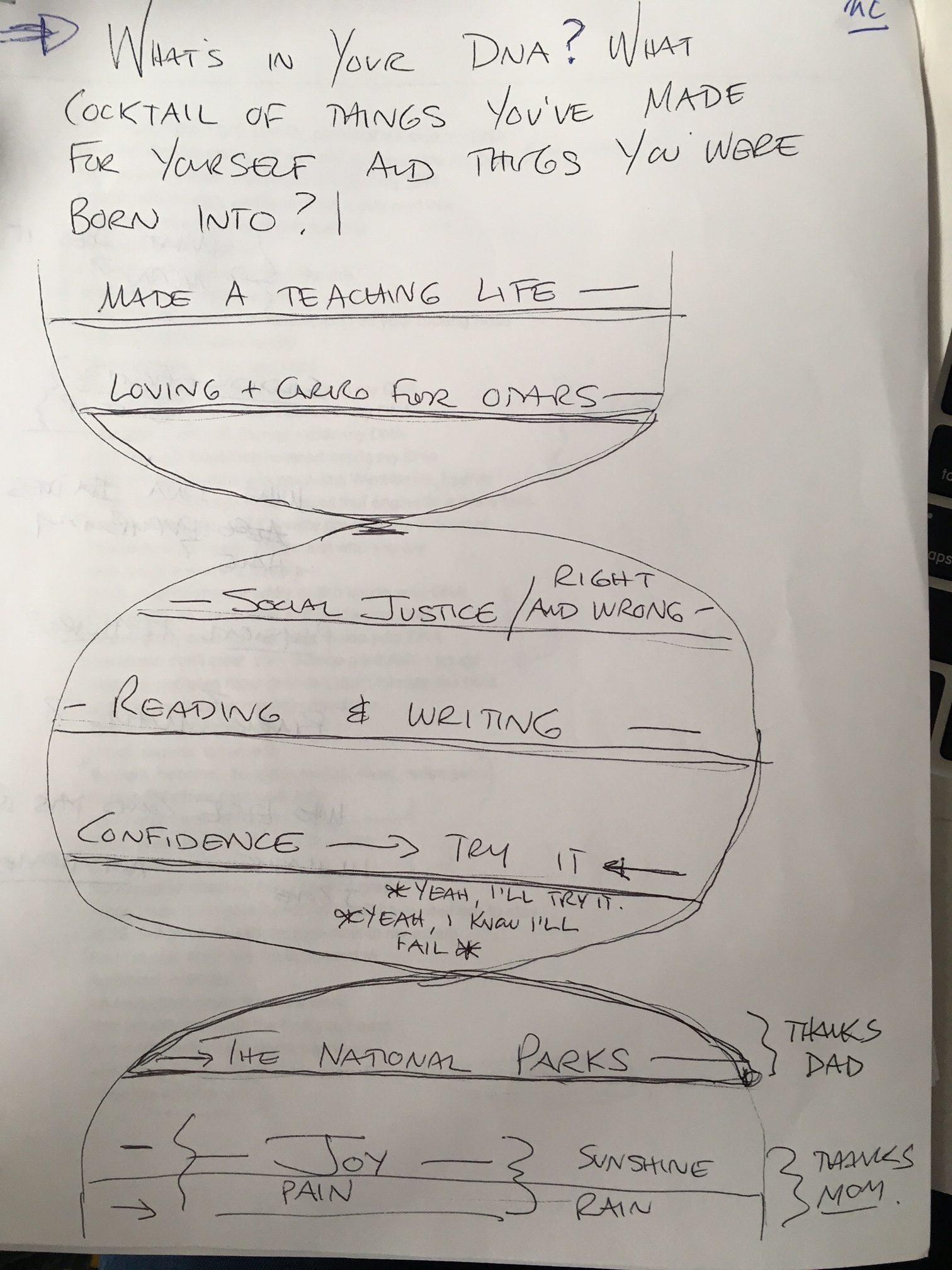
Circle: What’s in your dna?

If they’re all singing it, you may as well make it a circle activity. We did the drawing below and then had a conversation about what’s born and what’s made, what habits are given and what habits are created, what we inherit and we make for ourselves.

The conversation quickly turned to the ways in which we hold things simultaneously — I had written joy and pain (Rob Base) which the kids quickly noted was in the song we listened to next.

Best lines of encouragement

Tuesday’s circle I asked everybody to write motivational letters to themselves about how to finish this year strong. Here are the best lines:

“Remember that Uncle Spanky promised $20 for each A plus mom will kill me if we quack up for our last quarter.” –TC
“By the end of the year, I’m going to have my first episode finished.” –IJ
“Stay focused.” –KM
“Remember that you have someone looking up to you so if you mess up they will think it’s okay for them to mess up.” –MT
“You gonna finish up the year strong because you want your grades to go up.” –AH
“I expect my project to come to life and end up being a big program, even afterschool”
“I want to show people that if I can speak up they can speak up also.” –DD
“Think of the final product you will have at the end of the year.” BC
“If you don’t finish this project you are going to fail in life.” MH
“You will complete this project because you will make this world a better place.” HG
“By the time you read this, I will be dead. But keep your head up and keep pushing through the work” VG

Thoughts on May 1st

The way you do things matters as much as what you’re trying to do. From Martin Luther King:

One of the great philosophical debates of history has been over the whole question of means and ends. And there have always been those who argued that the end justifies the means, that the means really aren’t important. The important thing is to get to the end, you see.

So, if you’re seeking to develop a just society, they say, the important thing is to get there, and the means are really unimportant; any means will do so long as they get you there? they may be violent, they may be untruthful means; they may even be unjust means to a just end. There have been those who have argued this throughout history. But we will never have peace in the world until men everywhere recognize that ends are not cut off from means, because the means represent the ideal in the making, and the end in process, and ultimately you can’t reach good ends through evil means, because the means represent the seed and the end represents the tree.

–Martin Luther King, Christmas Sermon, 1967

One thought

This morning we went down to a theatre to see a performance of monologues sponsored by Philadelphia Young Playwrights. Taliya Carter, one of our amazing students, had submitted an entry that was selected as a winner along with seventeen others.

There was a power in this performance. One, the willingness, really the courage, of students to grapple with complex, challenging events and emotions was on full display. Their creativity and thoughtfulness was truly amazing.

There was also power in the theatre, in the authenticity of the production, in the fact that this work flowed out of the hard work of high school students but it was staged in such a professional way.

All that to say I got to have this conversation with a student as we walked back to the subway:

“Do you think I could do that?”

That’s why we do this. We want students to see the world and to see a vision of the world and to see if they couldn’t create something themselves. If you’re asking that question of yourself, you’re probably going to be okay. If you’re in a school where kids are asking this question, your school is going in the right direction.

Nodding acquaintance

In 1985 or so, I was standing in a McDonald’s near my high school. While I was waiting for my order, one of my former teachers asked me if I was Michael Clapper. I recognized her. I had been in her class the previous year and had been a, um, troubled, student. Still don’t know why I was struggling and it’s probably a tribute to the class that I can recall what we read — a biography of Lenin, a biography of Ghandi.

Still, after her gentle inquiry about how I was doing I’m pretty sure I said something like “I’ve got it figured out.” I know that she said something like “I’m glad you’ve got it figured out.”

About a week ago I was sitting with a student. I was trying to point out a series of not-so-great decisions. I was trying to gently explain there’s no on-off switch in real life. I was trying to express my worry for next year — will she be able to survive in a setting where there aren’t lots of adults looking out for her?

She said something like “I got this. Really, I got this.”

***
Joan Didion, On Keeping a Notebook

I think we are well advised to keep on nodding terms with the people we used to be, whether we find them attractive company or not.

Me at sixteen. Sigh. I wish I really had figured it out. I hadn’t. But I remember that part of me well enough not to browbeat my student, to pause, to nod, to say “I hope you got it.”

And there’s a kind of bittersweet feeling, to know that all I can do is try and keep the faith in this student, in the opportunities we’ve provided, the experiences we’ve created, the advice we’ve offered, the community we’ve tried to make with her, alongside of her, and sometimes just near her.

One of the great parts of our model is that we spend so much time with students that each of them glows with potential. You’ve had the chance to see them in so many different spaces and under so many different conditions that you can feel how alive they all are with possibility.

Feedback approach this quarter

Trying to do two things this quarter:

1. With each presentation, I want the students to reflect on what the student learned this quarter. Through their description of their work, their work process, and their accomplishments, can we feel what new knowledge and skills they gained through their projects.

2. The second part was to write about what we learned from them. For example, as I listened to TC, IJ, and BC I was forced to think about a number of things:

  • how do we break up responsibilities within project design? BC talked about how she was in charge of a particular deliverable and then held her group members accountable. Is this possible? If I did it this way, what would it mean?
  • how do we document change? In other words, TC talked about how she could stay focused this year whereas last year she would have given up. How can I help her document this for herself?
  • This happens every time I do exhibitions but I’m hoping the students can document (and feel) it too.

    Third Quarter Letter

    Dear Friends,

    It feels like third quarter went by in a blink of an eye. Like we started and then boom, it was over. Here are my reflections for third quarter:

    One, the students who are enjoying the most success (and I want this to be all of you) seem to have or are developing a clear sense of how the work we do across the morning relates. In other words, how did the work on a composter relate to the work we did in circle relate to the work we did in book group relate to the work we did in project block two relate to the work we did on our trackers? Are these all separate activities? Or should you think about them as closely related? Better yet, how do you see the value in each of these sections for your future plans?

    For example, having a clear understanding of oustanding will serve you well in any project you do. So will thinking about the origins of your decisions in service of an essay contest, considering how you best do work, and the difference between a task and a deliverable? (These were all circle conversations). The design process we took on during the Compost Project certainly applies to your individual pieces. Reflecting on how I set up a schedule might allow you to think about you best schedule yourself. And within a project, think about how all the different deliverables relate to each other. Forging these connections might be the most valuable thing you can do for yourself as a student, a worker, and a person.

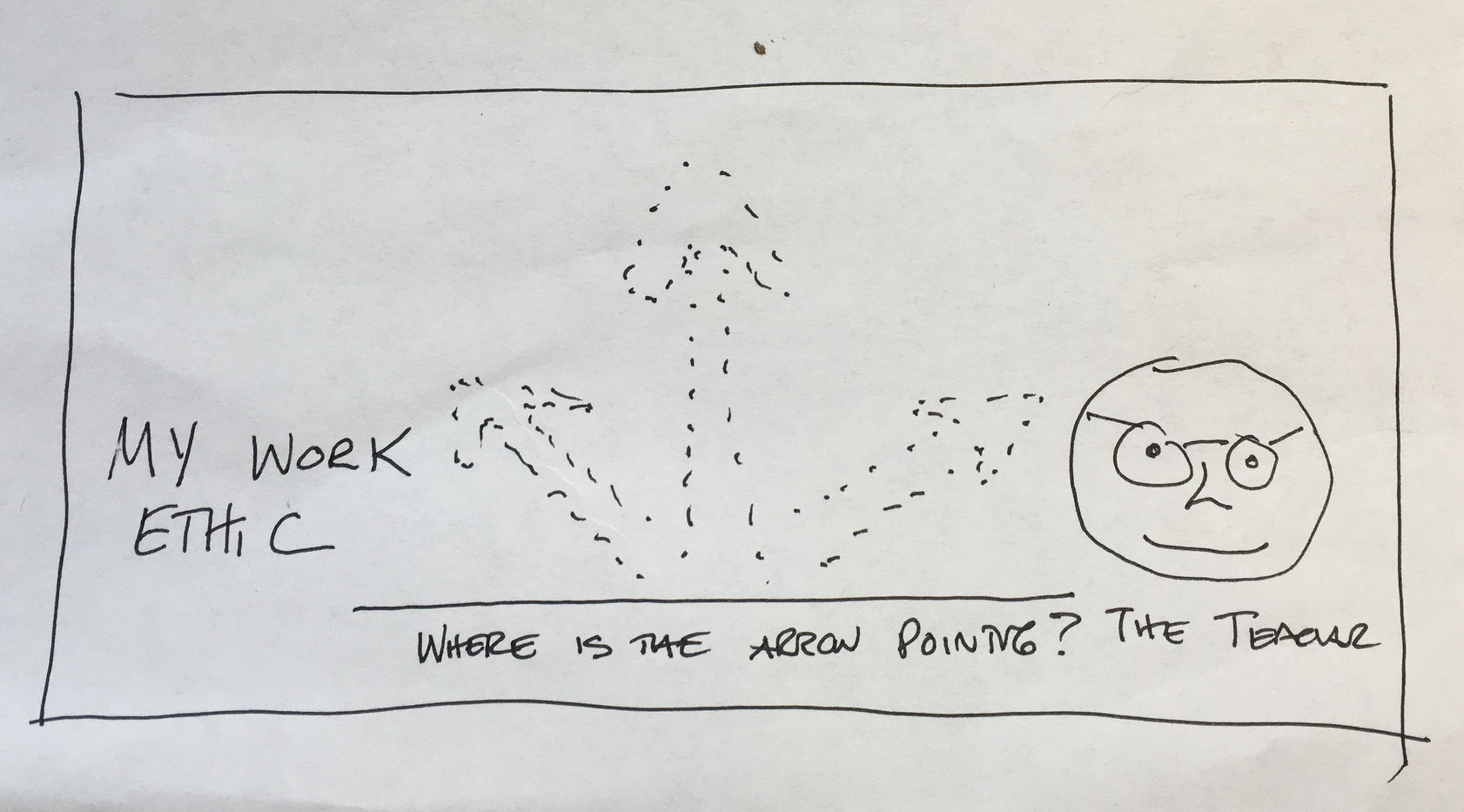
    Two, it’s the beautiful comment made by Mr. Watson the other day in class illustrated by the cartoon below:
    There are always things I can do better as a teacher. There are always things we can do better as a school. What I cannot forcibly change is what’s down to you and your work ethic. The best projects this quarter have emerged from the hard work that’s built upon feedback from me, from the the Penn students, from the experts you’ve solicited, from Mr. Hauger and the other faculty around the building. The best projects have revision histories that extend into the afternoon and evening. The best projects occur outside of school with significant help. The best projects made steady progress across the quarter. This what you should aspire to but it’s also what separates outstanding work on the report cards from you can do better.

    Three, I know that it drives you crazy but I want to share it with your parents. It’s what we’re calling the 2-50-10 rule. Each week, for each project, a student should be WRITING two pages, READING fifty pages, and INVESTING ten hours. Some of this will occur in class. Some needs to occur outside of class. Please think about this formula as often as you can. We don’t necessarily have formal homework but none of these projects can get done if there is no work occurring outside of school. I frequently ask students to plan their time outside of school via tracker questions and other activities. Work on this!

    Four, the philosophical question of how we, as human beings, have to handle things we don’t want to do. Students: this is a question to ask yourself: how do I handle things I don’t like doing? Do I stop and give up? Or do I think about a strategy to get through it, knowing that it will likely serve me well in the future? Sometimes it’s about simple stuff: I don’t like cleaning up but I really dislike having a disorganized work space. (Many students complain about laptops not being charged but every teacher in my room spends 4-6 minutes collecting and plugging laptops in after students have left them out). Sometimes it’s about school: I didn’t like everything I was told to read but I knew that it would be part of the final. Each human has their own strategy for dealing with what they don’t want to do. The more you can develop these strategies at 16, 17, 18 years old, the better off you will be. Students — you should all ask your parents how much of their day is consumed with things they don’t necessarily want to do and what strategies they employ to deal.

    Parents, one thing I would ask all of you to consider and reinforce: the School District of Philadelphia prints latenesses and absences on their official transcript. Too many students are showing double digit absences and latenesses. You cannot earn a scholarship ANYWHERE with this many latenesses and you lose elite opportunities with double digit latenesses and absences. As a school, we want the best for all of our students, but there is damage done to the culture of our classroom when students are constantly late as well an significant impact on the entire community’s ability to complete quality work.. In the comments below, you will see a number — it’s out of 121 — and that’s the number of days your child has been present on-time this year. Please have a conversation with them, to praise their commitment or to start figuring out how things can be different.

    As always, please feel free to contact me…

    Interdisciplinary tension with project work

    Twenty students. Sixteen projects. Five Workshop Skills. Four academic disciplines. One grading system.

    I’m forced into managing several things:

    *generally defining what makes outstanding work within an academic discipline in a way that most projects could reach. For example, what are the social science skills that might emerge in most projects?

    *making sure the students understand these standards for their three deliverables AND can point at the work they’ve done that I might miss. (As DW noted yesterday, Clapper doesn’t see everything.)

    Steps for today:
    1. What academic discipline is most represented in your project?
    2. How does your project measure up to these definitions of outstanding?
    3. What do you still need to do?