Making Learning Whole

Liking this book…Perkins is not overclaiming, not trying to kill you with the scholarship, and carefully offers some things to consider in framing a teaching practice.

Four things:
1. The question I’ve been churning on is “what makes something hard ?” He frames this out to help separate normal stuff that all humans contend with (I’d rather eat cookies than steamed broccoli) so that you can consider when and where your students will stumble. It was helpful for me to think about academic/intellectual stumbles and trying to identify the exact spots where they’ll need help.

2. In this section, he references an article I need to track down, where the authors discuss what can go wrong when kids don’t have enough structure or scaffolding in doing project based learning/problem based learning/inquiry learning.

Kichscner, PA, J Sweller, and R.E. Clark. “Why Minimal Guidance during Instruction Does Not Work: An Analysis of the Failure of Constructivist, Discovery, Problem Based, Experiential and Inquiry-Based Teaching.” Educational Psychologist 41, no. 2 (2006): 75–86.

3. There’s no reference to Grant Wiggins here. I like his books and thought Perkins travels many of the same roads; I might replace Educative Assessment with this book if I ever do teacher ed again. Just interesting that scholars can have similar conclusions and work in such similar areas yet you’d not know it.

4.Perkins uses foreground as a verb. A lot. Nothing new there. Got me thinking…what words/expressions do I use, knowing that I once I made my list, I was going to visual thesaurus.

clarifies
highlights
puts forward
advances
demonstrates

VT jpg:
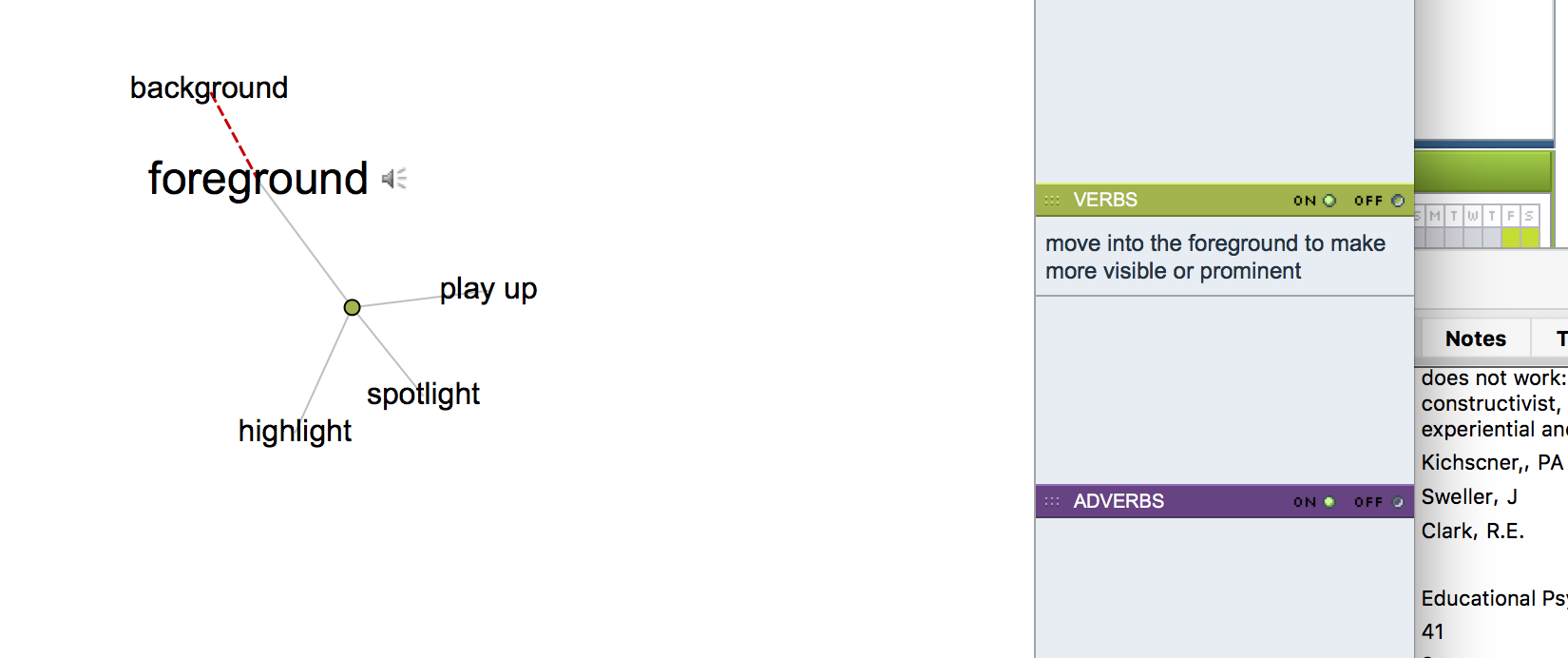
Screen Shot 2016-07-27 at 10.13.06 AM

Perkins, David N. Making Learning Whole: How Seven Principles of Teaching Can Transform Education. San Francisco, Calif.: Jossey-Bass, 2009.

Is the ground too hot?

Got back from vacation and the garden had cooked the lettuce into giant flowers. May be too hot, but I’m going to try and start summer plants with the hopes I can harvest in October.

SSE: Blondkopfchen
SSE: Hartman’s Yellow Gooseberry
SSE: Plum Lemon
SSE: Gold Rush Currant
All of the left over basil seeds.

Traveling and how we live

It was a privilege to travel for thirteen days across the American West. It fed my soul.

As we’re driving Wyoming, the incessant American need for more natural resources stayed in constant view. You’re always in sight of a gas or oil operation — you can see them dotted across the landscape — even if you rarely find yourself confronted with a massive coal operation, as we did on Tuesday. Driving past the Thunder Bay Mining Operation — an operation I know nothing about (maybe it’s the cleanest, best coal company going) — and you’re struck by the massive scale. Those trucks your kids you used to watch in videos? There they are. Signs that read “Blasting ahead! Avoid Orange Cloud” are on the side of the road. The landscape has been dug up and completely turned over.

Yet you’ll only see this if you go down the side road of a side road, a highway you needn’t ever travel.

How do you convince people to change their behavior when the thing that enables their behavior is wrecking the land 2000 miles away on a highway they will never see? How do you underscore how all decisions are interconnected when so much of mass culture is designed to make sure you don’t make those connections?

Modern Travel

6:05 Wake up in Keystone, South Dakota. Leave in rented Kia Rio
Drive 374 miles.
12:25 Drop car at Denver International Airport
12:30 Get on bus to go into terminal
1:10 Get on short train to go to gate
3:05 Fly 800 miles to Houston
7:05 Take short train to new gate
7:40 Fly 1200 miles to Philadelphia
11:50 Hit Uber app. Taxied 10 miles home.
1:00 Go to sleep.

Almost 100 miles an hour for sixteen hours straight.