“But now we have moved on. Veganism seems to be where much of our cooking desire has moved, hence the incredible success of the spiralizer. When they started appearing a couple of years ago, I felt that spiralizers were destined for immediate obsolescence, but I was completely wrong. Maybe it’s because of low-carb diets or maybe it’s the rise of #plantbased on Instagram, but it turns out that the ability to turn a beet or zucchini into something resembling telephone wire speaks to more people than I ever knew.”
Friday in May
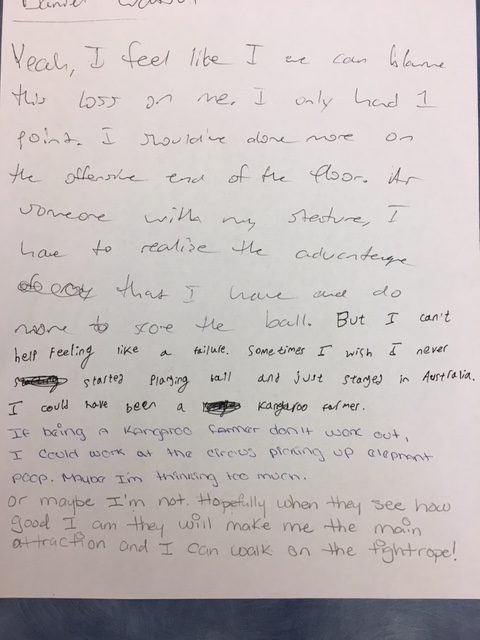
Let’s write monologues together. I had two starting points before today began:
What if you were a senior who had no plan for next year? What would you say in a monologue?
What if you were a basketball player on a team that had blown a twenty-two point lead?
Then somebody (AG) said, “I wake up every morning covered in scratches” so that became the third prompt: what if you were someone who woke up everyday covered in scratches?
One cool monologue, which didn’t devolve into a drug cartel drama, which is usually what happens in our collaborative sessions.
Constructive answer to not enough time
It’s that time of the year where the students are feeling like there isn’t enough time.
It’s that time of the year where it’s hard to watch certain behaviors and offer a civil response to complaints about not having enough time.
I’m thinking this afternoon about the positive things I’m going to say in response to these sorts of claims:
Let’s make a plan for the next week.
What do you feel the most stressed about?
What’s the one thing you could do right now that would help you feel caught up?
Have you made a list of everything you need to do?
What are the things you do that help you make the most of your time?
Have you looked at the requirements for the project, course, assignment? (With undergrads I find that re-reading the requirements helps them relax.)
I’m wondering, too, if I might enlist a few of the kids who are really working at managing their time to share their approach with the class.
What we accomplished
While it was a testing day, we still ran circle. Everybody came up with a list of their accomplishments during this school year. We looked at them and then tried to figure out if we were “real” this year.
I collected them and then we guessed at whose accomplishments were whose. Fun game.
It must have been a pretty good year because much of what was on the papers focused on our work together. Some years I’ve done this and kids have long lists that have nothing to do with anything we did, i.e., I got my license or I kept my job.
Teacher accomplishments
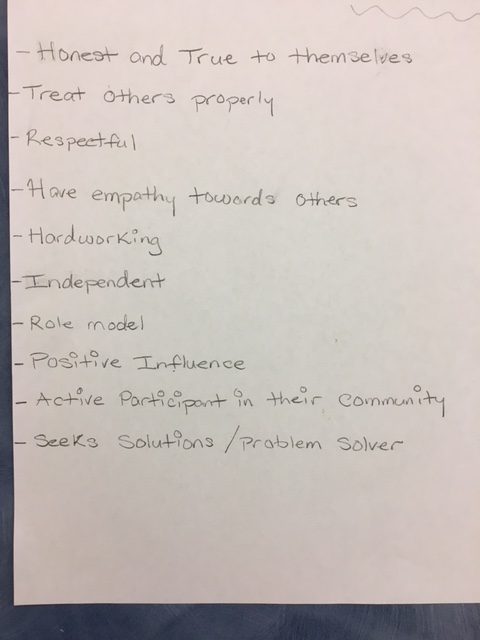
A person of substance
I keep trying to have the substance vs. style conversation in circle. I want students thinking about real work, authentic work, work with substance. And I want them thinking about how to maintain a consistent approach to work in all aspects of their lives.
But I have to do it in indirect ways. This week I’m asking them to think about how a person of substance navigates the world.
We began this week by trying to define this…
DC:
JJ: 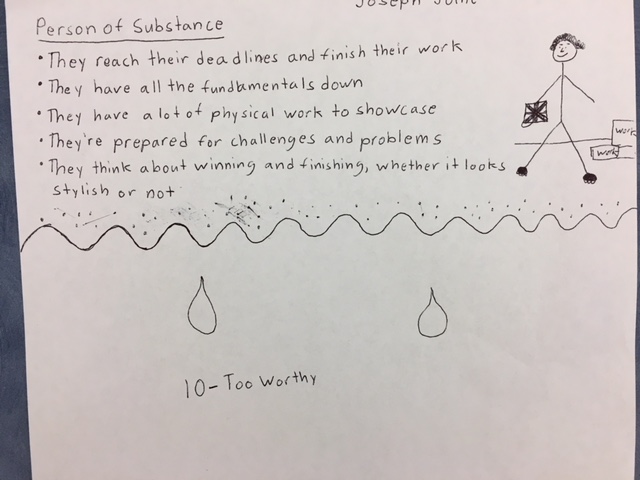
For me, substance is about follow through, which I worry about, at least for myself, during this time of year when I’m just trying to stay afloat.
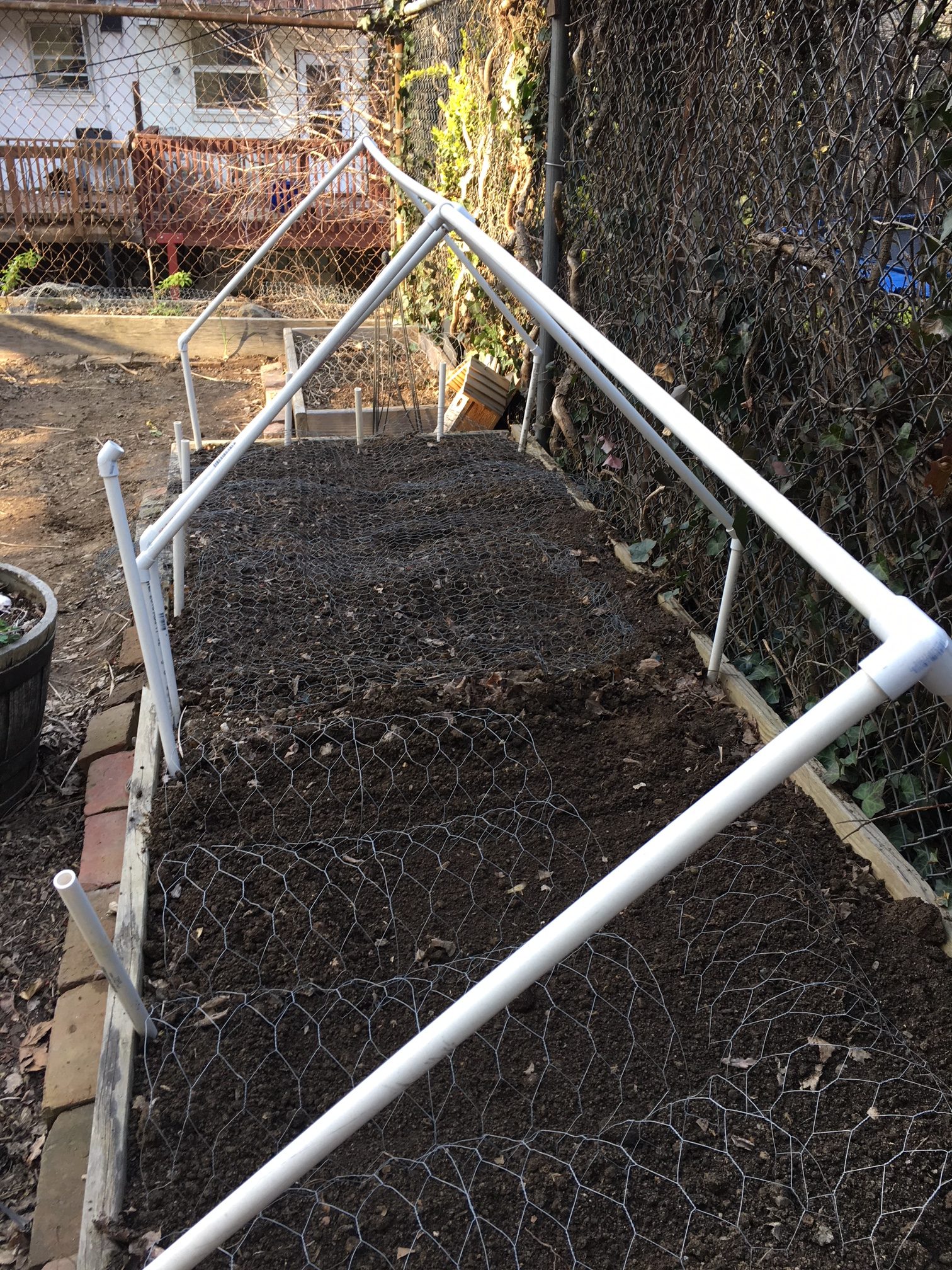
Lettuce bed in back
North half
| Marvel of Four Seasons/SSE | Red FLame/SSE | Black Seeded Simpson/Br | Grandpa Admires/SSE | Arugula/SSE |
| Amish Deer Tongue/SSE | Slobolt/SSE | Gulley’s Favorite/SSE | Tatsoi/SSE | Arugula/SSE |
| Bronze Arrowhead/SSE | Lettuce Mixture/SSE | Waldron’s Dark Green/SoC | Endive: Tres Fine/SSE | Arugula/SSE |
| For Ellen Schluss/SSE | Green Oak Leaf | Mesclun | ? | Arugula/SSE |
This bed is partially inspired by this article on the history of lettuce.
North section in the far part of the project.
Advice to tenth graders
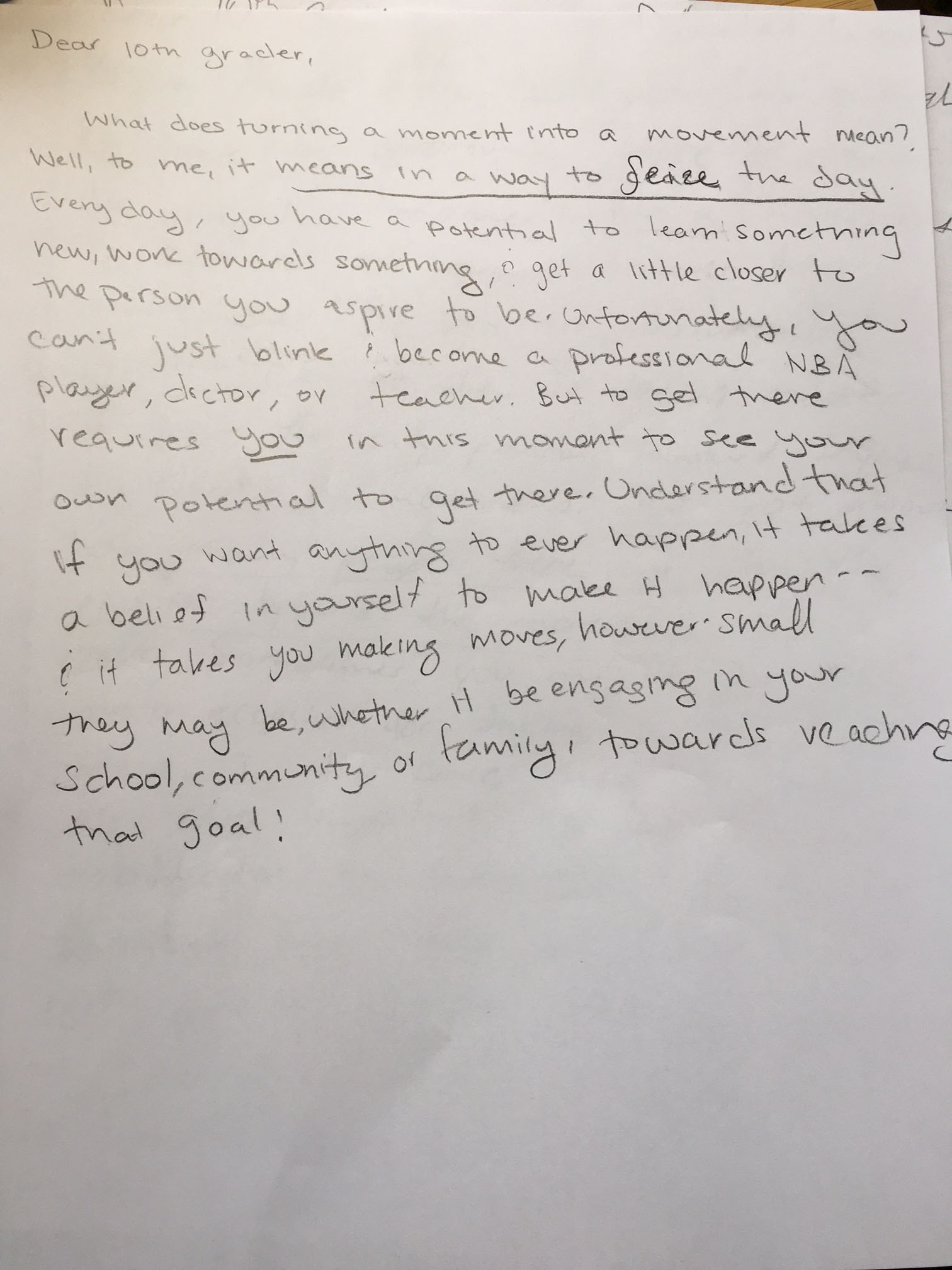
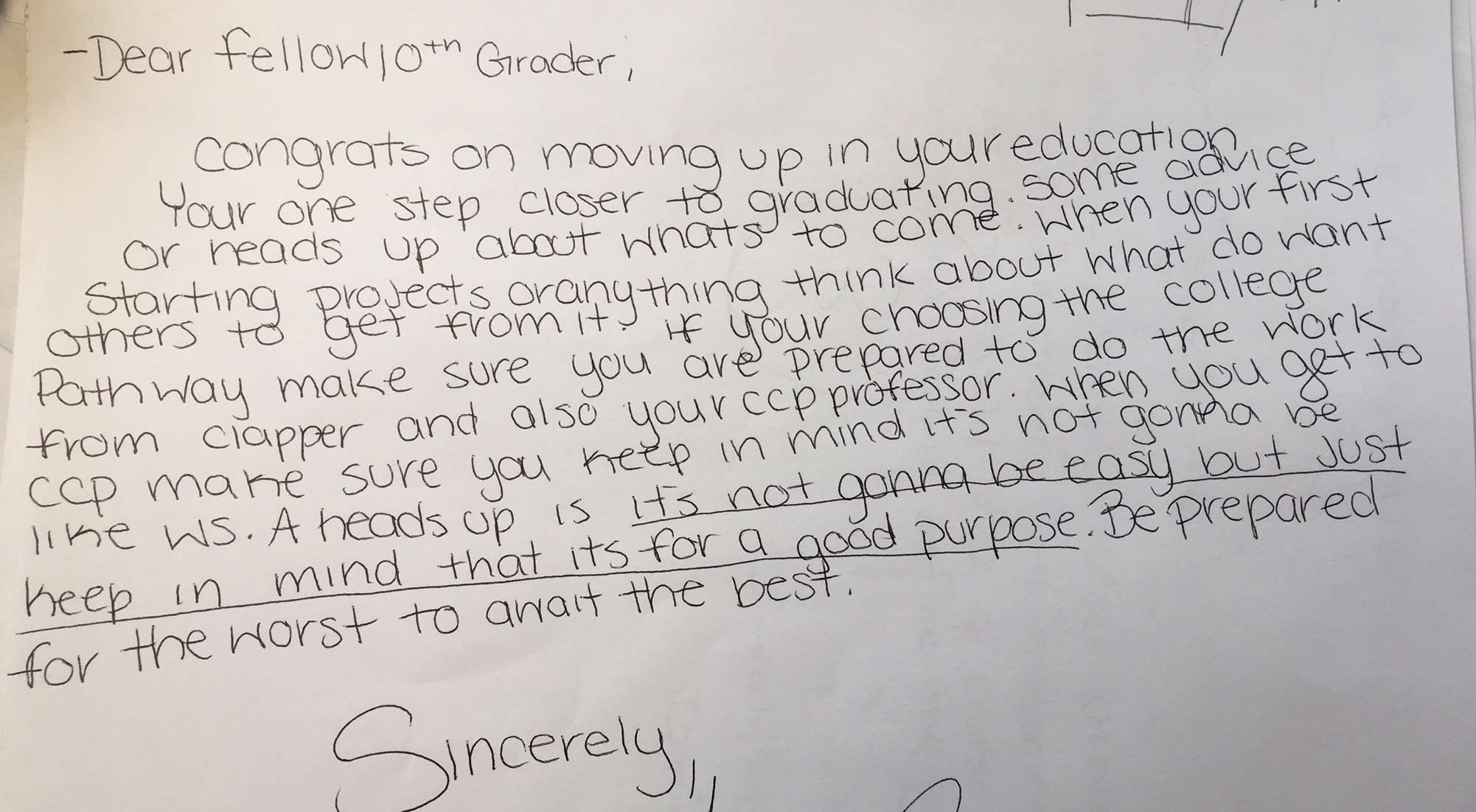
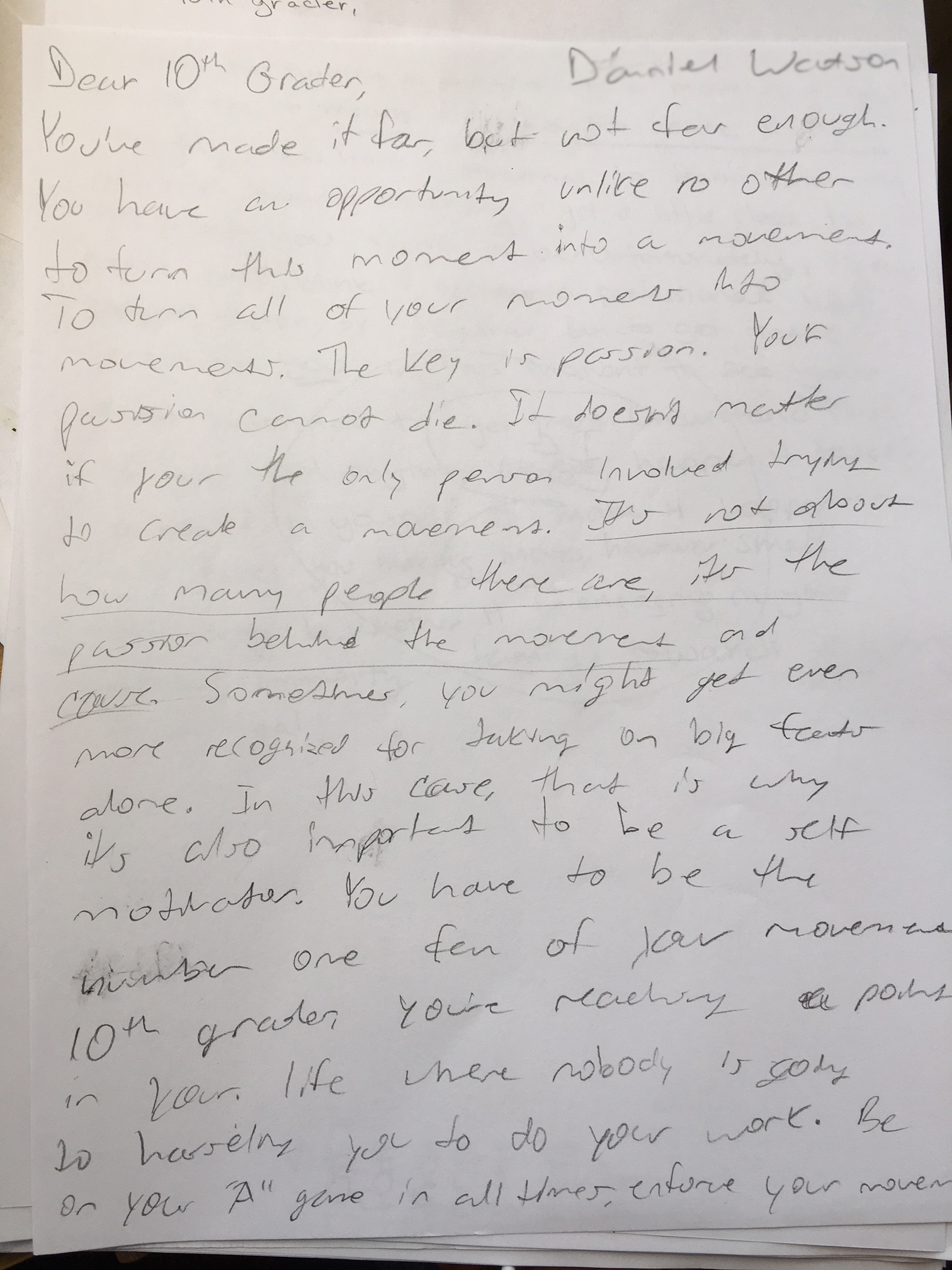
Finishing out the week, Friday’s circle was about connecting moments to movements. We wrote letters to our tenth grade friends offering advice on how to do this.
Some excerpts:
“Follow your passion.”
“My advice for you is not to rush into something without knowing about it thoroughly. Take your time and ask for help. Real shit, though, ask for help. Don’t try to do anything by yourself.” SJ
“Make sure your moments can lead to something to something that can last for a long time…Also, if you don’t know what you want to do take moments to explore your options and once you decide, make movements by following your choice.” JC
“Not everyone finds their cause right away. Eleventh grade is hard and confusing, remember that you are doing something even adults have trouble with. Always ask for help even if you don’t need it. Teachers will be nice if you show you tried. Call out BS when you can but don’t make it all you do.” CS
“Yo Dawg…believe in your self. If there’s anything you want to do, try it. Even if you aren’t sure you want to do it. Yell at your teachers and tell them about what you want to do. Eight times of ten, they’ll try to help you. Seven times out of ten, they’ll guide you to something cool. They don’t even have to your teacher, if you’re in Ms. C’s class, feel free to yell at Mr.A. if you think he’ll help.” MW
“Focus on your work and your future because these last two years will go by fast.”
MLK and a sad day
I read this article in this morning’s paper and knew I wanted to read it in class. I took it apart so I could print it — when did the NYT disable the print function or when did I get so blind — and got it into a document. Then I left the computer home.
So we began today with the question of what the difference is between a “moment” and a “movement”. Lots of super deep thoughts. AG did a great job facilitating. KH brought us the following statement: “You don’t want to be stuck in a moment, you want to get down with the movement.”
It was a great set-up for a conversation about playwriting. Being able to answer when a scene represents a moment as well as how these moments eventually add up to a movement is vital.
TC: a moment is when something happens and everyone’s talking about it for a short time but a movement is something that looks to solve a problem.
VG: Dr. King losing his life (a moment) meant something to the Civil Rights MOVEMENT.
DC: A movement is a group of people who join forces to bring light to a situation that is an issue to them; a moment is something that happens quickly, in a blink of an eye.
KN: A moment is like a time in the day. It’ll always come around. It doesn’t last but it’ll come back around.
JN: A moment just happens but a movement is something will change history.
Louie Anderson Quote
Driving and listening to NPR last week, we heard this quote from Louis Anderson:
I’m always on the verge of tears because I think everyday, you know, you should bring yourself to tears. Everyday you should be that passionate, and you should have a good laugh everyday. And you know, you should discover something new everyday.
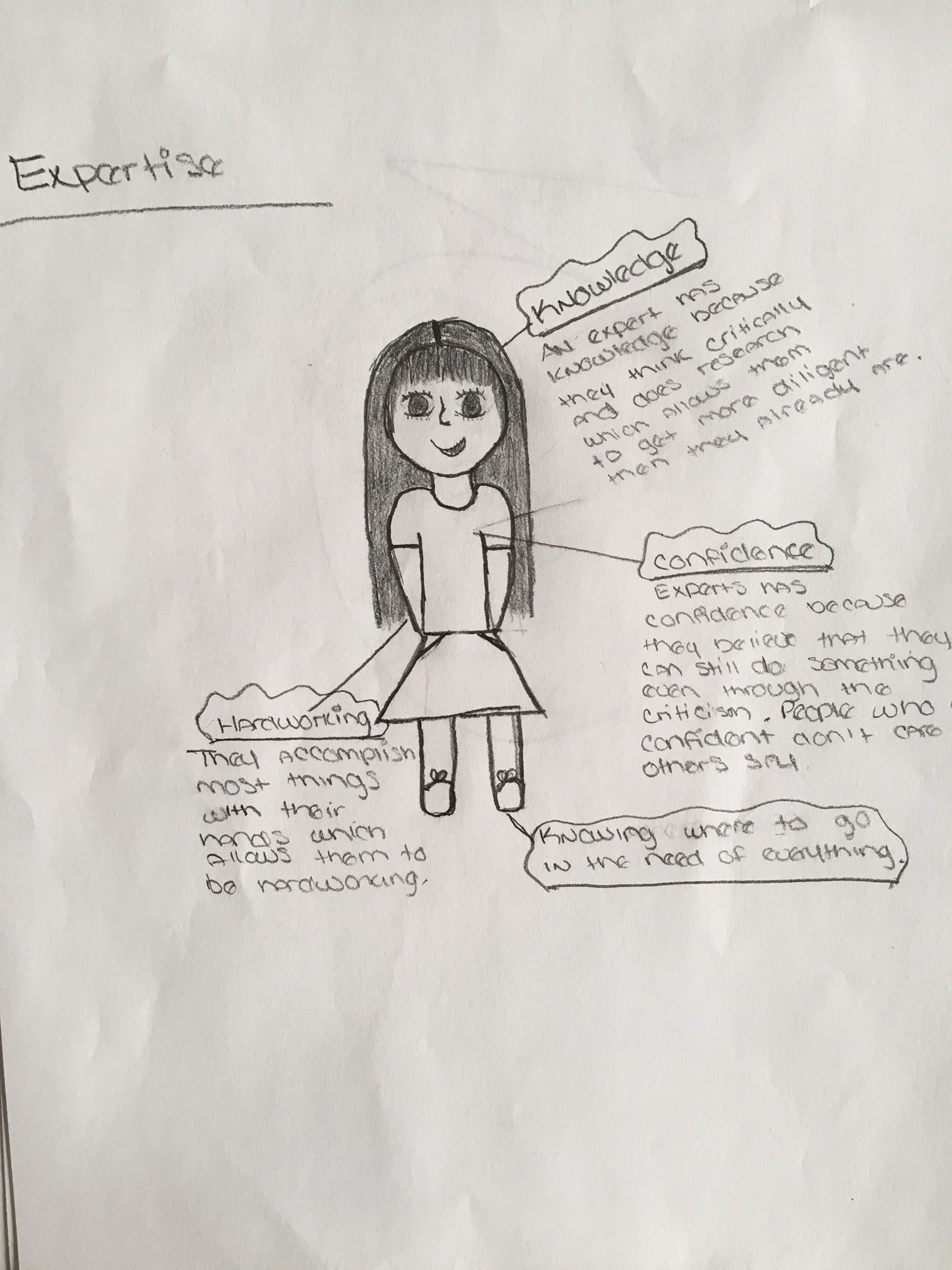
Expertise
The miraculous circle conversation happened again today on expertise.
Here’s a drawing as I asked them to consider what an expert has in their head, their hands, their heart, and their feet.