A good quarter. Some general thoughts on Workshop Tank 1.0:
You all were the pioneers, the pathbreakers, the first students at Workshop Tank to attempt to develop a fully-fleshed out organization plan. Twenty-two of you presented over four days to a real audience of professionals from around the Delaware Valley. There’s authenticity in this work that I hope you appreciated and, as I said, the judges were impressed by the poise, creativity, and energy you all displayed. Several clusters of feedback:
One, when you are presenting an idea you are also presenting yourself. Part of this process allowed the judges to see how great all of you are. Always remember that there’s no right or wrong way to present — you can be noisy and charismatic or you can be quiet and detail oriented — either will work so long as you display passion about what you’re saying. Almost everyone had a moment during their presentation where they lit up the room. That moment was usually the moment they fully connected with something they cared about deeply. No matter what you end up doing, that’s a place you need to find in yourself.
Two, there’s initial hard work in coming up with an original idea or a way to modify an existing program. What matters in these sorts of competitions (and in life) is that you have something behind what you’re saying, that you have back-up, that you have the evidence to support your idea going forward. For some of the presenters, when they struggled, they were able to reach back to their business plans and their research and find a way to move forward. For others, the presentation was all there was. What I’m trying to say is that the work is the work and that getting something started is a first step. All of these organizations required hard work to prepare a plan for and all of these organizations will require hard work to advance.
Three, going simple is always better than trying to fake it. You had ten weeks to come up with a plan and present. When you get nervous, return to the basic idea you came up and go from there. Do not improvise! Do not try and talk your way out of a corner as you will almost always get yourself into trouble. Better to say something like, “that’s a great question that I’m not sure about” then to make a claim you can’t possibly support.
All in all, a good project. I hope you enjoyed the final process as much as I did.
Thoughts on individual project block:
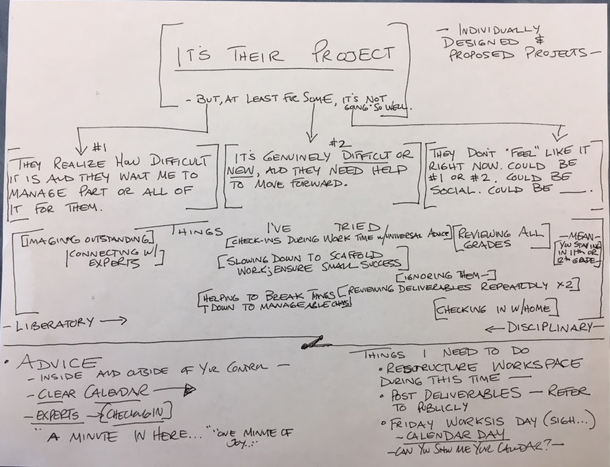
There were some provocative, creative, and outstanding individual projects. In watching the exhibitions, I was struck by one thing: what was the difference between folks who could talk about their individual deliverables (the products) and those who could not? The projects that had clear deliverables seemed to move and the individual doing them seemed to make regular progress. Others, not so much. What can we all do to keep the deliverables in the forefront of everyone’s minds? How do we help make that they are seen as stepping stones towards final excellence?
A second concern I want to bring up here is outstanding work. How do we get to conversations about outstanding? Simply doing the work doesn’t make it outstanding. Similarly, if someone from our community stands up with work that is clearly not outstanding, what do we owe them? We’ll talk more about this during fourth quarter.
Third, what do we do about time management. Our school is built on a four hour block together. Much of that block is given over to project work. There is a fifth period study hall two days a week and sixth and seventh period are wide open for project work. Yet I hear many folks say they do not have time. How do we reconcile this claim with reality? If were to look at the fifth period with Ms. Marina and the Tues/Thurs cafeteria times, would we see students plugging away at their projects and their CCP homework? If we looked into the revision history for project deliverables, would we see regular use of this time, or would we see extensive YouTube playlists? WARNING: annoying old person statement alert: you will never have as much time as you do right now. Developing good habits will take you a long way.
Finally, for juniors and seniors, I’m still hearing these kinds of statements way too much:
“I wasn’t passionate about it, so I didn’t do it.”
“I didn’t have time for that.”
We are a place where you have significant freedoms both within the projects themselves and in how you navigate the school. Part of that freedom is earned by completing the work. Much of life is consumed with tasks you don’t want to do, from small ones — taking out the garbage — to large ones — learning a skill well-enough that you can get paid to do it — and the sooner everyone understands that, the better. One of our biggest worries is always that students will interpret the freedom within our school to mean you only have to do things you want to do. Ask the humans you respect most about this issue, about how much of their time is taken up with difficult and not particularly rewarding tasks. See what they say.
A good quarter. Thank you all!
MC