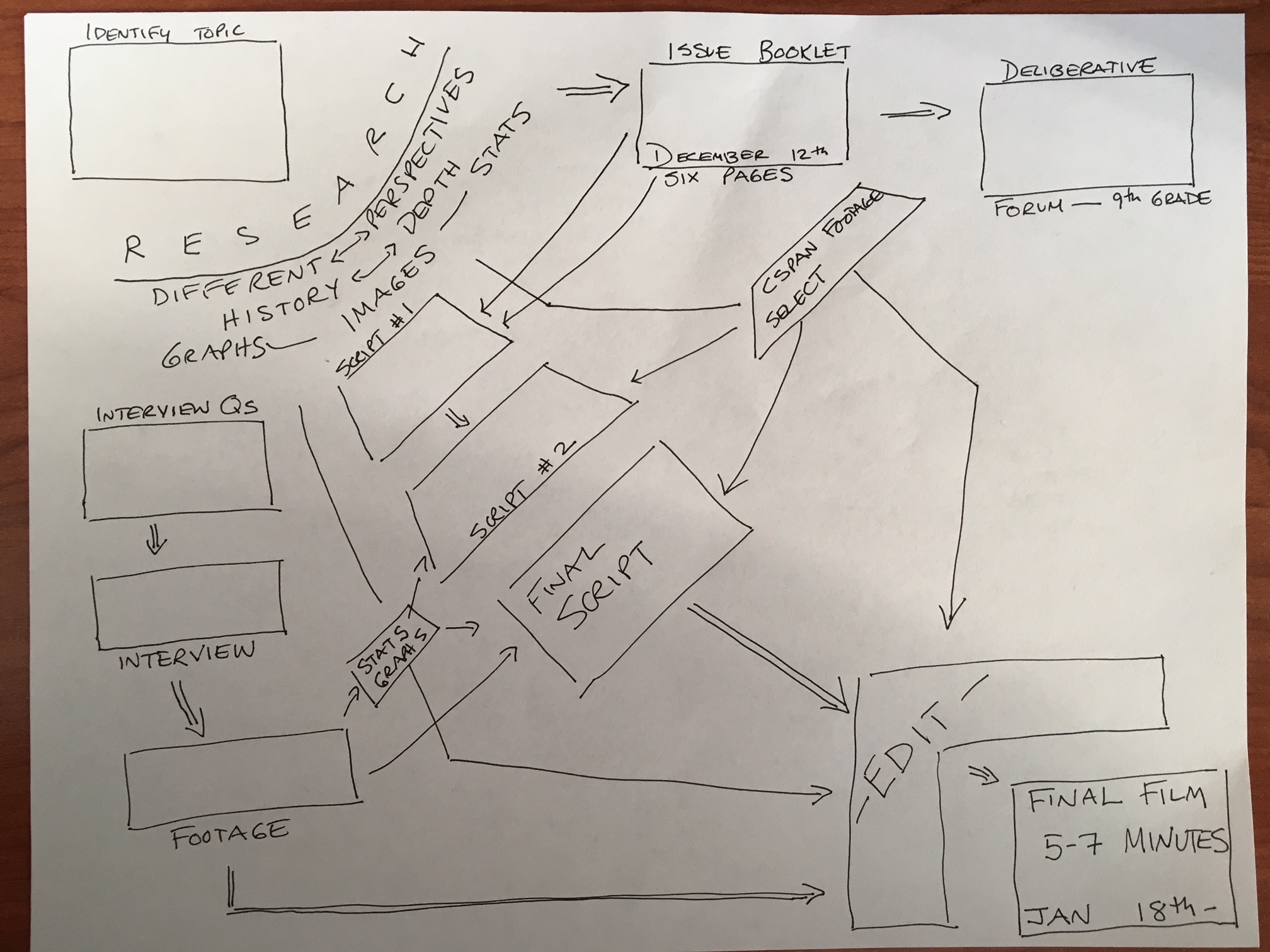
Community building going wrong? Right?
Every Thursday we play mafia. It’s a pretty good game.
Today I had to leave the room because a student was struggling. For thirty seconds.
I think the students then conspired to identify the mafia members and not accuse them in order to prolong the game, to slow down the work process. After all, it is the Thursday before the Holiday Break and the district has us going to work and school through tomorrow at 3:30PM.
It’s happening right now and I can’t really tell. But I think that’s what’s happening.
On the one hand, it’s the quietest I’ve ever heard this game. They’re actually deliberating and paying attention to the rules; it would be ironic that it takes the quest to prolong the game as a way of unifying the class. (I feel this way with my own children — I’m thrilled when they band together even when it’s in service of disagreeing with their parents.)
On the other hand, maybe the game has evolved to the point that who knows what the reality is.
Update: 9:29A They are clearly fillibustering. JY is extending this game in a way I didn’t see as possible. Dead brilliant.
The question of what role to play…
I had this brilliant Penn professor come through a couple of weeks ago. We were talking about the ways in which kids were approaching their CSpan films and then he was talking about how his students ought to approach my students as they approached their films.
He noted that he was putting on his “producer’s hat.”
I was thinking about this as we work through our films. In some ways, I’m the producer for these twenty-six documentaries. I’m helping kids frame them, gathering resources, trying to ask good questions, and pushing on spots I see as weaknesses. I think this is what producers do or at least some of what they do.
On great days, that’s what I feel like I’m doing. I do a bit of teaching — here’s something you all need to think about (transitions, framing a shot, invoking the Constitution) — but then I’m just traveling around talking to students about their films. As they see a need, I try to help them address it, as much as I can. It’s their work. I’m there to help.
On other days, though, it’s much harder. You can’t sit in that producer role when the director doesn’t want to work. You can’t make the film for them.
Circle: Filmmaking
Trying to refocus our CSpan work by looking at how other documentarians have approached things.
Used this interview. Some of the questions that resonated during our conversation:
Why make documentaries?
How do we achieve raw emotion when talking about the US Constitution?
Should we see ourselves as insiders or outsiders?
Guardian rules for writing
Article on soil quality
Here.
This is money:
On the other hand, carbon sequestration in soil and vegetation is an effective way to pull carbon from the atmosphere that in some ways is the opposite of geoengineering. Instead of overcoming nature, it reinforces it, promoting the propagation of plant life to return carbon to the soil that was there in the first place — until destructive agricultural practices prompted its release into the atmosphere as carbon dioxide. That process started with the advent of agriculture about 10,000 years ago and accelerated over the last century as industrial farming and ranching rapidly expanded.
From start to now
Did an activity where the students had to compare where they began with their CSpan film and where they are now.
Two favorites:
I have no idea/why the f*ck do we have to do this?
TO
My film is about the NFL’s protest due to the President’s comments on one of the Football Player’s choice to kneel during the National Anthem.
About Donald Trump
TO
I would first say my topic. Then talk about how society portrays Muslims and other religions and how even though it’s freedom of religion, we don’t really have it.
What’s left over?
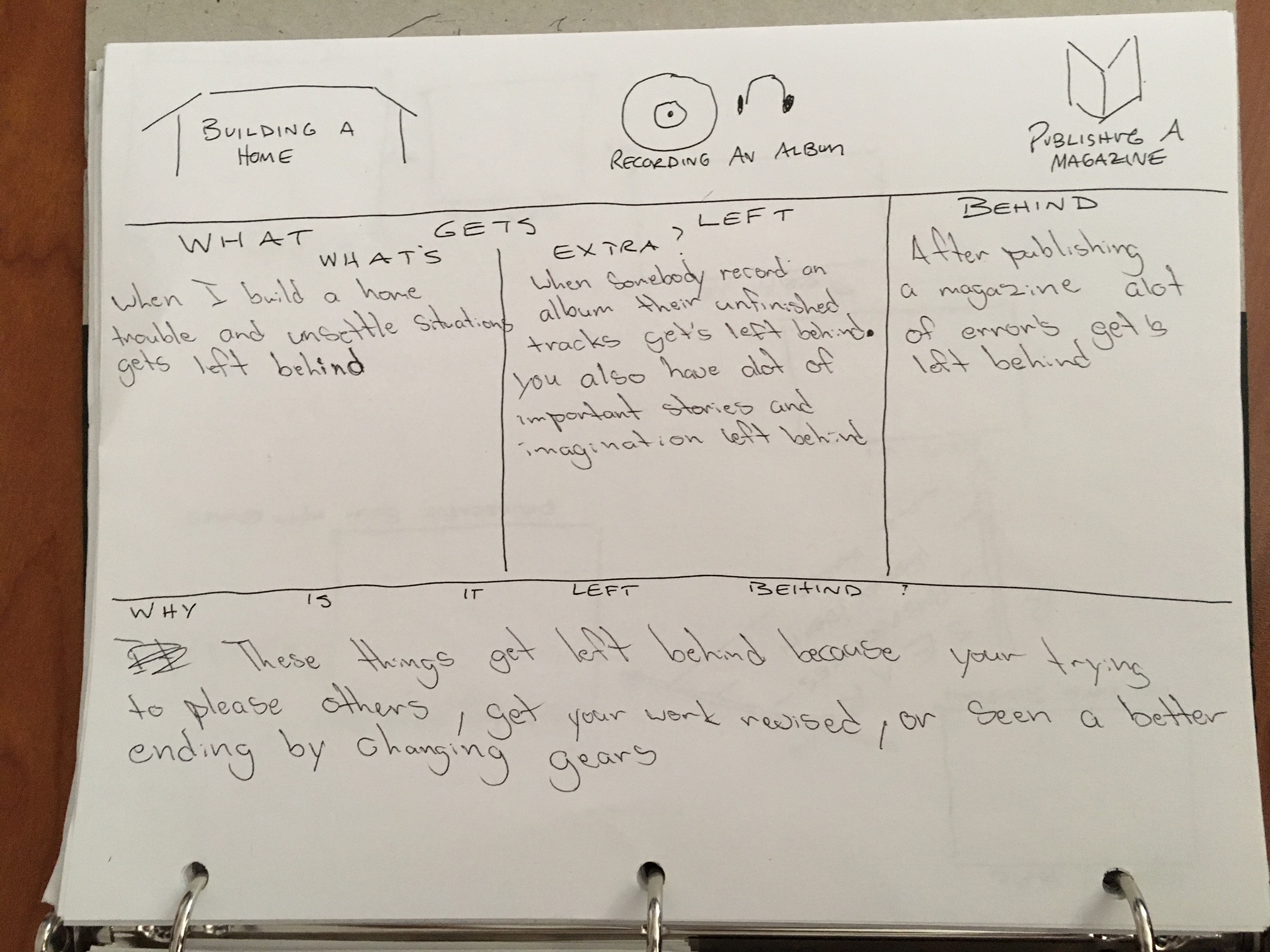
An attempt to help everyone realize that any project requires lots of extra work. In other words, how do you help kids realize that no real project has just enough work, that any project requires work that doesn’t always have immediate pay off.
I tried it with three areas — house building, recording an album, publishing a magazine — with the prompt of what gets left behind or what the extra work might be.
Example below:
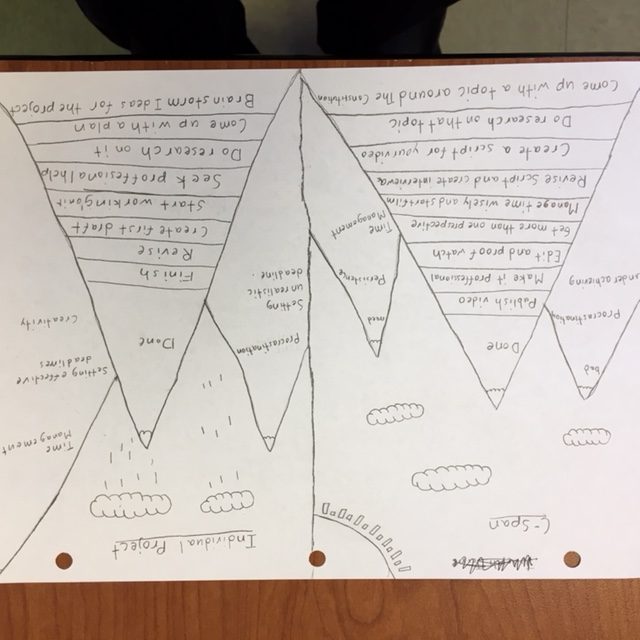
Drawing mountains based on the two projects
CSpan and Individually designed projects
Revised version of CSpan workflow
Based on student comments.