Rules…

Starting conversation for the day on the whiteboard:

“Why do rules matter? No, I don’t mean headphones or school stuff. I mean things like you can’t run with a basketball or you can’t have a paper with no punctuation. What purpose do they serve? Where do they come from? Why do they matter?”

My students and I tend to rotate through our morning circle activities. Sometimes we read. Sometimes we write. Sometimes we argue. Sometimes we watch a short video. Most days a student runs the conversation and most days a student keeps track of the conversation. Some of the conversations become posters (more on that later) and most end up in our binders.

Today’s discussion points, all of which are student driven:
do rules bring order?
Without rules, everything will be unorganized
Rules help things flow better
You learn from rules (they help you know what you supposed to do)
You learn from watching others follow rules.
Breaking rules to make a point.

Best part of the day was when someone made this comment: “you can’t practice school.” This will become tomorrow’s discussion starter. But all of the points above (culled from my list and our notetaker’s list) matter. They matter today, as sophomores, and today, as a weary 46 year old man.

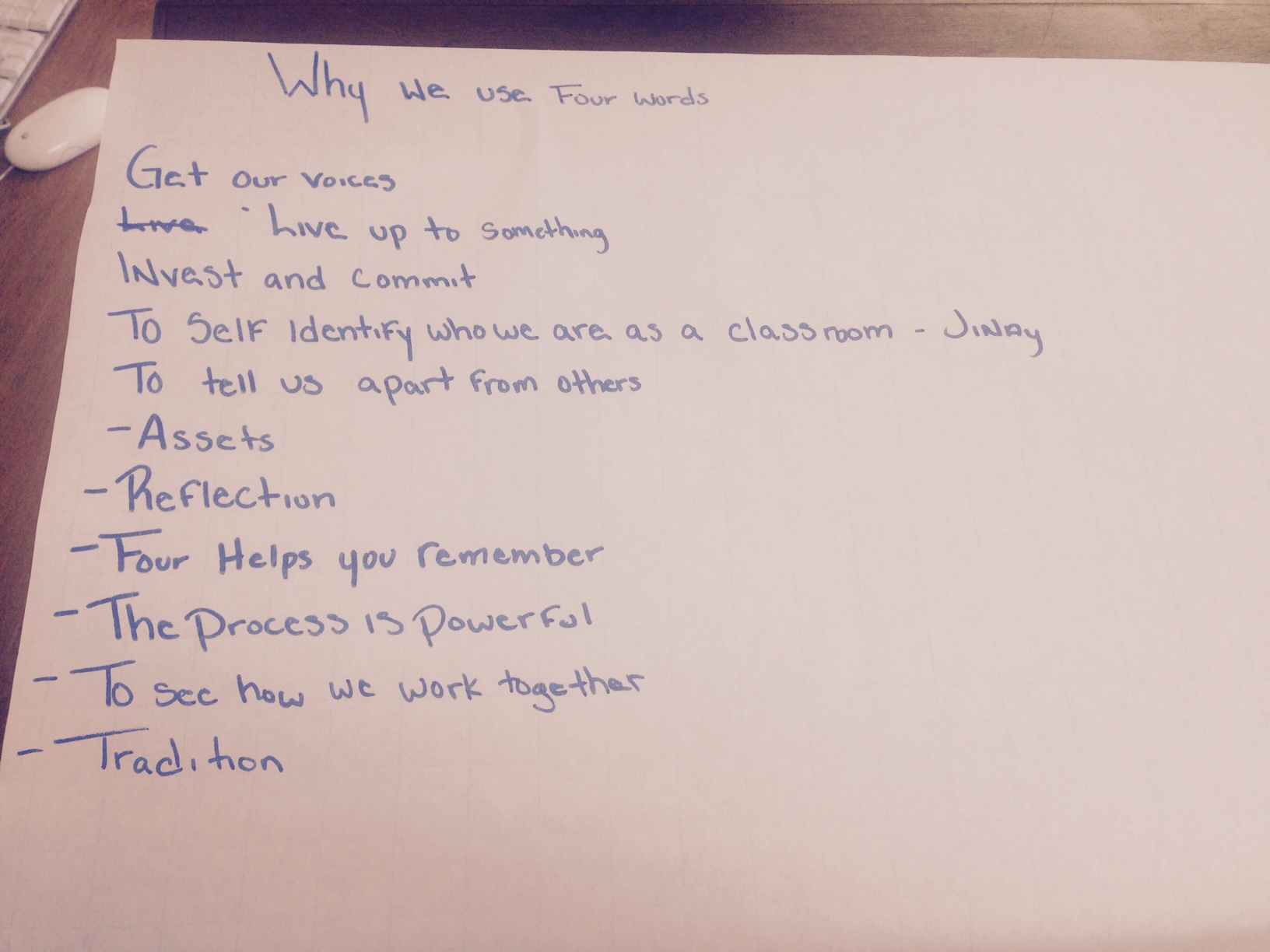
Why write about this? It’s central to our model for us to discuss why we do things and why we do things the way we do them. I wanted to have this conversation so that they could think about why writing conventions matter (we’re starting to write plays) but it drifted quickly to school. Some of the work is about learning to talk and listen; some of it is about learning to reflect about their intentions for the day.

Test-taking

Watching my tenth graders take the PSAT, I’m remembering the last standardized test I took — the English Praxis exam to earn a secondary English cert. I was prepared by disposition and academic training to blow the doors off that test.

I was pudding afterwards.

How do kids feel when they’re not prepared for tests and have the gaps in their own education so brutally thrust in their face?

The Circle

Started Dave Eggers’s new book last night on a soccer sideline. One of the characters begins the book with a new career at Google The Circle.

Book may turn out alright, may not. But it got me thinking of how rare it is to begin a job so happy and with all the tools you need to do it; how rare it is to have a job where your “boss” talks about the importance of humanity; how rare to have any kind of moral clarity that isn’t immediately and obviously compromised by the working conditions.

1. Dave Eggers, The Circle,(New York: Knopf, 2013).

Teju Cole

Liking this book a lot.

Quotes I’d talk over with students…

“I still have photographs, but I no longer know what my father looked like.”
(p.49)

“Writing is difficult, reading impossible. People are so exhausted after the hassle of a normal Lagos day that, for the vast majority, mindless entertainment is preferable to any other kind. This is the secret price paid for all those cumulative stresses of Lagos life: the ten-minute journeys that take forty-five minutes, the rarity of places of refuge, the constant confrontation with needs more abject than your own. By day’s end, the mind is worn, the body ragged.” (p. 68)

“Why is history uncontested here? There is no sign of that dispute over words, that battle over versions of stories that marks the creative inner life of a society. Where are the contradictory voices? I step out of the shop into the midday glare. All around me the unaware forest of flickering faces is visible. The area boys are still hard at work, but I imagine they will soon break for lunch. The past is not even past.” (p.117)

This quote I’d like to leave the opening identifier blank and ask students to fill it in or what it would mean to fill it in:

“______s do not always have the philosophical equipment to deal with the material goods they are so eager to consume. We fly planes but we do not manufacture aircraft, much less engage in aeronautical research. We use cell phones but do not make them. But, more important, we do not foster the ways of thinking that lead to the development of telephones or jet engines. Pat of that philosophical equipment is an attention to details: a rejection of only the broad outlines of a system, a commitment to precision, an engagement with the creative and scientific spirit behind what one uses.”

Is this true of Nigerians? Of Americans? Of Africans? Of urban or rural residents? Of Whites? Blacks? Can such a statement be true? Could you love your country and your people and make such a claim? How would you feel if such a statement were made about you?

Teju Cole, Every Day Is for the Thief (New York: Random House, 2014).

Quote from Linda Darling-Hammond

Such “accountability” schemes reinforce ineffective practice because they fundamentally misunderstand the experiential nature of teaching. Children need to study ideas in ways that connect to their motivations and prior knowledge, and teachers need to respond to the challenges and questions children raise (Brown, 1994). Like success in musical composition, chess playing, architectural design, and other creative fields, success in teaching involves an iterative process: teachers evaluate information about students and subjects, anticipate solutions, and then revise plans based on what actually happens in the classroom (Yinger, 1978).

Cool choice of a book for a class on curricular leadership, particularly as her understanding of teaching is so spot-on. As a book published in 1997, the sad part is that it predicts all that has gone wrong in the intervening years as teaching is given less and less respect.

Linda Darling-Hammond, The Right to Learn: A Blueprint for Creating Schools That Work,(San Francisco: Jossey-Bass, 2001), 75.

What I learned from my first 13.1 race

Many things:

1. There are immense, stupid lines for the portapotties. DO NOT wait in line for these. Go pee on a tree. Listening to the National Anthem and then the countdown for the race while looking at 20 people in front of you getting ready to pee sucks.

2. Practice drinking while running. I had never done it before. It’s much harder than it looks.

3. Don’t get sick the Friday before a race. Don’t pull a groin the Thursday before a race. Be annoyed that you have legitimate excuses for a cruddy time but that you still have a CRUDDY TIME.

4. Everyone has lots of advice. Listen to your own body. For example, I had gotten accustomed to running every other day and I took a week off before the race. My body felt out of practice. Also, my stretching routine (ha!) occurs after I run, so when I didn’t run, I didn’t stretch. I think I would have been better served running my normal schedule this week.

5. I didn’t lie about my time to get into the second corral. I honestly thought I could run a faster time. That being said, I will always overestimate now because the crowd thing was tough to take.

I don’t know exactly why my last 5k sucked. I couldn’t run any faster and I couldn’t accelerate (I tried once and felt the cramps waiting for me). Did I need to get some calories into me? Did I overexert myself in the early part of the race? Had I not trained enough? Was it simply too humid for long runs? I want to do another one to figure this out.

5k: 24:09
10k: 48:37
10 mile: 1:19
Total time: 1:46:37
Pace: 8:07

Goals for the school year

We worked yesterday on our goals for the year. My two goals (as a teacher) for the year:

1. Carefully and closely documenting the work with students in ways that will allow others to use and draw upon it and allow me to improve my practice.

3. Publicly finishing projects together. I want to make sure that each of the projects has as an authentic conclusion with as large an impact as possible.

Little Free Library

We’re going to do this with the sophomores. I went into the basement, found an old plant stand of my father’s, pulled whatever scrap wood I could find, and knocked together this prototype.

Punchlist:
1. Need to caulk all the way around.
2. Need to do something clever with the roof part.
(both of these have to do with waterproofing, which will be a huge design challenge. Flat roof? Not so smart…)
3. Need to stain the same color as the plant stand.
4. Need to figure out second floor and signage. Either a simple A-Frame roof or some funky triangle.
5. Need to figure out what to do about the door.

Untitled